- English
- French
- German
- Portuguese
- Spanish
- Russian
- Japanese
- Korean
- Arabic
- Greek
- German
- Turkish
- Italian
- Danish
- Romanian
- Indonesian
- Czech
- Afrikaans
- Swedish
- Polish
- Basque
- Catalan
- Esperanto
- Hindi
- Lao
- Albanian
- Amharic
- Armenian
- Azerbaijani
- Belarusian
- Bengali
- Bosnian
- Bulgarian
- Cebuano
- Chichewa
- Corsican
- Croatian
- Dutch
- Estonian
- Filipino
- Finnish
- Frisian
- Galician
- Georgian
- Gujarati
- Haitian
- Hausa
- Hawaiian
- Hebrew
- Hmong
- Hungarian
- Icelandic
- Igbo
- Javanese
- Kannada
- Kazakh
- Khmer
- Kurdish
- Kyrgyz
- Latin
- Latvian
- Lithuanian
- Luxembou..
- Macedonian
- Malagasy
- Malay
- Malayalam
- Maltese
- Maori
- Marathi
- Mongolian
- Burmese
- Nepali
- Norwegian
- Pashto
- Persian
- Punjabi
- Serbian
- Sesotho
- Sinhala
- Slovak
- Slovenian
- Somali
- Samoan
- Scots Gaelic
- Shona
- Sindhi
- Sundanese
- Swahili
- Tajik
- Tamil
- Telugu
- Thai
- Ukrainian
- Urdu
- Uzbek
- Vietnamese
- Welsh
- Xhosa
- Yiddish
- Yoruba
- Zulu
Differences Between TA1 and TA2 Titanium Plates Explained
Knowing the differences between TA1 and TA2 grades is important for getting the best performance and value for money when buying commercially pure titanium for industrial uses. The TA1 titanium plate is purer and doesn't rust, so it's perfect for harsh settings. On the other hand, the titanium plate TA2 is stronger and has more balanced qualities, so it can be used in more situations. Both grades are commercially pure titanium, but they are very different in their chemical make-up, especially the amounts of oxygen and iron they contain. This affects their mechanical properties, how easily they can be worked, and the industries that can use them, such as aerospace, chemical processing, and marine.
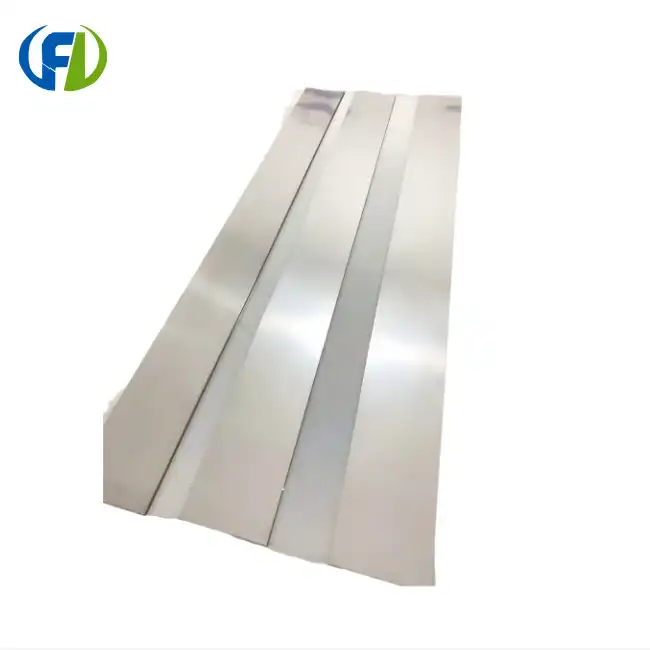
Overview of TA1 and TA2 Titanium Plates
TA1 and TA2 titanium plates are the building blocks of commercially pure titanium products. Each has its own benefits for certain industry uses. These types all have the good qualities that titanium has by nature, like being resistant to rust, biocompatible, and having a good strength-to-weight ratio. However, their chemical make-up gives them different performance traits.
Chemical Composition and Purity Levels
There is the least amount of oxygen in TA1 titanium plates (usually less than 0.18%) and the least amount of iron (usually less than 0.20%). Because it is so pure, TA1 is very flexible and easy to shape. This makes it very useful for complicated shaping tasks and uses that need the highest level of rust resistance.
TA2 titanium plates have a little more impurity than other plates. They can have up to 0.25% oxygen and up to 0.30% iron. These carefully chosen additions of interstitial elements make the material stronger while keeping its excellent rust resistance and workability, which meet most industrial needs.
Fundamental Properties and Characteristics
The main difference between these types is how they work mechanically and how they can be processed. TA1 has great ductility and cold-forming properties, which means it can be shaped in complicated ways without losing its structure. Because it doesn't rust, it's perfect for use in harsh chemical settings and in the sea environment.
TA2 has a good mix of strength and ductility, so it has better mechanical qualities while still being easy to shape. This grade is the most common designation for economically pure titanium because it works well in a lot of different situations and doesn't cost too much.
Both types are very good at welding, milling, and staying stable at high temperatures within their recommended temperature ranges, which are usually up to 360°C for constant service uses.
Detailed Comparison of TA1 and TA2 Titanium Plates
To figure out what the exact changes are between TA1 and TA2, you need to look at their chemical make-up, mechanical qualities, and how they were made. These differences have a direct effect on how different businesses choose materials and decide which ones are best for certain uses.
Chemical Composition Analysis
The changes in the elements that make up TA1 and TA2 have a big effect on how well they work. TA1 titanium plate keeps tighter limits on interstitial elements, especially oxygen, nitrogen, and carbon. This makes the material more flexible and resistant to rust. The smaller amount of oxygen in TA1 makes it better at cold-forming and works better in conditions that are very corrosive.
The slightly higher oxygen and iron content in TA2 makes it stronger without making it much less resistant to rust or difficult to work with. By carefully adding strengthening elements, TA2 can be used in situations that need better mechanical performance while still having all the benefits of commercially pure titanium.
Mechanical Property Differences
One of the most noticeable changes between these types is their tensile strength. Tensile strengths for TA1 are usually between 240 and 345 MPa, while those for TA2 are higher, between 345 and 450 MPa. While the strength goes up, the elongation properties go down at the same rate. However, both types still have better flexibility than titanium alloys.
Similar trends can be seen in the yield strength numbers, with TA1 being between 170-310 MPa and TA2 being between 275-380 MPa. These differences affect the choice of material for uses that need to meet certain strength standards while still being able to be shaped and not corrode.
Processing and Manufacturing Considerations
Because these types are made of different materials, they have different manufacturing properties. Because TA1 is so flexible, it can be used for difficult shaping tasks like deep drawing and severe bending. Its great cold-working qualities lower the cost of production and boost the speed of parts that need to be shaped in a lot of different ways.
Because its qualities are matched, TA2 is easy to shape and strong enough for uses that don't need extreme mechanical performance. Because the grade is flexible, it can be used in several industrial processes, such as pressing, welding, and machining.
Evaluating the Suitability for Specific Applications
The choice of TA1 or TA2 for an application relies on individual performance needs, environmental conditions, and cost factors. Each grade has its own benefits for certain types of businesses and working situations.
Aerospace and Defense Applications
Aerospace makers usually choose the TA1 titanium plate for uses that need the best corrosion protection and shapeability. Because this grade is so pure, it can be used for parts that will be exposed to hard environments or that need to be formed in complicated ways. TA1 is often used for its steady performance in aircraft structural parts, engine tools, and satellite gear.
When it comes to aircraft parts, TA2 is useful because it has high strength while still being resistant to rust. For the best performance and value, TA2 is often specified for brackets, fittings, and structural elements that need to be moderately strong but also easy to shape.
Chemical Processing and Marine Industries
TA1 is often required for equipment in chemical processing settings that is subject to highly corrosive media. TA1 is better at resisting corrosion in chloride-containing settings and harsh chemical solutions, which is good for heat exchangers, reaction tanks, and pipe systems.
Both grades are used in marine uses, based on the needs. TA1 works great in systems that remove salt from seawater, on offshore platforms, and in naval hardware that needs to be resistant to rust as much as possible. TA2 has better mechanical qualities and enough corrosion protection for naval uses that aren't too demanding.
Economic and Supply Chain Considerations
Cost is often a factor in choosing between TA1 and TA2 materials. Because TA2 is easier to find and costs less, it is a good choice for uses where its qualities meet performance needs. Because the grade is flexible, makers who use a lot of different titanium parts can keep their inventory simpler and save money on purchases.
There are different levels of supply chain dependability. Generally, TA2 has shorter wait times and more suppliers that can meet your needs. For TA1's unique uses, it might need longer buying processes and careful source qualification to make sure that quality standards and certification needs are met.
How to Choose Between TA1 and TA2 Titanium Plates for Your Project?
When choosing a material, it's important to think about the needs of the project, such as the material's mechanical qualities, the surroundings, the way it will be made, and the budget. A methodical technique makes sure that the best grade is chosen for each application.
Performance Requirements Assessment
Before choosing a material, you should list the basic performance needs, such as the need for strength, resistance to rust, and the ability to be shaped. TA1's better qualities are usually useful in situations where maximum corrosion protection or a lot of shaping is needed. TA2 is often better for projects that need to be stronger and less likely to rust.
The grade that is chosen is based on the temperature needs, since both materials work well within their designated temperature ranges. Think about thermal cycling, working temperatures that stay the same, and the possibility of being exposed to high temperatures during service or processing.
Manufacturing Process Compatibility
Check the production methods to see if they are compatible with the grade. The high flexibility of the TA1 titanium plate makes it ideal for complex shaping tasks, deep drawing, or heavy bends. Both grades can be formed, welded, and machined without any problems. This means that TA2's higher strength is useful without making processing more difficult.
Welding standards should be looked at because both types can be welded very well if the right steps are taken. When choosing between grades, you should think about the joint designs, the welding surroundings, and the handling needs after the weld.
Quality Assurance and Certification
Reliable providers provide full material certification, which includes chemical analysis, mechanical qualities, and making sure the material meets all standards. Check to see if the seller can provide the certificates, traceability paperwork, and quality assurance records that are needed for important purposes.
Establish relationships with suppliers that can consistently provide quality products, on-time deliveries, and expert help. Regular testing of materials and checks of suppliers help keep quality standards high and make sure that specs are always followed.
Conclusion
To choose between TA1 and TA2 titanium plates, you need to know how their different qualities and uses make them better. For challenging uses, TA1 is the purest, most resistant to corrosion, and easiest to shape. On the other hand, TA2 is stronger and has more balanced qualities, making it useful in a wide range of industrial settings. To choose the right material, you need to make sure that the grade's properties match the needs of the product, the manufacturing process, and the cost. Both types work very well as long as they are ordered from reputable companies that care about quality and customer service.
FAQ
Q1: What are the main ways that TA1 and TA2 titanium plates are different?
TA1 has less oxygen and iron, which makes it more flexible and resistant to rust. TA2, on the other hand, has a few more impurities, which make it stronger. TA1 is easier to shape and is better for difficult shaping tasks, while TA2 has higher tensile and yield strengths that make it better for structural uses.
Q2: Which grade is more resistant to corrosion?
Because it is purer and has less air in it, TA1 is better at resisting rust. It works especially well in places that are very corrosive, like seawater, chloride solutions, and harsh chemical handling, where it's important to protect against rust as much as possible.
Q3: Can both grades be welded using standard procedures?
Using the right titanium welding techniques, both TA1 and TA2 are very easy to join together. Welds are of high quality when the protecting gas, joint preparation, and heat input are all done correctly. Because TA1 is more flexible, it may be better for shaping welded parts that need to be shaped after they are welded.
Q4: What kinds of thicknesses do these titanium plates come in?
Standard titanium plates come in thicknesses between 0.187 inches (4.75mm) and 4 inches (101.6mm), and they come in both TA1 and TA2 grades. Specialized processing methods can be used to make custom thicknesses that meet the needs of a particular purpose.
Q5: How do I verify material certification and quality?
Suppliers you can trust give you full material certificates that include chemical analysis, mechanical qualities, and proof of compliance. Check certifications against relevant standards like ASTM-B265, ask for proof of traceability, and think about getting third-party testing for important uses that need an extra quality guarantee.
Partner with Freelong for Premium TA1 Titanium Plate Solutions
Baoji Freelong New Material Technology Development Co., Ltd is an expert at providing top-notch TA1 titanium plate and TA2 grade materials that are tailored to your exact needs and performance standards. Our factory is in China's famous Titanium Valley. It mixes advanced production with strict quality control to make sure that materials always have the same properties and deliveries happen on time. Our team has a lot of knowledge and knows how to meet the specific needs of aerospace, chemical processing, and marine uses. They can help you with technical issues throughout the whole buying process. We keep up-to-date licenses and testing tools to make sure that our products meet foreign standards. Contact jenny@bjfreelong.com right away to talk about your TA1 titanium plate supplier needs and find out how our experience can help your next project succeed.
References
1. American Society for Testing and Materials. "Standard Specification for Titanium and Titanium Alloy Strip, Sheet, and Plate." ASTM International, West Conshohocken, PA.
2. Boyer, R., Welsch, G., and Collings, E.W. "Materials Properties Handbook: Titanium Alloys." ASM International, Materials Park, Ohio.
3. Donachie, Matthew J. "Titanium: A Technical Guide, 2nd Edition." ASM International, Materials Park, Ohio.
4. Lutjering, Gerd and Williams, James C. "Titanium, 2nd Edition: Engineering Materials and Processes." Springer-Verlag Berlin Heidelberg.
5. Schutz, R.W. and Thomas, D.E. "Corrosion of Titanium and Titanium Alloys." Metals Handbook, 9th Edition, Volume 13, Corrosion, ASM International.
6. Titanium Development Association. "Guidelines for Design with Titanium." Technical Publication, Titanium Development Association, Dayton, Ohio.

_1746002567971.webp)
_1744877889674.webp)
_1775031357340.png)
_1748939104244.webp)
Learn about our latest products and discounts through SMS or email