- English
- French
- German
- Portuguese
- Spanish
- Russian
- Japanese
- Korean
- Arabic
- Greek
- German
- Turkish
- Italian
- Danish
- Romanian
- Indonesian
- Czech
- Afrikaans
- Swedish
- Polish
- Basque
- Catalan
- Esperanto
- Hindi
- Lao
- Albanian
- Amharic
- Armenian
- Azerbaijani
- Belarusian
- Bengali
- Bosnian
- Bulgarian
- Cebuano
- Chichewa
- Corsican
- Croatian
- Dutch
- Estonian
- Filipino
- Finnish
- Frisian
- Galician
- Georgian
- Gujarati
- Haitian
- Hausa
- Hawaiian
- Hebrew
- Hmong
- Hungarian
- Icelandic
- Igbo
- Javanese
- Kannada
- Kazakh
- Khmer
- Kurdish
- Kyrgyz
- Latin
- Latvian
- Lithuanian
- Luxembou..
- Macedonian
- Malagasy
- Malay
- Malayalam
- Maltese
- Maori
- Marathi
- Mongolian
- Burmese
- Nepali
- Norwegian
- Pashto
- Persian
- Punjabi
- Serbian
- Sesotho
- Sinhala
- Slovak
- Slovenian
- Somali
- Samoan
- Scots Gaelic
- Shona
- Sindhi
- Sundanese
- Swahili
- Tajik
- Tamil
- Telugu
- Thai
- Ukrainian
- Urdu
- Uzbek
- Vietnamese
- Welsh
- Xhosa
- Yiddish
- Yoruba
- Zulu
Small diameter zirconium filament
Brand: FRL Metal
Grade: Zr702, Zr705
Name: Zirconium Wire
Density: 6.51 g/cm³
Thickness: 0.01–2.0 mm
Size: Customized
Standards: ASTM, DIN, EN
Production Process: Hot Rolled, Cold Rolled
Surface Treatment: Pickled/Bright
Certification: ISO9001
Delivery Time: 5-7 days
Payment Method: Wire Transfer (T/T)
Packaging: Standard Packaging
Zirconium wire is a special rare metal wire material made from high-purity metallic zirconium (Zr) or zirconium alloys through precision plastic processing such as vacuum melting, hot working, multi-pass cold drawing, and vacuum heat treatment. With its extreme corrosion resistance, excellent nuclear properties, good biocompatibility and mechanical stability, it has become an irreplaceable core functional material in extreme working conditions in chemical, nuclear, medical, and electronic fields.
I. Core Grades and Classifications Based on chemical composition and application, mainstream zirconium wires can be divided into three main categories. The core grades and their suitable applications are as follows:
|
Product Category |
Mainstream Brands | Core Ingredient Characteristics | Core Application Scenarios |
|
Industrial pure zirconium wire |
R60702 (Zr-3) | Zr+Hf≥99.2%, low impurity content, excellent weldability | Applications: Welding of chemical equipment, corrosion-resistant structural parts, corrosion-resistant springs, general and special welding |
| Zirconium alloy wire | R60705 (Zr-5) | Zr-2.5Nb, creep resistant, hydrogen embrittlement resistant, high-temperature strength | Nuclear reactor structural components, high-pressure welding, high-temperature corrosion resistant parts |
| Zirconium alloy wire | Zr-4 | Zr-Sn-Fe-Cr alloy, optimized for radiation resistance and high-temperature water corrosion resistance | Nuclear reactor fuel cladding, nuclear-grade structural welding |
| High-purity zirconium wire | Zr-0 (Zr01) | Zr+Hf≥99.9%, extremely low impurity content | Applications: Electronic vacuum devices, precision instruments, scientific research experiments, high-end medical devices |
II. Key Core Performance
Exceptional Corrosion Resistance: At temperatures ranging from room temperature to 100℃, its resistance to hydrochloric acid, nitric acid, organic acids, and strong alkalis far surpasses that of titanium and 304/316 stainless steel. In a boiling 10% sodium hydroxide solution, the corrosion rate is only 0.0025 mm/a, allowing for long-term tolerance to extreme chemical corrosion conditions.
Superior Nuclear Performance: With a thermal neutron absorption cross-section of only 0.18 Å, its extremely low neutron capture efficiency makes it a core material for nuclear reactors and the preferred substrate for nuclear fuel cladding and in-reactor structural components.
Stable Mechanical Properties: Industrial-grade zirconium wire boasts a tensile strength of 550-750 MPa, elongation of 20%-35%, and strength retention exceeding 85% at 400℃. It exhibits excellent hot and cold working properties, making it suitable for precision forming and welding requirements.
Excellent biocompatibility: After surface oxidation treatment, the medical-grade zirconium wire meets the ISO 10993-5 standard for cytotoxicity. Its osseointegration period after implantation is superior to titanium alloys, with no sensitization or rejection reactions.
Basic physical parameters: Density 6.51 g/cm³, Melting point 1855℃, Boiling point 4409℃, Resistivity at room temperature 40.0 μΩ・cm, Coefficient of thermal expansion 5.7 μm・m⁻¹・K⁻¹ (25℃).
III. Production Process and Supply Status
Core production process: Sponge zirconium → Vacuum consumable melting and casting → Forging → Hot rolling/hot extrusion → Multi-pass precision cold drawing → Vacuum annealing for stress relief → Surface treatment (pickling/brightening/oxide film removal) → Straightening/slitting/winding → Non-destructive testing and finished product inspection.
Mainstream Supply States:
Cold-worked state (Y): High strength, excellent dimensional accuracy, suitable for precision structural parts;
Recrystallized annealed state (M): Good plasticity, balanced performance, suitable for welding and forming processes;
Based on surface condition, it can be divided into three categories: pickled surface, bright surface, and oxide-free clean surface.
IV. Standards
International Standards: ASTM B550 (Specification for Zirconium and Zirconium Alloy Wires), AWS A5.24 (Specification for Zirconium and Zirconium Alloy Welding Wires), which are globally recognized trade and production standards;
Nuclear-grade products additionally meet the specifications for nuclear industry-specific materials and irradiation performance testing requirements.
V. Specifications and Forms
Diameter Range: Conventional industrial wire 0.1mm~10mm, precision ultrafine wire up to 0.076mm, nuclear-grade and electronic-grade wires can be customized to non-standard specifications upon request;
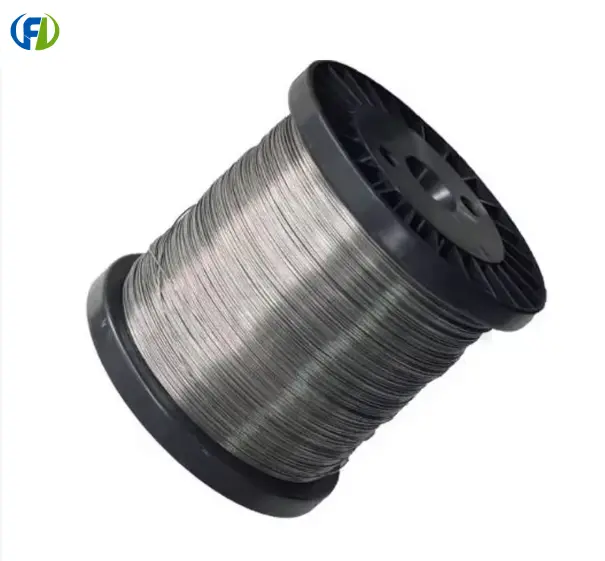
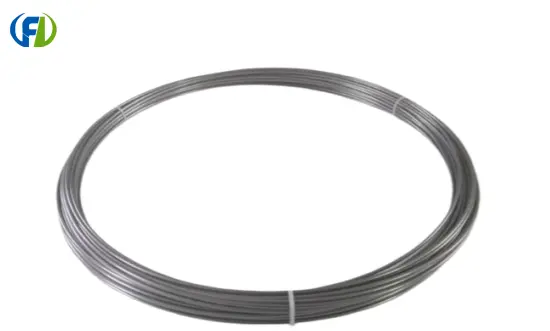
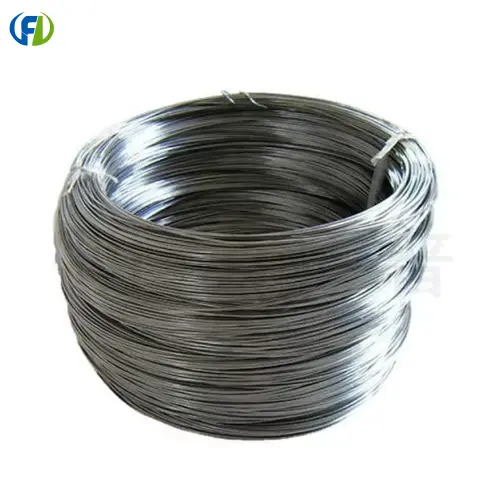
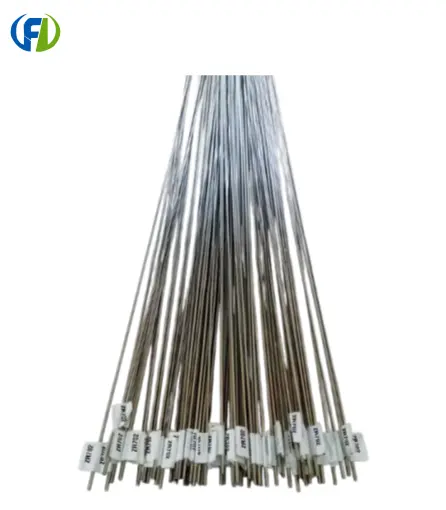
Supply Forms: Mainly divided into two categories: coiled wire (spooled) and straight wire. Straight wire has a standard length of 1000mm~3000mm, and coiled wire can be customized in terms of single-coil weight and length according to customer requirements.
VI. Core Application Areas
Nuclear Industry: Nuclear reactor fuel cladding wire, in-core structural positioning grids, control rod guide tubes, and welding wire for nuclear-grade equipment are core materials for both civilian nuclear power and the nuclear industry.
Chemical Corrosion Protection: Specialized welding wire for chemical reactors, heat exchangers, and pipelines; acid-resistant pumps and valves; corrosion-resistant springs; and cathodic protection wire, widely used in highly corrosive environments such as pesticides, pharmaceuticals, chlor-alkali plants, and hydrometallurgy.
Medical and Biological Fields: Wires for medical sutures, orthopedic implants, dental implants, and minimally invasive surgical instruments, leveraging excellent biocompatibility to become a core substrate for high-end medical devices.
Electronics and Special Welding Fields: Wires for electronic vacuum devices, ion sputtering, high-temperature furnace heating elements, and precision instruments; also used for welding dissimilar materials in aerospace, marine engineering, and other fields.
Other Fields: Special functional components for high-purity scientific research materials, pyrotechnics and military applications, seawater desalination equipment, and new energy, among other high-end manufacturing fields.
 |
 |
 |
 |
Quality Control and Testing
Each product undergoes rigorous inspection before shipment:
Dimensional Inspection: Precise measurement of thickness, length, and width
Chemical Composition and Mechanical Property Analysis: Third-party testing reports
Surface Inspection: Visual and microscopic inspection for defects
Ultrasonic Testing: Detection of internal defects
Why Choose Us
Technology and Quality: Located in Baoji, China's Titanium Valley, we possess professional production technology and extensive experience in non-ferrous metal manufacturing.
Global Coverage: We provide consistently high-quality products to customers in Australia, South Korea, Germany, the USA, the UK, Malaysia, and the Middle East.
Quality Commitment: We never compromise on quality and are responsible for every product we manufacture.
Technical Support: We have professional personnel overseeing the entire process from raw materials to finished products!
Contact Us
Our team is dedicated to serving you and hopes that every product you purchase will meet your expectations!
Email: lucky@bjfreelong.com
WhatsApp: +86 13335371763

Please contact us for detailed quotations and technical specifications. We look forward to becoming your trusted high-end titanium materials partner.
_1745896779579.webp)
_1745738866000.webp)
_1762331611360.webp)
_1744958752532.webp)
Learn about our latest products and discounts through SMS or email