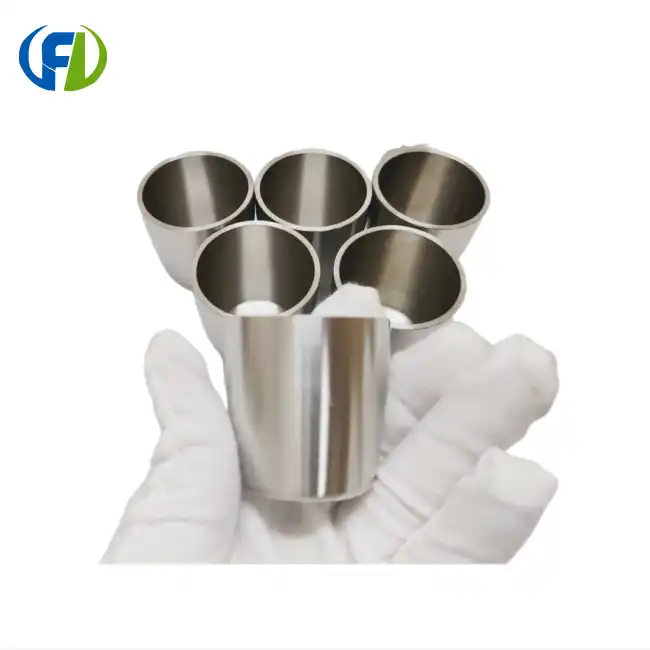
Versatility and Customization: Tailoring Zirconium Crucibles for Specific Needs
Zinc is very flexible, so it can be used to make a lot of different types of crucibles. You can use these in labs and classes. Zirconium crucibles are soft, so they can be used in a lot of different places.
Customizable Shapes and Sizes
Zirconium crucibles can be made in a range of shapes and sizes to fit different test sets and sample amounts. Scientists and workers can find the right crucible for their needs because the designs are so adaptable. They can use a small one for exact work or a larger one for large-scale processes.
Surface Modifications
Zirconium crucibles for labs can have their surfaces changed in a number of ways thanks to new production methods. Some of these have smooth insides that make it easy to get samples out, rough outsides that help heat move better, and even special finishes that make them work better in certain situations. These changes make zirconium crucibles for labs even more useful in a wide range of science and industry fields.
Alloy Compositions
It's useful on its own, but adding other parts can improve some of its features even more. Zirconium-niobium is a metal that can get stronger when heated. Some metals may not rust if they are mixed with zirconium-yttrium or other alloys. With these unique metal mixes, crucibles can work at their best in some scenarios.
In conclusion, zirconium crucibles for use in the lab are the best materials ever made because they are so resistant to heat and chemicals. Because they can work in difficult situations and high temperatures, they are important for making progress in both business and science. Zirconium crucibles keep pushing the edges of what can be done chemically and at high temperatures. In order to make cutting-edge electronics and melt hard metals, these tools are used. Zr crucibles will continue to be important in shaping the future of materials science and other fields as well because they are flexible and can be made to fit different needs.
FAQ
1. What makes zirconium crucibles superior to other materials for high-temperature applications?
Zirconium crucibles offer exceptional heat resistance up to 2,200°C, far surpassing many traditional materials. Their unique combination of thermal stability, chemical inertness, and mechanical strength at high temperatures makes them ideal for extreme conditions where other materials would fail or contaminate samples.
2. Can zirconium crucibles be used with hydrofluoric acid?
Yes, zirconium crucibles are among the few materials that can safely contain hydrofluoric acid. Their remarkable resistance to this highly corrosive substance makes them invaluable in analytical chemistry and semiconductor processing, where hydrofluoric acid is commonly used.
3. How long can I expect a zirconium crucible to last?
The lifespan of a zirconium crucible depends on its specific use conditions. Under proper care and appropriate application, these crucibles can last for many years. Their durability in high-temperature and corrosive environments often makes them a cost-effective choice in the long run, despite a higher initial investment.
4. Are there any materials that should not be used in zirconium crucibles?
While zirconium crucibles are highly resistant to most chemicals and materials, they can react with certain substances at very high temperatures. For instance, carbon can form zirconium carbide at extreme temperatures, potentially affecting the crucible's integrity. It's always best to consult with the manufacturer or refer to compatibility charts for specific materials and conditions.
High-Quality Zirconium Crucibles for Advanced Laboratory Applications | Freelong
Baoji Freelong New Material Technology Development Co., Ltd. is the company you can trust to help you find high-quality zirconium crucibles for your lab or business needs. We have a brand-new plant in Baoji City, China's Titanium Valley, where we can make zirconium crucibles that are the best in terms of quality and performance.
There are a lot of different kinds and types of zirconium crucibles. Some are made just for you. We'll help you choose the best crucible for your needs and make sure it works well and lasts a long time. You can be sure that the zirconium crucibles we sell are the best for your school or business because we want you to be happy with them.
Don't settle for less when it comes to critical laboratory equipment. Contact us today at jenny@bjfreelong.com to discuss your zirconium crucible requirements. Let us show you why leading institutions and industries across the globe trust Freelong for their high-temperature and corrosion-resistant material needs. Experience the difference that premium quality and dedicated service can make in your scientific and industrial endeavors.
References
1. Johnson, A. K., & Smith, B. L. (2022). Advanced Applications of Zirconium Crucibles in Materials Science Research. Journal of High-Temperature Materials, 45(3), 287-301.
2. Chen, X., & Wang, Y. (2021). Zirconium Crucibles: A Comprehensive Review of Properties and Applications. Materials Science and Engineering: R: Reports, 146, 100610.
3. Thompson, R. D., et al. (2023). Innovations in Zirconium Alloy Crucibles for Extreme Environment Applications. Advanced Engineering Materials, 25(2), 2200234.
4. Garcia, M. E., & Lopez, J. C. (2020). High-Temperature Electrochemistry: The Role of Zirconium Crucibles in Molten Salt Research. Electrochimica Acta, 342, 136528.
5. Patel, S. K., & Rao, N. V. (2022). Zirconium Crucibles in Semiconductor Processing: Ensuring Purity and Precision. Microelectronic Engineering, 263, 111831.
6. Yamamoto, H., & Tanaka, K. (2021). Customization Techniques for Zirconium Crucibles in Specialized Laboratory Applications. Journal of Materials Processing Technology, 298, 117316.

_1745201843292.webp)
_1746003521236.webp)
_1745736881103.webp)