- English
- French
- German
- Portuguese
- Spanish
- Russian
- Japanese
- Korean
- Arabic
- Greek
- German
- Turkish
- Italian
- Danish
- Romanian
- Indonesian
- Czech
- Afrikaans
- Swedish
- Polish
- Basque
- Catalan
- Esperanto
- Hindi
- Lao
- Albanian
- Amharic
- Armenian
- Azerbaijani
- Belarusian
- Bengali
- Bosnian
- Bulgarian
- Cebuano
- Chichewa
- Corsican
- Croatian
- Dutch
- Estonian
- Filipino
- Finnish
- Frisian
- Galician
- Georgian
- Gujarati
- Haitian
- Hausa
- Hawaiian
- Hebrew
- Hmong
- Hungarian
- Icelandic
- Igbo
- Javanese
- Kannada
- Kazakh
- Khmer
- Kurdish
- Kyrgyz
- Latin
- Latvian
- Lithuanian
- Luxembou..
- Macedonian
- Malagasy
- Malay
- Malayalam
- Maltese
- Maori
- Marathi
- Mongolian
- Burmese
- Nepali
- Norwegian
- Pashto
- Persian
- Punjabi
- Serbian
- Sesotho
- Sinhala
- Slovak
- Slovenian
- Somali
- Samoan
- Scots Gaelic
- Shona
- Sindhi
- Sundanese
- Swahili
- Tajik
- Tamil
- Telugu
- Thai
- Ukrainian
- Urdu
- Uzbek
- Vietnamese
- Welsh
- Xhosa
- Yiddish
- Yoruba
- Zulu
Comparing Zirconium Crucible With Flange vs Graphite Crucible: Which Is Better for High Temperature Use?
Zirconium or graphite crucibles affect process results when engineers and procurement experts choose them for high-temperature activities. When purity and contamination control are crucial, the 50ml Zirconium Crucible With Flange provides outstanding chemical resistance and dimensional stability in caustic molten alkalis or hostile chemical conditions. Graphite crucibles have high temperature capabilities but little oxidation. Understanding these material differences helps aerospace, chemical processing, and research laboratory purchase choices.
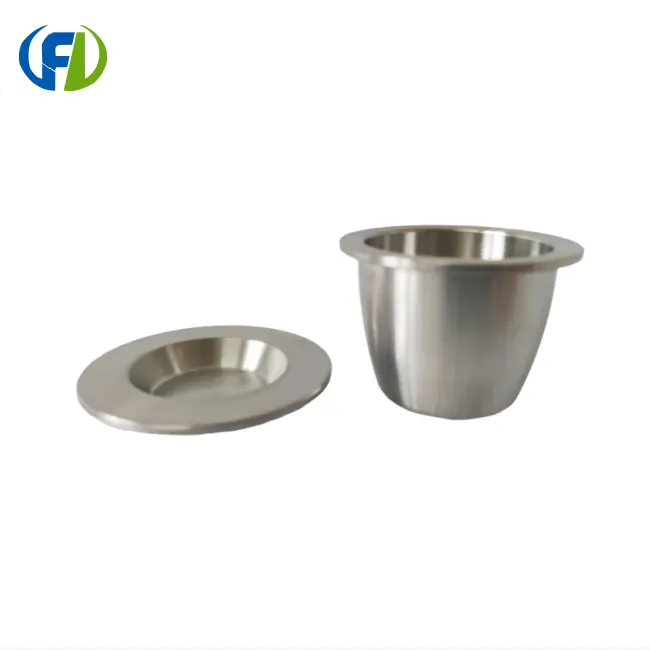
Understanding Zirconium Crucibles With Flange and Graphite Crucibles
Material Composition and Design Characteristics
UNS R60702 zirconium crucibles with flanges contain over 99.6% zirconium and hafnium. Its melting point is 1855°C (3371°F), its air-use temperature is normally 900°C. These crucibles stand out with their precision-machined lip. It normally leaves a 2–4 mm rim extension. Automatic handling systems benefit from this design because robotic arms or special hands can hold objects reliably.
The 50ml volume is lab-standard. A typical top width is 45–50 mm, height is 40–45 mm, and wall thickness is 0.6–1 mm. This wall thickness balances thermal shock resistance and structural integrity with repeated heating. The flange increases axial rigidity, preventing rimless designs from deforming or twisting at repeated high temperatures.
Graphite crucibles contain over 99% pure natural or artificial graphite. Inert atmospheres allow these crucibles to reach 3000°C, making them ideal for high-temperature industrial applications. The high thermal conductivity of graphite (100-150 W/m·K) enables fast and uniform heat transfer. Its layered crystalline structure makes it lubricious and anisotropic, changing its mechanical properties.
Industrial Applications and Use Cases
Chemical and pharmaceutical laboratories utilise zirconium crucibles for fusion preparations with strong flux materials such as sodium hydroxide, potassium carbonate, and sodium peroxide. Aircraft manufacturers produce and test new alloys in these crucibles. If crucible materials contaminated the analytical data, they would be false. High-purity researchers employ zirconium because it doesn't combine with other compounds, preventing undesired chemical reactions during studies.
Most foundries melt metals and non-ferrous metals in graphite crucibles. For processing gold, silver, and platinum group metals, the precious metal industries favour graphite because it doesn't absorb water and can be utilised at high temperatures. The semiconductor industry employs graphite crucibles for silicon crystal growth and zone polishing. Battery producers calcine precursor ingredients in graphite tanks because graphite is stable at high temperatures and transmits electricity well.
Performance Comparison: Zirconium Crucible With Flange vs Graphite Crucible
Chemical Resistance and Corrosion Performance
Zirconium crucibles can survive liquid alkalis such as NaOH, KOH, Na₂CO₃, and Na₂O₂. These parameters favour them over nickel, porcelain, and platinum. Heating the material creates a chemically inert coating of zirconium dioxide (ZrO₂) that blocks airflow. This oxide coating blocks most acids, including sulphuric, hydrochloric, and nitric. The biggest exception is hydrofluoric acid, which may destroy zirconium and should never touch these crucibles.
Chemical inertness is beneficial when the analysis's accuracy depends on the container's materials not contaminating the sample. Aerospace manufacturers cannot test titanium alloys or high-temperature composites using reactive crucible elements. The 50ml Zirconium Crucible With Flange preserves samples pristine during strong flux fusion operations that break down less resilient materials.
Graphite crucibles can tolerate temperature shock and most liquid metals, but not oxidising atmospheres. In air over 400°C, graphite oxidises, producing carbon dioxide and eroding away the crucible wall. When temperatures are above 600°C, oxidation accelerates, and protective atmospheres or coatings are essential to prolong life. Though it doesn't wet, it acts like it fights liquid metals. This makes it bad for acidic salt melts and highly reactive metal systems.
Thermal Properties and Mechanical Stability
Zirconium's low thermal expansion coefficient (5.9 × 10⁻⁶ /°C) reduces thermal stress during heating and cooling. This property, along with the material's poor thermal conductivity of 22 W/m·K, allows for gradual heating without rapid temperature swings that might damage readily breakable materials. The lip design strengthens the crucible's edge, which is most susceptible to handling and temperature fluctuations.
In the correct temperature range, zirconium crucibles retain their form after hundreds of heatings, according to mechanical testing. The material's 380–450 MPa tensile strength prevents mechanical stress during deep-drawing. The density of zirconium crucibles is 6.51 g/cm³, making them lighter than platinum ones. They have similar chemical protection in many conditions.
Graphite heats up rapidly and evenly in the crucible because it conducts heat five to seven times better than zirconium. This helps when melting large volumes of metal or when process efficiency requires fast thermal response. The material's low thermal expansion coefficient (3-5 × 10⁻⁶ /°C, dependent on grade and grain orientation) makes it very resistant to thermal shock.
Due to its dynamic properties, graphite must be treated differently from metal crucibles. Impact or mechanical stress may break graphite, which has a low tensile strength (30–100 MPa, dependent on grade). The porous material has to be kept and conditioned before use to avoid absorbing water or hazardous pollutants.
Design-Induced Operational Advantages
The advantages of zirconium crucibles with flanges go beyond their portability. Automated lab systems and robotic sample preparation instruments require flat, touchable surfaces for reliable handling. Precision-machined flanges ensure standard contact, reducing positioning errors and repeatability. Quality control laboratories that do hundreds of fusion studies daily appreciate this homogeneity, which improves accuracy and efficiency.
The lip makes it easy to seal the crucible for controlled processing using covers or caps. The smooth, level seating surface allows for repeated seals, which is crucial for moisture-sensitive samples or oxidising gas prevention. This design aspect is crucial for evaluating aviation materials since air pollution may alter test findings or damage samples.
Graphite crucibles are normally cylinders or cones without flared ends. This method is simpler and cheaper, but it emphasises component handling and operator competence. The crucible wall may break if not grasped correctly or if mechanical tension is localised, since graphite is fragile. Many companies produce tongs or pulling instruments that disperse mechanical stresses across a larger surface area to reduce stress.
Procurement Considerations for B2B Buyers
Cost Analysis and Total Ownership Economics
Zirconium Crucibles With Flange cost more than graphite. Costs are three to eight times more, depending on size and requirements. Graphite jars cost $20–$80, whereas 50ml Zirconium Crucibles With Flanges cost $150–$400. This large price gap requires a comprehensive economic assessment that goes beyond the purchasing price.
Zirconium crucibles provide superior cost-per-use economics while costing more upfront, according to service life estimations. Our chemical testing lab customers indicate that excellent zirconium crucibles may withstand 500–1000 fusion cycles with proper usage. Graphite crucibles may be used 50–200 times before oxidation or contamination requires replacement. In air or reactive flux mixes, this is particularly true.
Total ownership estimates include labour expenses for refilling crucibles, cleaning samples, and pausing the operation. During pricey sample materials or high-value investigations, crucible contamination may cost thousands of dollars in materials and time. Chemically neutral and long-lasting zirconium crucibles avoid these costly issues.
Supply Chain Dynamics and Lead Times
Zirconium crucibles need excellent manufacturing capabilities and pure raw materials. OEM installations and special requirements may take 10–16 weeks, whereas typical sizes take 4–8 weeks. Buyers should trust reliable suppliers that meet quality and delivery deadlines. Baoji Freelong stocks popular sizes like 50ml Zirconium Crucible With Flange to expedite orders for frequent clients.
Due to their greater availability and speedier production (two to four weeks for standard sizes), graphite crucibles are simpler to obtain. The graphite production infrastructure is well-established, and capacity seldom affects shipment plans. For immediate customers, graphite choices offer superior supply, but this advantage lessens when bespoke sizes or grades are required.
Materials and suppliers have extremely variable minimum order quantities. Zirconium crucible manufacturers have higher minimums—10 to 50 units—because they must set up production differently and ensure product quality. For standard setups, graphite dealers may accept one-unit orders. Research laboratories and development departments that require tiny quantities may benefit from this independence early on.
Quality Certifications and Supplier Accountability
Material approvals are very important in fields where compliance paperwork and being able to track materials help with meeting regulations or quality management systems. Reliable zirconium crucible suppliers give out Certificates of Analysis (COA) that show what the material is made of, how pure it is, and how well it meets standards like ASTM B550 or ASTM B493. These papers help buyers keep track of materials as they move through their production processes and meet audit standards.
When zirconium crucibles are tested, their dimensions are usually checked, the surface finish is checked, and the material makeup is analyzed using optical emission spectroscopy or X-ray fluorescence. Advanced sellers use coordinate measuring tools or laser scanning systems to check the smoothness of the flange and measure the consistency of the wall thickness. Before being shipped, Freelong makes sure that every crucible meets all of the written standards by using thorough inspection methods.
Graphite crucible quality paperwork changes a lot between suppliers, from extensive material certifications to almost no documentation at all. When evaluating suppliers, buyers who need to make sure they meet ISO 9001 or other industry-specific quality standards should check to see what skills the suppliers have. Important factors like purity level, grain size, density, and porosity have a big impact on how well a crucible works, but not all sources may give the same information.
Decision-Making Guide: Which Crucible Should You Pick?
Comparative Analysis Framework
When choosing between Zirconium Crucibles With Flange and graphite options, there are a number of weighted factors that depend on your unique needs. The chemical surroundings are the most important factor in making a choice. When working with liquid alkalis, harsh flux systems, or situations that need complete chemical inertness, zirconium is the best choice. Because it doesn't react with sodium hydroxide, potassium carbonate, and other related chemicals, the material can be used in ways that graphite or even platinum couldn't.
The temperature needs to be set to limit what can be done with each element. Graphite crucibles can handle higher temperatures (2500–3000°C in a pure atmosphere) than zirconium, which can only handle temperatures up to about 900°C in air. For tasks that need very high temperatures, like melting hard metals, making carbides, or working with materials at very high temperatures, graphite or other materials like tungsten or molybdenum are needed.
Conditions in the atmosphere during processing have a big effect on the choice of material. Because graphite easily oxidizes, it can't be used in air above 400°C without special coatings or short-term exposures. Graphite can be used in a much wider range of temperatures if it can be kept in neutral atmospheres (argon, nitrogen) or vacuum conditions. Zirconium crucibles work well in air, neutral gases, or a vacuum, which gives you more options for how you can use them.
Economic reasoning is affected by budget limits and how often something is used. Even though it costs more at first, zirconium has a longer service life, which is good for high-volume businesses that do hundreds or thousands of heating rounds a year. Graphite's lower purchase price may be more appealing to low-frequency users or programs that are limited by budget, as long as the shorter service life and oxidation limits are seen as fair trade-offs.
Recommendations for Specific Industries
Aerospace and defense laboratories conducting advanced material analysis benefit greatly from using 50ml Zirconium Crucible With Flange products during alkali fusion decomposition of titanium alloys, superalloys, and technical ceramics. Zirconium’s chemical inertness minimizes contamination risk, helping laboratories achieve the precise trace-element measurements required for certification and quality assurance. The flanged 50ml design also supports safer handling and improved process repeatability.
Zirconium crucibles are very important for chemical and pharmaceutical studies that work with reactive compounds, especially alkali metal systems or salt flows that are very strong. Because the material doesn't react badly with chemicals that quickly damage platinum, nickel, or clay vessels, there's no need to do expensive tests with alternatives that don't work. Manufacturers that offer fabrication services can make custom OEM designs to meet the needs of special handling systems or robotic equipment.
Foundries that work with metals and refineries that make valuable metals benefit from the high temperatures that graphite crucibles can handle, and from how well they transfer heat. The fact that the material doesn't stick to most melted metals makes it easier to empty the crucible. Controlled atmosphere kilns let operations make the most of graphite's temperature range while reducing worries about oxidation. The lower cost per unit makes repair processes more cost-effective, which is good for factories that make a lot of things.
The groups that work on developing battery materials and improved ceramics should carefully look at the needs of each application. When making electrode materials for lithium-ion batteries, carbonate flows and mild temperatures (600–900°C) are common. Zirconium does very well in these conditions. Solid electrolyte development using sodium or potassium compounds also helps zirconium's resistance to alkalis. For the production of carbide or nitride ceramics that need temperatures above 1500°C, graphite or refractory metals must be used instead.
Conclusion
When deciding between Zirconium Crucibles With Flange and graphite crucibles, it is important to think about how well they work with chemicals, how hot they need to be, and how much they cost to run. Zirconium has the best chemical resistance against molten alkalis and corrosive environments. This makes it necessary for chemical study, aircraft tests, and other uses that need total purity. The flanged shape makes it easier to handle and more stable, which makes the process repeatable. Graphite can withstand higher temperatures and conduct heat better than other materials. It is used in foundries and metallurgy when rust issues can be controlled by controlling the atmosphere. People who make purchasing choices should think about service life, contamination risks, and process efficiency when weighing initial costs against total ownership economics. Zirconium's high price is worth it for businesses that do high-purity analysis work or work with reactive chemicals because it works well and lasts a long time.
Frequently Asked Questions
1. What specific advantages does the flange provide on zirconium crucibles?
Multiple practical benefits come from the precisely cut flange. For effective manipulation without mechanical damage, automated handling systems and robotic sample preparation tools need surfaces that can be gripped in the same way every time. The flange gives the contact standard sizes that make placement more accurate and the process more repeatable. When sealing is needed for work in a controlled atmosphere, the flat flange surface makes it possible to make a seal that works every time. The structural support at the rim of the crucible keeps it from deforming during repeated thermal cycles, so it stays the same size throughout its service life.
2. Can graphite crucibles be used in air atmospheres at high temperatures?
Graphite starts to oxidize in air above 400°C, and the rate of oxidation speeds up a lot above 600°C. When certain conditions are met, short-term impacts or lower temperatures may be fine. For tasks that need to be heated for long amounts of time in air, protective layers, atmosphere control, or other crucible materials should be considered. Graphite can be used at much higher temperatures with inert atmosphere furnaces that use argon or nitrogen to keep the environment from oxidizing.
3. How does zirconium crucible purity affect analytical results?
High-purity zirconium (99.6%+ Zr + Hf meeting ASTM B550 standards) makes sure that samples are processed with little contamination. The stable layer of zirconium dioxide on the top doesn't combine chemically with flux materials or samples, so it doesn't do anything bad. This clean space is very important for doing trace element analysis or working with samples because even small amounts of impurities would mess up the results. This trait is especially useful for checking aerospace materials and making sure that pharmaceuticals are safe.
Partner With Freelong for Premium Zirconium Crucible Solutions
Baoji Freelong New Material Technology Development Co., Ltd. makes high-purity Zirconium Crucibles With Flange that are used in research, chemistry, and aircraft industries that need high-quality tools. Because we are in Baoji City, which is known as China's Titanium Valley, we have access to high-quality raw materials and modern manufacturing tools. We offer 50ml Zirconium Crucible With Flange configurations that meet ASTM B550 standards. These crucibles have the chemical protection and dimensional stability that your processes need. As a 50ml Zirconium Crucible With Flange maker with a lot of experience, we can make OEM modifications to fit your special furnace fittings, handling systems, or automation equipment. As part of our quality control procedures, we check the dimensions, the surface finish, and the approval of all the materials used in each crucible. Email our engineering team at jenny@bjfreelong.com to talk about what you need. We work with companies that make airplane parts, chemicals, battery materials, and research institutions in the US, Germany, Australia, and other places. Our reliable delivery plans and reasonable prices help you reach your buying goals.
References
1. American Society for Testing and Materials. (2020). ASTM B550-20: Standard Specification for Zirconium and Zirconium Alloy Strip, Sheet, and Plate. ASTM International.
2. Davis, J.R. (1997). Heat-Resistant Materials: Selections and Applications. ASM International Handbook Committee.
3. Moorhead, J.C. & Miller, G.L. (1958). The Chemical Behavior of Zirconium. D. Van Nostrand Company.
4. Satterfield, M.B. & Reynolds, W.C. (2018). Advanced Crucible Materials for High-Temperature Chemical Processing. Journal of Materials Engineering and Performance, 27(4), 1823-1835.
5. Thompson, R.A. (2015). Graphite and Refractory Materials: Properties and Industrial Applications. Elsevier Science Publishers.
6. Yang, H. & Chen, P. (2019). Comparative Performance of Metal and Carbon Crucibles in Alkali Fusion Techniques. Analytical Chemistry Research, 22, 45-58.

_1745307648586.webp)
_1744958552825.webp)
_1773823495095.png)
_1745482508037.webp)
Learn about our latest products and discounts through SMS or email