- English
- French
- German
- Portuguese
- Spanish
- Russian
- Japanese
- Korean
- Arabic
- Greek
- German
- Turkish
- Italian
- Danish
- Romanian
- Indonesian
- Czech
- Afrikaans
- Swedish
- Polish
- Basque
- Catalan
- Esperanto
- Hindi
- Lao
- Albanian
- Amharic
- Armenian
- Azerbaijani
- Belarusian
- Bengali
- Bosnian
- Bulgarian
- Cebuano
- Chichewa
- Corsican
- Croatian
- Dutch
- Estonian
- Filipino
- Finnish
- Frisian
- Galician
- Georgian
- Gujarati
- Haitian
- Hausa
- Hawaiian
- Hebrew
- Hmong
- Hungarian
- Icelandic
- Igbo
- Javanese
- Kannada
- Kazakh
- Khmer
- Kurdish
- Kyrgyz
- Latin
- Latvian
- Lithuanian
- Luxembou..
- Macedonian
- Malagasy
- Malay
- Malayalam
- Maltese
- Maori
- Marathi
- Mongolian
- Burmese
- Nepali
- Norwegian
- Pashto
- Persian
- Punjabi
- Serbian
- Sesotho
- Sinhala
- Slovak
- Slovenian
- Somali
- Samoan
- Scots Gaelic
- Shona
- Sindhi
- Sundanese
- Swahili
- Tajik
- Tamil
- Telugu
- Thai
- Ukrainian
- Urdu
- Uzbek
- Vietnamese
- Welsh
- Xhosa
- Yiddish
- Yoruba
- Zulu
Cost Analysis: Are High-Density Zirconium Crucibles Worth the Investment?
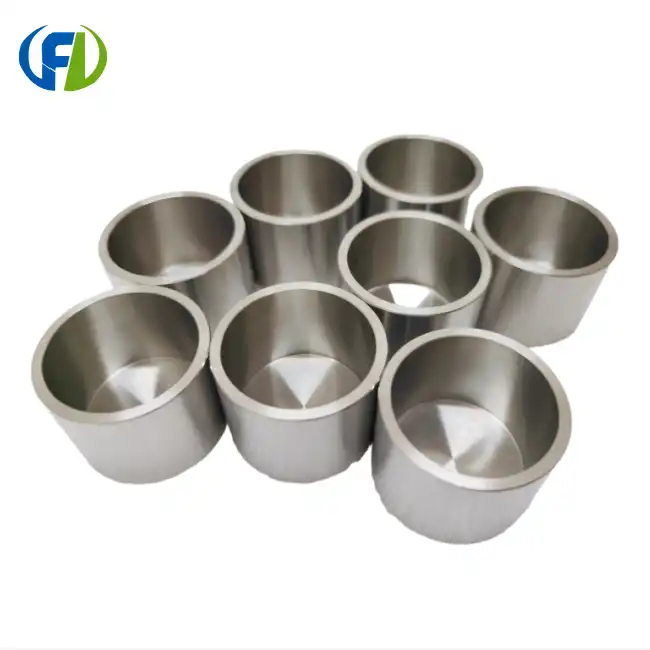
When purchasing materials for high-temperature industrial uses, buying managers often check to see if the higher prices of quality crucibles are worth it. High-density Zirconium Crucible units are expensive to buy, but their long life, ability to keep out pollution, and temperature stability often mean that their total ownership costs are much lower. These vessels are made from ultra-pure zirconium using advanced densification methods. They offer chemical inertness and structural stability that normal options just can't match in harsh environments, like making aerospace alloys and refining platinum group metals.
Understanding High-Density Zirconium Crucibles
High-density Zirconium Crucible units are containers used in science labs and factories. They are made from very pure zirconium, usually Grade 702, which has more than 99.2% zirconium and hafnium mixed. The way these crucibles are made is what makes them unique: advanced cold-working or flow-forming methods are used to squeeze the material to almost theoretical density while improving the grain structure. This gets rid of the tiny holes that are common in cast or fused materials.
Why Density Matters in Critical Applications
The higher density directly fixes three problems that have been bothering the business for a long time. Cross-contamination between melts is a major problem in analytical laboratories that do trace element analysis because porous crucible surfaces hold onto sample leftovers. When sodium peroxide or lithium salts are used in alkaline fusions, regular crucibles break down quickly and need to be replaced often, which slows down work. Even after hundreds of thermal cycles, the high-density versions' metallurgical link stability keeps them from breaking down slowly.
Material Specifications and Standards
ASTM B551 standards for zirconium and zirconium alloy strip, sheet, and plate are met by high-density zirconium crucibles used in industry. The material stays mechanically stable at temperatures ranging from room temperature to 1,800°C, and the protective ZrO₂ oxide layer can fix itself when it gets damaged by oxygen. Mineral acids, organic liquids, and molten salts are very hard for this passive film to stick to. These are the kinds of settings where graphite oxidizes, and alumina reacts chemically.
For some uses in recycling nuclear fuel, the requirements are even tighter. These crucibles can handle strong nitric acid and keep their shape when exposed to radiation. This keeps radioactive material from getting inside through tiny surface flaws. The almost-zero porosity makes it easier to follow decontamination steps between processing batches, which greatly lowers the risks to operational safety.
Cost Drivers Behind High-Density Zirconium Crucibles
To understand the price structure, you need to look at both how complicated the manufacturing process is and how much the raw materials cost. Zirconium is taken out of zircon sand through several steps of chlorination and reduction, followed by vacuum arc remelting to get the purity levels needed for making a High-density Zirconium Crucible. The next steps of cold-working to get a high density add a lot of value, but they also take longer and cost more in tools.
Initial Purchase Price Comparison
A standard High-density Zirconium Crucible that can hold 50ml costs between $800 and $1,500, based on the wall thickness and the size limits. Graphite crucibles of the same size, on the other hand, cost $40 to $80, while high-purity alumina versions cost $150 to $300. This 10–20× price difference is the most obvious thing stopping people from adopting it, and it often makes people hesitate to buy it.
Lifecycle study, on the other hand, shows a more complex picture. Graphite crucibles used in environments with air oxidize after 15 to 30 heat cycles. If you shock an alumina crucible with heat or use certain alkaline fluxes on it 50–100 times, it will break. It is common for high-density zirconium crucibles to be used more than 500 times under the same conditions. This brings down the yearly cost of replacement to levels that are competitive.
Hidden Cost Factors in Total Ownership
Aside from how often things need to be replaced, a number of operating costs have a big impact on the real-world economy. Failure of a crucible in the middle of a process leads to lost samples, repeated analyses, and downtime for equipment, all of which cost money that purchase plans often don't account for. When making pharmaceutical-grade metals, a single contamination event can mean that whole batches worth tens of thousands of dollars have to be thrown away.
Maintenance times are also very different. Because zirconium is chemically neutral, crucibles only need to be cleaned mechanically between uses. Porous materials, on the other hand, need to be treated with acid or abrasives to get rid of contaminants that are embedded in them. The way you use energy is also important. For example, better thermal conductivity shortens heating cycles, which cuts furnace running hours and power costs by 12–18% in settings where production is ongoing.
Performance and Efficiency Benefits Relative to Investment
The assessment of the return on investment depends on performance gains that can be measured in the real world. Our work with aerospace makers has shown measurable gains in a number of operational measures.
Contamination Prevention in Superalloy Production
Nickel-based superalloys used in turbine blades that are aerospace-grade must be completely pure. As little as 10 microns of ceramic can cause stress concentration sites that turn into fatigue cracks when the material is loaded and unloaded over and over again. When vacuum arc remelting is done, normal crucibles let small amounts of silicates and aluminates into the melt pool. High-density Zirconium Crucible units completely block this line of contamination.
A defense contractor's case study showed that moving from alumina to high-density zirconium containment vessels led to a 40% drop in non-destructive testing rejects. Since a single blank for a turbine blade costs between $15,000 and $25,000 before it is machined, the investment in the crucible was paid for in just three production runs.
Chemical Stability in Platinum Group Metal Refining
Rhodium, platinum, and palladium are all refined at temperatures higher than 1,800°C. At these temperatures, silica-based refractories partly dissolve into the precious metal melt, lowering the end purity below the 99.95% level needed to make catalytic converters. The pollution also speeds up the breakdown of refractory, which makes the costs go up and up.
High-density zirconium crucibles keep their shape and chemical inertness over a wide temperature range. Refiners say they can consistently get 99.99% pure products without having to do any intermediate purification steps. This cuts out a whole manufacturing step. Because you skip secondary refining, you save energy, and the output is worth more, so the return time is less than six months, even at high crucible prices.
Thermal Efficiency and Process Consistency
A big part of the costs of doing business in high-temperature metals is energy. Zirconium's thermal conductivity is about 22 W/m·K at room temperature. It moves heat more efficiently than alumina (30 W/m·K along crystal planes but very unevenly) and is also much more resistant to thermal shock. When used with an induction heater, this combination cuts heating times by 15 to 20 minutes per run.
Process engineers like these crucibles because they keep the temperature even. Compositional segregation happens in metal melts because of hotspots and temperature gradients. This makes the material inconsistent, which shows up as differences in how well finished parts work. Because high-density zirconium tanks are dimensionally stable, the shape of the melt pool stays the same over hundreds of cycles. This makes it easier to control the process and lowers the amount of scrap that is produced.
Making the Procurement Decision: When to Choose High-Density Zirconium Crucibles
Not every application is worth the money. The decision process should take into account operating needs, total cost estimates, and expected service life.
Application-Specific Selection Criteria
The first screen is based on temperature needs. If the temperature is below 1,200°C, alumina or silicon carbide may work well enough and cost a lot less. The chemical climate is also important. Neutral or slightly oxidizing situations don't put as much stress on materials as alkaline fluxes or halogenated compounds do.
The strongest justification criteria are batch value and contamination sensitivity. When making medical implants out of biocompatible titanium alloys, makers can't let any unwanted materials get in. Just the regulatory compliance risk alone requires high-purity containment. In the same way, making semiconductor sputtering targets needs very low amounts of impurities, which can only be safely provided by High-density Zirconium Crucible vessels.
Break-even points can be found by figuring out the production amount. Low-throughput study labs that only do 50–100 melts a year might not be able to pay off the high cost of their crucibles in an acceptable amount of time. High-volume operations that work multiple shifts hit cost parity within a few months because they don't have to repair parts as often and don't have to stop production as often.
Supplier Evaluation and Customization Options
Decisions about where to get things go beyond unit price. In regulated industries, being able to track certified materials is important. Full mill test records that list the chemical makeup, mechanical properties, and grain structure provide proof for quality management systems. Compliance with ASTM B898 for metallurgically bonded composites (useful for clad plate uses) shows that a manufacturer is skilled in reactive metal processes.
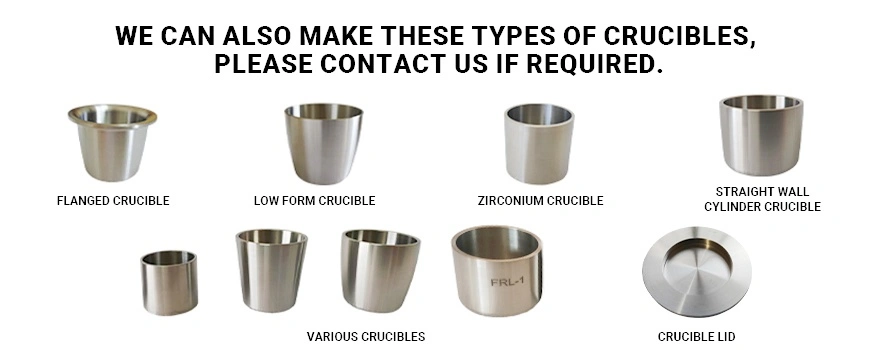
The ability to customize has a big effect on practical fit. Standard stock sizes don't always perfectly fit current tools. When suppliers offer custom sizes, wall thickness variations, and special shapes (like tapered designs for better melt pouring), customers don't have to buy expensive adapter tools or make process adjustments. When it comes to research schools that need small batch sizes for experimental programs, minimum order amounts make it harder to be flexible with purchases.
Reliability of lead times affects plans for output. Reactive metals like zirconium need special production tools that aren't available everywhere. Fully custom fabrications may take 8–12 weeks, but suppliers who keep a lot of inventory in popular designs can get orders to customers faster. In competitive bidding situations, payment terms and volume price structures are two more ways that vendors' value offers are different.
Conclusion
High-density Zirconium Crucible units are more of an investment than a simple buy of a good. Premium materials often have higher starting costs than more common options, but when you look at things like how often they need to be replaced, how well they keep things clean, how much energy they use, and how consistently they work, the total cost of ownership often makes them more appealing in challenging situations. Within 6 to 18 months, aerospace alloy production, valuable metal polishing, and high-purity chemical processing all show a clear return on investment. For processes that don't need to be as pure and happen at lower temperatures, cheaper materials may work just fine. To get the most long-term value, purchasing choices should be based on application-specific needs, batch value, and production number predictions.
Frequently Asked Questions
1. How long do high-density zirconium crucibles typically last compared to alternatives?
Different uses have different service lives, but High-density Zirconium Crucible units can usually handle 500+ heat cycles in alkaline fusion settings, whereas graphite breaks after 30 cycles, and alumina breaks down after 100 uses. The 5- to 10-year edge immediately means lower replacement costs and fewer breaks in production. The actual lifespan relies on the working temperature, the chemicals that are exposed, and the rate at which the temperature changes. To get accurate estimates, talk to the makers about your particular conditions.
2. Can these crucibles be customized for specialized equipment?
Manufacturers with a good reputation usually can meet unusual requests, such as non-standard sizes, changes to wall thickness, and unique shapes. For custom fabrication, you may need to provide full-dimensional models and a minimum order quantity. Lead times are longer (6–10 weeks) for fully customized designs than for changed stock setups (2–3 weeks). Talking about the tools you need early on in the buying process makes sure that it will work without having to be changed in expensive ways.
3. Do the performance benefits justify the higher unit cost?
The reason for it depends on your working situation. When you have high-value batches, strict limits on contamination, and a lot of production, you can make strong economic cases with payback times of less than a year. It's possible that businesses with lower throughput or apps with lower demands won't save enough money to cover the premium. Asking providers for a thorough ROI analysis, including modeling of replacement frequency and quantification of contamination risk, helps you make decisions based on data that is specific to your needs.
Partner with Freelong for Premium Zirconium Solutions
You can get approved High-density Zirconium Crucible solutions directly from the workshop of Baoji Freelong New Material Technology Development Co., Ltd. These solutions are made for tough industrial uses. Our integrated production skills cover the whole reactive metals value chain, from refining raw materials to making precise parts. We are located in Baoji City, which is known as China's Titanium Valley. We follow strict quality standards that are in line with ASTM guidelines and give full paperwork on how materials can be tracked for legal compliance.
Together with buying professionals, our technical team designs the best crucible setups for your particular needs, including custom sizes and prices based on volume. We have the knowledge and production ability to meet your long-term supply needs, whether you're looking for materials for aerospace metals, semiconductor manufacturing, or analytical labs. You can talk to our engineering team about your needs at jenny@bjfreelong.com or get full quotes from a reputable High-density Zirconium Crucible manufacturer.
References
1. Davis, J.R. (2000). Nickel, Cobalt, and Their Alloys. ASM International Handbook Committee.
2. Lide, D.R. (2004). CRC Handbook of Chemistry and Physics, 85th Edition. CRC Press.
3. Schweitzer, P.A. (2010). Fundamentals of Metallic Corrosion: Atmospheric and Media Corrosion of Metals. CRC Press.
4. American Society for Testing and Materials. (2018). ASTM B551 - Standard Specification for Zirconium and Zirconium Alloy Strip, Sheet, and Plate. ASTM International.
5. Reed, R.C. (2006). The Superalloys: Fundamentals and Applications. Cambridge University Press.
6. Gupta, C.K. (2005). Extractive Metallurgy of Rare Earths. CRC Press.

_1745892497407.webp)
_1745736599661.webp)
_1744958752532.webp)
Learn about our latest products and discounts through SMS or email