- English
- French
- German
- Portuguese
- Spanish
- Russian
- Japanese
- Korean
- Arabic
- Greek
- German
- Turkish
- Italian
- Danish
- Romanian
- Indonesian
- Czech
- Afrikaans
- Swedish
- Polish
- Basque
- Catalan
- Esperanto
- Hindi
- Lao
- Albanian
- Amharic
- Armenian
- Azerbaijani
- Belarusian
- Bengali
- Bosnian
- Bulgarian
- Cebuano
- Chichewa
- Corsican
- Croatian
- Dutch
- Estonian
- Filipino
- Finnish
- Frisian
- Galician
- Georgian
- Gujarati
- Haitian
- Hausa
- Hawaiian
- Hebrew
- Hmong
- Hungarian
- Icelandic
- Igbo
- Javanese
- Kannada
- Kazakh
- Khmer
- Kurdish
- Kyrgyz
- Latin
- Latvian
- Lithuanian
- Luxembou..
- Macedonian
- Malagasy
- Malay
- Malayalam
- Maltese
- Maori
- Marathi
- Mongolian
- Burmese
- Nepali
- Norwegian
- Pashto
- Persian
- Punjabi
- Serbian
- Sesotho
- Sinhala
- Slovak
- Slovenian
- Somali
- Samoan
- Scots Gaelic
- Shona
- Sindhi
- Sundanese
- Swahili
- Tajik
- Tamil
- Telugu
- Thai
- Ukrainian
- Urdu
- Uzbek
- Vietnamese
- Welsh
- Xhosa
- Yiddish
- Yoruba
- Zulu
How does shape memory Nitinol wire work?
Memory Nitinol Wire works by changing between two different crystal structures, called martensite and austenite, in a solid state that can be undone. The wire is in a softer martensitic phase when it is bent at lower temperatures. When heated above its transformation temperature, which is usually the Austenite Finish (Af) point, the material changes to the austenite phase and returns to the shape it had before it was heated. This thermally triggered mechanism lets the wire "remember" its original shape and return to it. This provides precise actuation forces in medical devices, aircraft actuators, and robots where normal materials permanently deform or fail from fatigue.
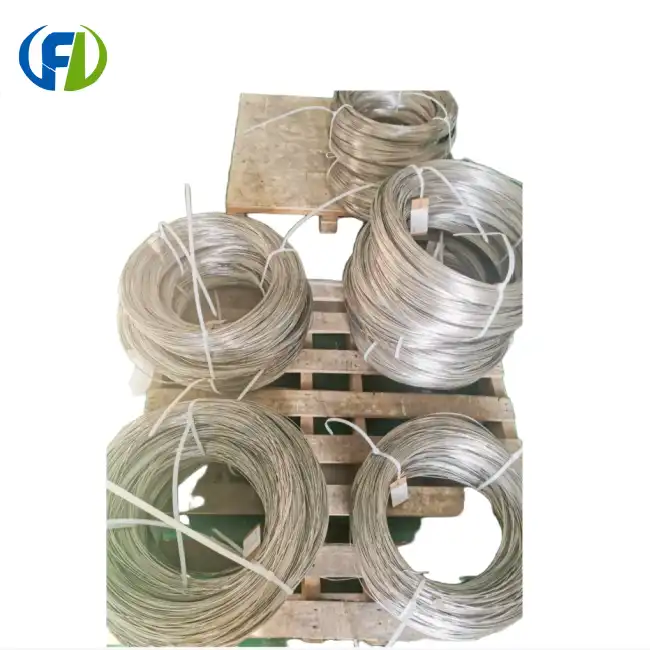
Understanding the Basics of Shape Memory Nitinol Wire
Memory Nitinol Wire and other nickel-titanium alloys are a big step forward in practical metallurgy. This equiatomic intermetallic material is made up of about 55% nickel and 45% titanium. It has two unique non-linear elastic properties that set it apart from other industrial metals.
The Phase Transformation Mechanism
For shape memory to work, the crystalline phase change between martensite and austenite is what makes it happen. Nitinol changes to a monoclinic martensite structure (B19') at lower temperatures, which makes it easy to shape with little stress. When heated above the Af temperature—which can be anywhere from -20°C to +100°C depending on the composition and heat treatment—the material changes into a cubic austenite structure (B2), which forces the wire back to the shape it remembered.
Shape Memory Effect Versus Superelasticity
These changes in phase show up as two separate operating modes. The Shape Memory Effect (SME) happens when the wire is bent while it is in the martensitic state and then heated, which makes it return to its original shape. When a material is already in the austenite phase at its working temperature, it can recover up to 8% of its original strain right away after being unloaded. This makes it behave like an elastic metal rubber.
Physical and Mechanical Properties
The density of Nitinol wire is 6.45 g/cm³, and it melts at 1310°C. Its ultimate tensile strength is between 1000 and 1400 MPa, and it can stretch more than 10%. In contrast to stainless steel, which permanently deforms under high strain, Nitinol has a stress-strain plateau where the force stays the same over a wide range of deflections. The passive titanium oxide (TiO₂) layer is as resistant to corrosion as 316L stainless steel, which meets the requirements of ASTM F2063 for medical devices that are implanted. Because of these qualities, the material is required in situations where it must have high kink resistance, fatigue endurance, and biocompatibility.
Core Applications and Industry Use Cases of Nitinol Memory Wire
Because of its special features, Memory Nitinol Wire has led to huge steps forward in many high-precision areas. More and more, engineers and buying experts ask for this material when standard alloys don't work well enough.
Medical Device Innovation
Cardiovascular stents are one of the most important medical advances. When these devices are compressed and put through a catheter in the martensitic state, they automatically expand to their preset width when they hit body temperature. This supports the vessel without the need for external action. When compared to stainless steel options, orthodontic archwires use constant force application across the superelastic plateau to apply gentle, continuous pressure no matter how much the teeth move. This makes the treatment less painful and shorter for the patient.
Surgical instruments with Nitinol wires can move through complicated body pathways without permanently bending. Because the material has a stable oxide layer, it is biocompatible and doesn't cause the inflammation that is common with copper-based alloys. The material's wear resistance means that orthopedic implants can be loaded and unloaded millions of times without breaking down.
Aerospace and Defense Systems
Shape memory actuators are used in aircraft actuators to change the form of wing parts and launch mechanisms. The high strength-to-weight ratio helps with critical mass limits in satellite systems, where each gram affects the cost of launch. Nitinol's predicted change temperatures make it possible to precisely control temperature in space. In defense applications, antenna deployment systems are used that stay small while being transported and reliably expand when heated up. This gets rid of the need for complicated motorized mechanisms that can break.
Industrial Automation and Robotics
Robotic grippers with Nitinol motors can do precise handling jobs that can't be done with electromagnetic or pneumatic systems. It's possible to make small designs in tight spaces because the wire has a high force density. Without using electronics, temperature monitors with shape memory elements can show when a barrier has been crossed visually. Vibration dampers in precision machinery use the hysteresis loop of the material to release energy. This keeps sensitive equipment safe from resonant frequencies that would damage other dampening systems.
Comparing Nitinol Memory Wire to Other Materials
To make good choices about what materials to use, you need to carefully compare how Memory Nitinol Wire performs against well-known options. Procurement professionals can find the best solutions by understanding these differences.
Nitinol Versus Stainless Steel
Stainless steel springs behave like linear elastic bands that forever bend past their yield strength. Nitinol can recover from eight times as many strains before it stops working. Testing for fatigue shows that Nitinol can handle 10 million cycles at 8% strain, while stainless steel breaks at 0.5% strain after the same number of cycles. Corrosion resistance is about the same, but Nitinol's passive layer heals itself after being worn down, while stainless steel needs to have its chromium replaced.
Nitinol Versus Spring Steel and Titanium Alloys
Spring steel is very strong, but it's not very flexible, so it can't be used in situations where a steady force is needed over a range of deflections. Beta titanium is very biocompatible and resistant to rust, but it can't regain its shape as well as Nitinol. Pure titanium is useful for building things, but it can't be used to move things. Copper-based shape memory alloys break down quickly in biological settings and have lower transformation temperatures, which makes them less useful in medicine.
Wire Gauge and Surface Finish Considerations
The thickness of the wire has a direct effect on how much force it produces and how it changes shape. Different diameters, from 0.1 mm to 3.0 mm, are used for different things. Thinner wires are better for minimally invasive catheters, while thicker sizes give you more actuation power. Surface treatments have a big effect on how well something works. Electropolished finishes eliminate microcracks, which is important for internal devices because they increase wear life. Black oxide coatings make drawing easier, but they need to be taken off before they can be used in medicine. Etched surfaces are biocompatible because they don't contain oxides.
Buying from ISO 13485 and FDA-registered sources makes sure that you can track down materials and make sure that each batch is the same. Certification documents, such as Certificates of Analysis (COA), make sure that the transformation temperatures are within ±2°C of the required range and that the levels of impurities are below the levels that could cause stress cracks to start.
Procuring Nitinol Memory Wire: What B2B Buyers Need to Know
To find your way through the global supply chain for high-performance metals, you need to know about technical requirements for Memory Nitinol Wire, quality control procedures, and logistics.
Identifying Qualified Suppliers
Reputable manufacturers keep vertical integration going all the way from refining the raw materials to drawing the last wire. For transformation behavior to be reliable, this control makes sure that the makeup stays the same. Suppliers should give full certifications of the materials they sell, such as ASTM F2063 compliance for medical grades and ASTM F2516 testing methodology validation. Ask for proof of production facilities that use clean rooms to keep out contaminants that could cause inclusions, which are tiny impurities that can cause cracks to form during cyclic loads.
Custom Specification and Sample Requests
For most uses, the transition temperatures need to be just right. Tell them exactly what the temperature and humidity are where the device will be working. For example, body temperature devices need Af temperatures of around 30°C ±5°C, and industrial actuators may have activation points at 70°C. In purchase requests, you should write down the wire diameter tolerances, tensile strength standards, and surface finish specs. Before you buy a lot of something, ask for samples and full test reports that show differential scanning calorimetry (DSC) results that prove phase transformation temperatures and tensile testing that proves mechanical properties.
Pricing Factors and Lead Times
Due to its complicated production processes, Nitinol commands a high price. The prices of raw materials change with the prices of nickel and titanium. Tight tolerances on small-diameter wires mean that they need more processing steps, which raises the cost per unit. Medical-grade standards require tighter quality control, which is reflected in the price. For custom sizes, the standard lead time is 6 to 12 weeks. For stock diameters, it may only take days to ship. The framework deals with suppliers to make sure that attention is given when capacity is limited.
Shipping and Compliance Documentation
Material Safety Data Sheets (MSDS) and export compliance paperwork are needed for international shipping. Medical-grade wire exports to the US must include details about how the company is registered with the FDA. When shipping, the packaging should keep things from breaking. For example, coiled wire needs secure tubes to keep it from kinking. Formulations that change form at different temperatures might need climate-controlled shipping to keep them from changing phases by accident while they're being shipped.
Partner with Freelong for Reliable Memory Nitinol Wire Supply
Baoji Freelong New Material Technology Development Co., Ltd. is located in China's Titanium Valley and has a lot of experience making high-performance alloys. We make, customise, and send out high-quality Memory Nitinol Wire options for use in aircraft, medical devices, and precision engineering. International standards are used to make sure that our facility's strict quality control procedures make sure that every batch meets the required change temperatures and mechanical features. We have built relationships with clients in the US, Germany, Australia, and Korea that show how committed we are to on-time delivery and expert support.
We know the problems that engineers and supply chain managers face when they have to buy things. You can choose from wire diameters ranging from 0.1 mm to 3.0 mm, surface finishes such as electropolished and etched, and transformation temperature specifications that are tailored to your specific needs. Our expert team works with your engineering staff to choose the best materials, which cuts down on development time and lowers the risk of poor performance. Sample requests are quickly fulfilled, and full test reports are sent out with them. This lets customers do a full evaluation before committing to production.
Freelong always provides consistent quality and clear documentation, whether you need medical-grade biocompatible wire for implantable devices or industrial-grade actuator wire for aerospace systems. We never lower the standards for handling or the quality of the materials we use. Email jenny@bjfreelong.com to talk about your unique needs, get detailed data sheets, or set up shipping of samples. Visit frlmetal.com to see all of our products and get access to expert tools that can help you with your design projects.
Conclusion
When engineers understand how Memory Nitinol Wire works by changing phases back and forth, they can use its special properties in a wide range of tough situations. Because the material can recover large strains, provide constant forces, and last through millions of fatigue cycles, it overcomes important problems that normally happen with alloys. From life-saving medical implants to high-precision aircraft devices, Nitinol keeps pushing the limits of what is possible. For implementation to go smoothly, you need to work with suppliers who uphold strict quality standards and offer full technical support during the whole process of buying things and putting them together.
FAQ
1. What activation temperature range is appropriate for medical implants?
Medical-grade superelastic Nitinol usually has Af temperatures between 25°C and 35°C. This keeps the wire in the austenite phase at 37°C, which is body temperature. This makes superelastic behavior possible right away after deployment. Tighter tolerances of ±2°C ensure consistent performance across all patient groups and stop activation from happening too early or too late, which could damage the device's functionality.
2. How does Nitinol's corrosion resistance compare to stainless steel?
In physiological settings, Nitinol creates an inactive titanium dioxide layer that is as resistant to rust as 316L stainless steel. The self-healing oxide layer builds back up on its own after the surface is damaged, but stainless steel needs a certain amount of chromium to stay passive. Long-term studies of implantation show that Nitinol is very stable in biological fluids that are high in chloride, without pitting or crevice corrosion.
3. Can wire diameter and coating be customized?
Reliable suppliers allow for a lot of customization. The diameters of the wires range from 0.1 mm for microcatheters to 3.0 mm for high-force actuators. Electropolishing for maximum biocompatibility and wear resistance, etching for oxide removal, or speciality coats that improve lubricity during catheter delivery are some of the ways that surfaces can be treated. Transformation temperatures can be fine-tuned by using heat treatment methods that are specific to your needs.
Ready to Source Premium Memory Nitinol Wire for Your Next Project?
Choosing the right Memory Nitinol Wire provider affects how well the product works, how well it meets regulations, and how reliable it is in the long run. Freelong delivers materials that meet the strictest requirements by combining decades of experience in metalworking with customer-focused service. Email us at jenny@bjfreelong.com right now to get samples, talk about custom formulations, or get quotes from other companies. Our engineering team is ready to help you with your design problems by giving you expert advice and material options that will move innovation forward.
References
1. Duerig, T., Pelton, A., & Stöckel, D. (1999). An overview of nitinol medical applications. Materials Science and Engineering: A, 273-275, 149-160.
2. Otsuka, K., & Ren, X. (2005). Physical metallurgy of Ti-Ni-based shape memory alloys. Progress in Materials Science, 50(5), 511-678.
3. Morgan, N. B. (2004). Medical shape memory alloy applications—the market and its products. Materials Science and Engineering: A, 378(1-2), 16-23.
4. Pelton, A. R., Schroeder, V., Mitchell, M. R., Gong, X. Y., Barney, M., & Robertson, S. W. (2008). Fatigue and durability of Nitinol stents. Journal of the Mechanical Behavior of Biomedical Materials, 1(2), 153-164.
5. ASTM International. (2012). ASTM F2063-12: Standard Specification for Wrought Nickel-Titanium Shape Memory Alloys for Medical Devices and Surgical Implants. West Conshohocken, PA: ASTM International.
6. Stoeckel, D., Pelton, A., & Duerig, T. (2004). Self-expanding nitinol stents: material and design considerations. European Radiology, 14(2), 292-301.

_1772243606318.png)
_1744875870420.webp)
_1772505582368.png)
Learn about our latest products and discounts through SMS or email