- English
- French
- German
- Portuguese
- Spanish
- Russian
- Japanese
- Korean
- Arabic
- Greek
- German
- Turkish
- Italian
- Danish
- Romanian
- Indonesian
- Czech
- Afrikaans
- Swedish
- Polish
- Basque
- Catalan
- Esperanto
- Hindi
- Lao
- Albanian
- Amharic
- Armenian
- Azerbaijani
- Belarusian
- Bengali
- Bosnian
- Bulgarian
- Cebuano
- Chichewa
- Corsican
- Croatian
- Dutch
- Estonian
- Filipino
- Finnish
- Frisian
- Galician
- Georgian
- Gujarati
- Haitian
- Hausa
- Hawaiian
- Hebrew
- Hmong
- Hungarian
- Icelandic
- Igbo
- Javanese
- Kannada
- Kazakh
- Khmer
- Kurdish
- Kyrgyz
- Latin
- Latvian
- Lithuanian
- Luxembou..
- Macedonian
- Malagasy
- Malay
- Malayalam
- Maltese
- Maori
- Marathi
- Mongolian
- Burmese
- Nepali
- Norwegian
- Pashto
- Persian
- Punjabi
- Serbian
- Sesotho
- Sinhala
- Slovak
- Slovenian
- Somali
- Samoan
- Scots Gaelic
- Shona
- Sindhi
- Sundanese
- Swahili
- Tajik
- Tamil
- Telugu
- Thai
- Ukrainian
- Urdu
- Uzbek
- Vietnamese
- Welsh
- Xhosa
- Yiddish
- Yoruba
- Zulu
Maintenance Guide for Zirconium Crucibles: Keep Your 30mm Crucible in Top Shape
The accuracy of your analyses and the length of time it works depend on how well you take care of your 30mm High Zirconium Crucible. These precisely designed vessels need to be cared for in a planned way, including being cleaned after analysis, managing thermal cycles, and getting them ready for use. Not doing maintenance on time speeds up the breakdown of materials, raises blank values, and threatens the integrity of dimensions. These problems lead to inaccurate test results and higher costs for replacements too soon. By following structured maintenance plans, labs and factories can increase the useful life of crucibles by 40 to 60 percent while keeping the very low levels of carbon and sulphur that are needed for trace element analysis in metallurgical applications.
Understanding Your Zirconium Crucible's Unique Properties
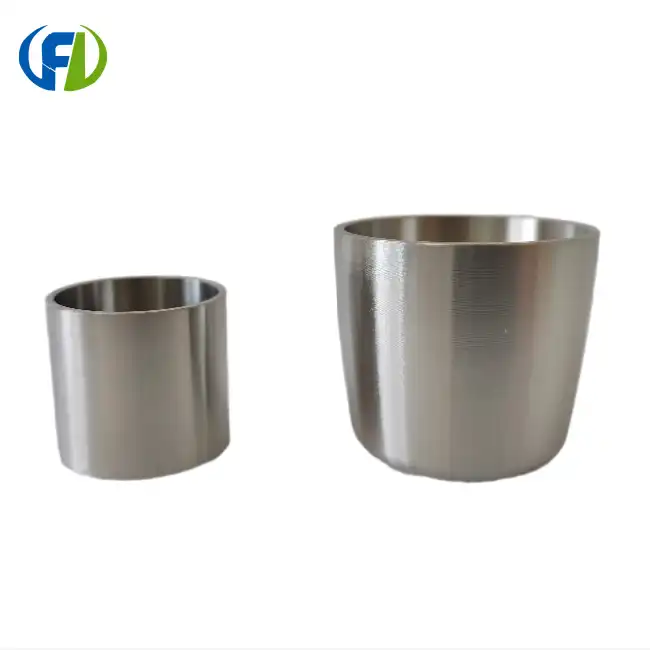
The science behind how long a zirconium crucible lasts starts with how it is made. These jars are made by companies like Baoji Freelong New Material Technology Development Co., Ltd. from high-purity zirconium silicate or stabilised zirconia with more than 65% ZrO₂ content. This mix makes the material very resistant to thermal shock, which is a must when vessels are put through induction heating processes that hit 2200°C in seconds.
30mm High Zirconium Crucibles work better at high temperatures than other materials made of alumina because their crystal structures are stable at these temperatures. These keep cracks from forming during fast temperature changes caused by transformation. The 30mm width isn't just a guess; it perfectly matches the automatic sample loader systems in LECO, Horiba, and Eltra analytical instruments. During high-throughput testing processes, even small changes in dimensions can cause mechanical jams.
Chemical inertness is another trait that makes something unique. The chemical stability of the 30mm High Zirconium Crucible stops reactions with molten flux accelerators like iron, tin, and tungsten that would otherwise bring in pollution. When properly kept, this trait keeps its analytical purity over thousands of heating cycles.
Pre-Use Inspection and Preparation Protocols
Before any analytical run, visual inspection establishes the baseline condition. Hold the crucible against strong backlighting to detect hairline fractures, chips along the rim, or surface anomalies. Aerospace component manufacturers performing titanium alloy analysis cannot afford compromised vessels that might skew critical safety-related compositional data.
Dimensional verification using precision calipers confirms the outer diameter remains within ±0.2mm tolerance. Expanded or contracted dimensions indicate thermal stress accumulation. Research institutions conducting materials science studies should document these measurements in equipment logs—tracking degradation patterns helps predict replacement timelines.
The cleaning ritual begins with compressed air purging at 3-5 bar pressure to dislodge particulate matter. Avoid abrasive brushes that scratch the internal surface. Even microscopic gouges create nucleation sites where slag penetration accelerates. Electronic-grade isopropyl alcohol applied with lint-free wipes removes organic residues without leaving conductive ions.
Drying requires controlled conditions. Place crucibles in laboratory ovens at 105-110°C for 30 minutes minimum. Residual moisture vaporizes explosively under induction heating, causing catastrophic fractures. Chemical processing plants analyzing reactor alloy compositions have lost entire sample batches from improper drying protocols.
Thermal Management During Analytical Cycles
Induction furnace operators must master heating ramp profiles. While the zirconium crucible melting point exceeds 2500°C, thermal shock tolerance depends on gradual energy application. Program furnaces to reach target temperature across 45-60 second intervals rather than instantaneous jumps. This gradient allows uniform heat distribution through the crucible wall thickness.
Peak temperature selection balances analytical requirements against material longevity. Carbon-sulfur determination in steel samples requires 1600-1800°C—sufficient for complete combustion without approaching the upper operational threshold. Medical device manufacturers testing titanium implant feedstock should calibrate instruments conservatively, preserving crucible lifespan while meeting ASTM B348 specifications.
Cooling protocols mirror heating discipline. Rapid quenching induces tensile stresses that propagate microfractures. Allow crucibles to cool naturally within the furnace chamber to approximately 400°C before pneumatic ejection. Battery electrode material producers running continuous analysis shifts should integrate cooldown time into workflow scheduling rather than forcing premature extraction.
Contamination Prevention Strategies
Cross-contamination destroys analytical credibility. Dedicate specific crucibles to material categories—segregate ferrous alloy testing from non-ferrous applications. A 30mm High Zirconium Crucible for metal melting used with nickel-based superalloys shouldn't subsequently analyze pure copper samples. Trace element carryover becomes statistically significant at sub-ppm detection levels.
Storage environment matters profoundly. Maintain crucibles in desiccated cabinets with humidity below 30% RH. Moisture absorption degrades surface chemistry, elevating baseline blank values. Distributors supplying aerospace testing laboratories should verify that the zirconium crucible supplier's storage facilities meet these atmospheric controls before establishing procurement relationships.
Handling discipline prevents mechanical damage. Always grip crucibles around the exterior cylindrical surface—never by the rim where stress concentrations occur. Operators wearing powder-free nitrile gloves eliminate skin oil transfer that carbonizes during heating cycles. These protocols seem elementary yet account for 25% of premature crucible failures across industrial laboratories.
Post-Analysis Cleaning and Restoration
Slag removal techniques separate amateur operations from professional metallurgical labs. Allow crucibles to reach ambient temperature naturally—thermal gradients make hot vessels brittle. Invert the crucible and tap gently against a rubber mat. Most solidified flux detaches without force.
Stubborn residue requires chemical intervention. Prepare a warm solution of 10% hydrochloric acid for iron-based slags or 15% nitric acid for oxidized coatings. Submerge crucibles for 10-15 minutes, monitoring dissolution progress. The zirconium crucible's corrosion resistance withstands these concentrations without matrix degradation, unlike graphite alternatives that absorb reactive species.
Rinse sequences must be exhaustive. Seven cycles using deionized water remove all acidic traces. Residual acids concentrate during subsequent heating, attacking the crucible's internal structure. New energy battery manufacturers analyzing lithium-ion electrode materials cannot tolerate ionic contamination that skews electrochemical measurements.
Final inspection under 10x magnification reveals surface condition. Smooth, glossy interiors indicate proper maintenance. Roughened or discolored zones suggest flux penetration or thermal overstress. Document these observations photographically—trending degradation patterns inform replacement scheduling and supplier quality assessments.
Lifespan Optimization and Performance Monitoring
Set up plans for movement across several crucibles. Continuous use speeds up wear failure, while job cycles that happen every so often extend service life. Laboratories that do 200 or more studies a month should keep at least six crucibles on hand and cycle the jars to spread the heat stress evenly.
The calibration connection shows how performance is getting worse. Every three months, use approved reference materials and compare the results to previous levels of performance. As blank values or scattered precise data increase, they show that the crucible's integrity is being lost before a catastrophic failure happens. Proactive replacement keeps analysis from being interrupted during important checks of production quality.
Premium maintenance methods are justified by a cost-benefit study. The price of a 30mm High Zirconium Crucible is usually between $80 and $150, but it depends on the purity grade and how precise the measurements need to be. With proper care, the life of an instrument can be extended from 2000 to 3200 heating cycles, which cuts the cost of each study by 37%. During technical talks, metal distributors who work with semiconductor sputtering target makers should stress this lower total cost of ownership benefit.
Strategic Sourcing for Consistent Quality
Zirconium crucible manufacturers employ varying quality control standards. Baoji Freelong New Material Technology Development Co., Ltd implements five-stage verification protocols, including ICP-OES chemical analysis, ultrasonic flaw detection per ASTM E114, and precision laser dimensional metrology. These measures ensure batch-to-batch consistency—critical when qualifying crucibles for aerospace material certification programs.
Supply chain reliability impacts operational continuity. Distributors maintaining strategic inventory positions in Australia, Germany, Malaysia, and the United States minimize lead time disruptions. Aviation component producers cannot afford 8-12 week procurement delays when qualification testing schedules drive production milestones.
Technical support differentiates commodity suppliers from value-added partners. Access to metallurgical engineers who understand application-specific thermal profiles, flux chemistry interactions, and instrument compatibility troubleshooting transforms procurement from transactional purchasing into collaborative problem-solving. Research institutions developing novel refractory metal alloys require this consultative expertise.
Conclusion
Maintaining zirconium crucible durability requires disciplined protocols spanning thermal management, contamination control, and systematic inspection routines. The operational advantages—extended service life, consistent analytical accuracy, and reduced total ownership costs—justify rigorous maintenance investments. Organizations prioritizing quality control in high-stakes applications recognize that crucible performance directly correlates with final product integrity. By partnering with established suppliers offering technical consultation alongside premium materials, laboratories transform maintenance from reactive troubleshooting into proactive performance optimization.
Partner With Freelong for Superior Zirconium Crucible Solutions
Baoji Freelong New Material Technology Development Co., Ltd delivers ultra-consistent 30mm High Zirconium Crucible inventory backed by comprehensive metallurgical support. Located in China's Titanium Valley, our advanced production facilities serve aerospace testing labs, semiconductor material manufacturers, and metallurgical research institutions across six continents. Contact jenny@bjfreelong.com to discuss your analytical requirements and discover how our quality-first philosophy translates to measurable performance advantages in your specific application environment.
References
1. Kingery, W.D., Bowen, H.K., and Uhlmann, D.R. (1976). Introduction to Ceramics, Second Edition. John Wiley & Sons, New York.
2. Reed-Hill, R.E. and Abbaschian, R. (1994). Physical Metallurgy Principles, Third Edition. PWS Publishing Company, Boston.
3. ASTM International (2021). ASTM E1019-18: Standard Test Methods for Determination of Carbon, Sulfur, Nitrogen, and Oxygen in Steel, Iron, Nickel, and Cobalt Alloys. West Conshohocken, PA.
4. Carter, C.B. and Norton, M.G. (2007). Ceramic Materials: Science and Engineering. Springer Science+Business Media, New York.
5. Bannister, M.J. (1986). "Thermal Shock Resistance of Refractory Ceramics in Rapid Heating Applications." Journal of the American Ceramic Society, Volume 69, Issue 4, pp. 269-276.
6. Green, D.J., Hannink, R.H.J., and Swain, M.V. (1989). Transformation Toughening of Ceramics. CRC Press, Boca Raton, Florida.

_1745734139357.webp)
_1745305883534.webp)
_1744875870420.webp)
_1774508349533.png)
Learn about our latest products and discounts through SMS or email