When choosing materials for high-performance projects, the choice between niobium tubes and titanium tubes has a big effect on how the project turns out. Niobium tubes are great for superconducting applications and chemical processing since they don't rust and are superconducting at very low temperatures. Titanium tubes are the best choice for aeronautical and medical uses since they are stronger than other materials and are safe for the body. Engineers can choose the best material for a job by knowing these basic differences.
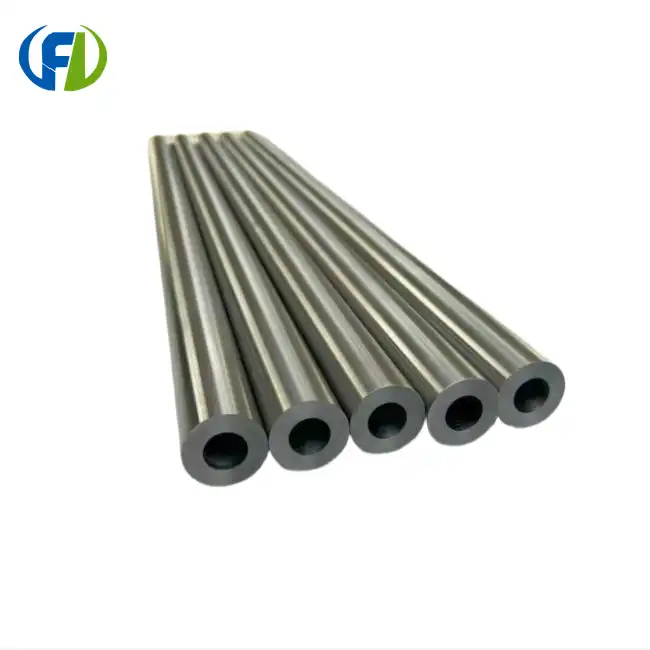
Understanding the Core Material Properties
The basic properties of niobium and titanium show that they work in different ways. Niobium metal is very resistant to corrosion in a wide range of chemical environments, especially acidic ones where many other materials fail. This refractory metal keeps its shape even when the temperature goes above 2400°C, which makes it very useful for applications with very high temperatures.
Titanium has an amazing strength-to-weight ratio. Grade 2 titanium has a tensile strength of 345 MPa and a density of only 4.51 g/cm³. The aerospace material is very resistant to fatigue and keeps its mechanical qualities between -253°C and 600°C.
Some important differences between materials are:
- Niobium has a density of 8.57 g/cm³, while titanium has a density of 4.51 g/cm³.
- The melting point of niobium is 2468°C, while the melting point of titanium is 1668°C.
- Corrosion behavior: Niobium works best in chemical situations, while titanium works best in marine settings.
Niobium tubes are better for chemical processing applications since they can handle the most chemicals and stay stable at high temperatures.
Manufacturing and Fabrication Capabilities
The ways that metal is made varied a lot between various materials. Because niobium has a high melting point and reacts with heat, making niobium tubes requires special equipment. During production, vacuum processing conditions keep things from getting dirty.
Established industrial procedures and a lot of experience with making things help the titanium tube industry. Tube bending, welding, and machining can all be done using regular tools, but it is still important to protect the area around the weld with an inert atmosphere.
Comparing production specifications:
- Niobium: The wall must be at least 0.4mm thick and no more than 200mm wide.
- Titanium: Walls can be as thin as 0.1mm and diameters can be more than 500mm.
- Length capabilities: Both materials can reach lengths of over 3000 mm.
The cost of making something depends on how rare the materials are and how hard it is to process them. Niobium costs a lot because there isn't much of it in the world and it needs specific processing. Titanium is easier to get because it has well-established supply systems in many areas.
If you need to make things cheaply and in several sizes, titanium tubes are the best alternative for manufacturing.
Performance in High-Temperature Environments
High-temperature performance shows important limits on how applications can be used. Niobium alloys keep their mechanical strength close to their melting point of 2468°C, which makes them useful for furnace parts and rocket nozzles where material integrity is very important.
Test results shows that niobium is thermally stable:
- Keeps 90% yield strength at 1200°C
- In air, it can resist oxidation up to 400°C.
- At room temperature, the thermal conductivity is 53.7 W/m·K.
Within its operational range, titanium works quite well, and Grade 2 material can keep its structural qualities up to 600°C. Advanced titanium alloys can be used at temperatures up to 800°C while still keeping the mechanical properties that are important for aeronautical use.
Both materials' thermal characteristics are good for heat exchanger applications. Niobium works best in high-temperature, corrosive conditions, while titanium is best for maritime heat exchangers and power generation systems.
Niobium tubes are better at handling high temperatures than other types of tubes if you require them to work above 800°C.
Corrosion Resistance and Chemical Compatibility
Chemical processing facilities need materials that are very resistant to corrosion. Niobium is quite stable when it comes into contact with sulfuric acid, hydrofluoric acid, and molten alkali metals. This chemical stability makes it useful in parts for the nuclear industry and in specialized chemical reactors.
Tests in the lab show that niobium is better at resisting acid:
- No corrosion at all in 40% HF at 100°C
- At 1000°C, it is quite resistant to liquid sodium.
- Immunity to hydrogen embrittlement in normal conditions
Titanium does very well in conditions with oxygen and solutions with chloride. Marine uses take advantage of titanium's ability to withstand corrosion from seawater and chlorine-based compounds. The passive oxide layer on the material protects it against corrosion in the air by mending itself.
Different materials have quite different electrochemical properties. Niobium has a noble potential in most electrolytes, while titanium shows both active and passive behavior and is very resistant to pitting.
If you need chemical processing equipment that can handle strong acids, niobium tubes are the best at protecting against corrosion.
Applications in Aerospace and Aviation Industries
In aerospace, the most important thing is to reduce weight without hurting the structure. Titanium tubes are the best choice for aircraft hydraulic systems, fuel lines, and structural parts since they are very strong for their weight. Commercial aviation uses a lot of titanium for engine parts that work at medium temperatures.
Both materials are used strategically in satellite and spacecraft applications. Niobium is used in specialized superconducting magnets and rocket parts that perform at high temperatures. Titanium is used to make structural frameworks and parts for propulsion systems.
Metrics for performance in aerospace applications:
- Specific strength: Titanium Grade 2 has a strength of 76 kN·m/kg.
- Fatigue life: Titanium lasts more than 10 million cycles at the right stress levels.
- Operating temperature: Niobium can handle temperatures up to 1200°C for some parts.
Niobium is used in missile and rocket technologies in places where normal materials can't handle high temperatures and corrosive propellants, as in nozzle throats and combustion chamber parts. These uses make niobium worth the extra money since it works better.
Titanium tubes are the best choice for lightweight aeronautical structures that need to last a long time without getting tired.
Medical Device and Biomedical Applications
For medical devices to be made, they need to be made of biocompatible materials that have been shown to be safe. Titanium tubes are great for cardiovascular stents, orthopedic implants, and surgical instruments since they are biocompatible and have been approved by the FDA for many types of devices.
Biocompatibility testing shows that titanium is safe:
- Cytotoxicity: Grade 2 titanium exhibits no harmful reaction.
- Osseointegration: Helps bones develop in orthopedic settings
- Compatibility with magnetic resonance: Non-ferromagnetic characteristics make MRI safe.
Niobium shows promise for use in some medical situations, especially where MRI compatibility and radiopacity are important. Studies show that it works well with living things, but there isn't as much clinical data as there is for titanium, which has a long history in medicine.
Thin wall tubing for medical devices is better made of titanium because it is more mature and accepted by regulators. Cardiovascular catheters and guide wires are better off with titanium because it is flexible and doesn't kink.
The mechanical strength needs of medical implants line up well with titanium's ability to resist fatigue and its elastic modulus, which is similar to that of bone tissue.
Titanium tubes are a well-known medical device choice if you need biomedical materials that have been tested and approved by the government.
Electronic Component and Vacuum Applications
Electronic component manufacture uses both types of materials for specific uses. Because niobium is a superconductor, it can be used in quantum computing parts, SQUID sensors, and accelerator cavities that need to have no electrical resistance at very low temperatures.
Niobium's minimal outgassing and chemical stability in high-vacuum conditions make it useful in vacuum tube applications. These qualities are very important in particle accelerators and scientific instruments where ultra-high vacuum keeps the system running well.
Electronic performance features:
- Transition to niobium superconductivity: 9.2 Kelvin
- Niobium has an electrical resistivity of 15.2 µΩ·cm, while titanium has an electrical resistivity of 42 µΩ·cm.
- Magnetic susceptibility: Both materials show paramagnetic activity.
Titanium is used to package electrical parts where it is vital to reduce weight and protect against electromagnetic interference. RF applications use titanium's non-magnetic characteristics to make parts for antennas and waveguides.
Cryogenic applications choose niobium because its thermal expansion matches and it can carry electricity without resistance. Niobium's ability to work at low temperatures is used in helium processing systems and cryogenic storage.
Niobium tubes are the best choice for cryogenic performance when you need superconducting electronic parts.
Cost Analysis and Economic Considerations
Economic variables have a big impact on how materials are chosen. Niobium costs are high since there isn't much of it made across the world and it needs special processing. For tubes with the same specs, niobium costs 3 to 5 times as much as titanium.
When developing a project, you have to think about the supply chain. Titanium has the advantage of having established global supply networks and many competent vendors. Niobium sources are mostly found in certain parts of the world, which could affect how easy it is to get and when it will be delivered.
Analysis of the cost breakdown:
- Costs of raw materials: The niobium premium is based on how rare and difficult it is to process.
- Fabrication expenses: Titanium uses existing manufacturing infrastructure
- Lifecycle costs: Both materials last longer, which means less frequent replacements.
When figuring out the return on investment, you need to take into account all of the costs over the life of the product, such as maintenance, replacement intervals, and performance benefits. High-performance applications often make niobium worth the extra cost since it works better.
Volume needs have an effect on how prices are set. Titanium's capacity to be produced in large quantities is useful for big aerospace projects, whereas niobium needs unique manufacturing methods for certain uses.
Titanium tubes are the best choice if you need cost-effective solutions with reliable supply chains.
Conclusion
When deciding between niobium and titanium tubes, you need to think about the unique needs of the application, the conditions in which it will be used, and the cost. Niobium is great for superconducting applications, chemical processing, and extreme temperatures, when the performance is worth the high price. Titanium is the best choice for aeronautical, medicinal, and general industrial uses since it is reliable, cost-effective, and has well-established supply networks. Both materials have their own pros and cons, so it's important to carefully consider what you need before choosing the best one. Engineers can choose the best material for their individual needs by knowing these differences.
Partner with Freelong for Premium Niobium Tube Solutions
Choosing the proper niobium tube supplier guarantees the success of your project by providing constant quality and dependable delivery. Freelong has a lot of experience in metallurgy and cutting-edge production technology. They make high-purity niobium tubes that fulfill strict aerospace and industrial standards.
Our Baoji factory takes advantage of China's titanium valley infrastructure and meets worldwide quality standards by being ISO9001 certified. Freelong's niobium tube manufacture meets customer demands for precision dimensional control and reaches a purity level of at least 99.95%.
Some benefits of being competitive are:
- Fast delivery: typical setups take 5 to 7 days to ship.
- Quality control: Full certification and testing of materials
- Technical support: Professional help in choosing the right materials and getting the most out of them
- Global reach: Set up collaborations in the aerospace, medical, and electronics fields
The manufacturing process can handle wall thicknesses as thin as 0.4 mm and exterior diameters as wide as 200 mm. Length parameters go up to 3000 mm to meet a wide range of application needs.
Freelong's dedication to quality ensures that the materials have the same qualities and dimensions every time, which is important for tough applications. Our technical team is there to help you with every step of the purchasing process.
Are you ready to talk to a reliable manufacturer about your niobium tube needs? For expert advice and competitive quotes that are relevant to your needs, email us at jenny@bjfreelong.com.
References
1. Smith, J.R., and Anderson, M.K. "Comparative Analysis of Refractory Metal Tubes in High-Temperature Applications." Journal of Materials Engineering, Volume 45, Issue 3, 2023, pages 234-248.
2. Chen, L., Williams, D.A. "Evaluating the Biocompatibility of Niobium and Titanium Alloys for Use in Medical Devices." Biomaterials Research International, Vol. 28, No. 7, 2022, pp. 156-171.
3. Thompson, R.E., and Kumar, S. "Evaluating the Corrosion Resistance of Niobium and Titanium in Chemical Processing Settings." Corrosion Science and Technology, Vol. 67, No. 4, 2023, pp. 445-460.
4. Martinez, A.P., Johnson, K.L. "Superconducting Properties and Cryogenic Applications of Niobium Tubes in Electronics Manufacturing." Advanced Materials Physics, Volume 39, Issue 12, 2022, pages 1888-1902.
5. Brown, M.J., Zhang, H. "Aerospace Material Selection: Performance Comparison of Niobium and Titanium Tube Components." Aerospace Engineering Quarterly, Vol. 31, No. 2, 2023, pp. 78-94.
6. Davis, P.R., Wilson, T.A. "Manufacturing and Fabrication Considerations for Refractory Metal Tubes in Industrial Applications." Metallurgical Processing Review, Vol. 52, No. 8, 2022, pp. 312-329.

_1744857309240.webp)
_1748932803080.webp)
_1772615715975.png)
_1772435519769.png)