- English
- French
- German
- Portuguese
- Spanish
- Russian
- Japanese
- Korean
- Arabic
- Greek
- German
- Turkish
- Italian
- Danish
- Romanian
- Indonesian
- Czech
- Afrikaans
- Swedish
- Polish
- Basque
- Catalan
- Esperanto
- Hindi
- Lao
- Albanian
- Amharic
- Armenian
- Azerbaijani
- Belarusian
- Bengali
- Bosnian
- Bulgarian
- Cebuano
- Chichewa
- Corsican
- Croatian
- Dutch
- Estonian
- Filipino
- Finnish
- Frisian
- Galician
- Georgian
- Gujarati
- Haitian
- Hausa
- Hawaiian
- Hebrew
- Hmong
- Hungarian
- Icelandic
- Igbo
- Javanese
- Kannada
- Kazakh
- Khmer
- Kurdish
- Kyrgyz
- Latin
- Latvian
- Lithuanian
- Luxembou..
- Macedonian
- Malagasy
- Malay
- Malayalam
- Maltese
- Maori
- Marathi
- Mongolian
- Burmese
- Nepali
- Norwegian
- Pashto
- Persian
- Punjabi
- Serbian
- Sesotho
- Sinhala
- Slovak
- Slovenian
- Somali
- Samoan
- Scots Gaelic
- Shona
- Sindhi
- Sundanese
- Swahili
- Tajik
- Tamil
- Telugu
- Thai
- Ukrainian
- Urdu
- Uzbek
- Vietnamese
- Welsh
- Xhosa
- Yiddish
- Yoruba
- Zulu
The Critical Role of Niobium Sheets in Modern Superconducting
One name always comes to mind when I think of the materials that power the most cutting-edge superconducting technologies of today: Ro4200 Niobium Sheet. This reactor-grade material is now needed in particle accelerators, MRI systems, and cutting-edge aerospace projects. It is very pure—more than 99.9%—and has a superconducting transition temperature of 9.2K. This makes it a key material for engineers and procurement managers who need solid performance in cryogenic settings. What really amazes me about this material is that it can keep its shape and electrical stability in situations where most metals would just break.
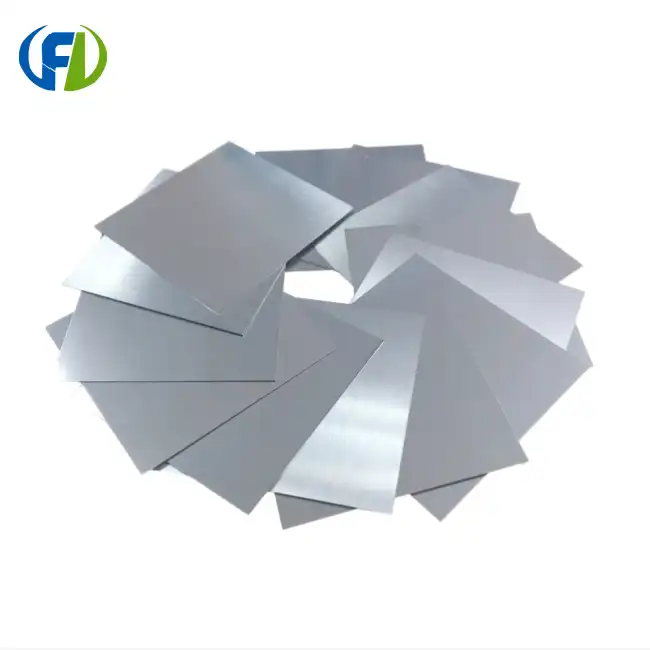
Understanding Ro4200 Niobium Sheet: Properties and Performance
Chemical Composition and Purity Standards
Ro4200 Niobium Sheet is the reactor-grade rating according to ASTM B393 Type 1 rules. For this designation to be given, interstitial impurities must be strictly controlled. The amount of oxygen stays below 150 ppm, and Glow Discharge Mass Spectrometry is used to carefully watch the levels of nitrogen, carbon, and hydrogen. The amount of tantalum is very important because even small changes can change how neutrons are absorbed. These strict controls make sure that the material always works as a superconductor, even when it's made in different batches.
Mechanical Characteristics and Formability
This material's mechanical profile shows why manufacturers like to use it for complicated manufacturing processes. It can handle deep-drawing processes without having to go through intermediate annealing steps because its tensile strength is between 125 and 175 MPa when it is annealed, and its stretch is more than 30%. The specific gravity of 8.57 g/cm³ makes it very strong for its weight, which is especially useful in aircraft uses. When the recrystallisation percentage is above 90%, the grains will be uniform, usually reaching ASTM E112 Grain Size 5 or smaller. This keeps the surface from getting flaws when the metal is formed.
Thermal and Corrosion Resistance
The thing that really makes this material stand out is how well it handles heat. Because its melting point is 2,468°C, it can be used in hot places where other metals would break down. On the surface, a stable, stick-on oxide film (Nb2O5) forms spontaneously. This protects against nitric, hydrochloric, and sulphuric acids in different amounts. Due to its resistance to rust, this material makes tools last longer and costs less to maintain in labs and chemical processing plants. When other materials like hastelloy or tantalum can't be used because of restrictions, this niobium-based solution lasts longer.
How Ro4200 Stands Out: Comparison with Other Niobium Sheets and Alternatives
Performance Benchmarking Against Standard Grades
It's easy to see the differences between commercial-grade materials like R04210 and Ro4200 Niobium Sheet. The reactor-grade specification puts more restrictions on the amount of impurities and tantalum that can be present. This makes it suitable for nuclear uses that need low thermal neutron cross-sections. Higher amounts of impurities are possible in commercial-grade alternatives, which could hurt performance in high-precision superconducting uses. Engineers working on particle physics projects or advanced medical imaging systems know that buying more pure materials pays off by making their devices work better and last longer.
Material Alternatives and Cost Considerations
Alloys of titanium and niobium are sometimes seen as possible replacements, but they don't always have the pure performance qualities needed for superconducting uses. Titanium isn't superconducting at temperatures that are useful, and niobium metals can add resistance that isn't needed. The total cost of ownership calculation needs to take into account how long the material lasts, how it needs to be processed, and how consistently it performs. Purchasing managers learn that the original cost of materials is only one part of the issue. Less downtime, fewer replacements, and consistent batch quality all add up to long-term value that is greater than the savings that might be seen from cheaper alternatives.
Adaptability Across Industrial Sectors
This adaptability covers a wide range of high-performance areas. For satellite parts and defence equipment, aerospace makers like that it doesn't rust and stays stable at high temperatures. The electrical properties of the material are used by electronics companies to make sputtering targets and semiconductors. Medical device companies like that it works well with the body for implantable devices. This wide range of uses makes it a good choice for wholesalers with a variety of clients, since one material specification can meet the needs of many market groups.
Procurement Guide for Ro4200 Niobium Sheets: What B2B Buyers Need to Know
Sourcing from Certified Manufacturers
Paying attention to certification guidelines and quality paperwork is important for finding suppliers you can trust. Manufacturers with a good reputation will give you EN 10204 3.1 Material Test Reports that include heat number tracking, full chemical makeup splits, mechanical test results, and confirmation that the product meets ASTM B393 standards. We at Baoji Freelong New Material Technology Development Co., Ltd. know that buying managers need more than just materials. They also need paperwork that meets the needs of internal quality systems and government rules. Because we are in Baoji City, which is known as China's Titanium Valley, we have easy access to high-tech production facilities and strict quality control systems.
Customization Options and Minimum Orders
Standard sheet sizes might not work perfectly in all situations. When projects need specific thicknesses, widths, or surface finishes, the ability to customise becomes very important. We work closely with clients to fully understand their needs and then provide custom solutions that reduce waste and working time. We have different minimum order quantities depending on how complicated the customisation is, but we are still able to handle both large-scale production runs and smaller pilot projects for research institutions. Lead times are usually between four and eight weeks, but they can be longer or shorter based on the specifications and how busy the factory is right now.
Quality Control and Inspection Protocols
Everything that is shipped goes through a lot of tests for Ro4200 Niobium Sheet. GDMS study of the chemical composition shows that the amounts of oxygen, nitrogen, carbon, and tantalum are within the acceptable ranges. At room temperature, tensile strength, yield strength, and elongation are all checked by mechanical means. Micrographic analysis looks at the structure of the grains to make sure they are fully recrystallised and evenly distributed so that there is no chance of orange peel effects happening during the making process. Inspections of the surface's integrity find any laps, seams, or inclusions, and measures of the surface's roughness show that it is suitable for vacuum uses. Checking the dimensions and tolerances makes sure that the thickness is the same on all sides, which is important for stacking parts in capacitor assemblies or diamond press equipment.
When these inspection methods are used together, they give buying teams faith that the material will do what it's supposed to do. Because we deliver work that meets or beats our clients' quality standards, we've built relationships with clients in Australia, Korea, Germany, the US, the UK, Malaysia, and the Middle East. Because we're committed, we never lower our quality standards, no matter how big the order is or how quickly it needs to be delivered.
Applications of Ro4200 Niobium Sheets in Modern Superconducting Technologies
Particle Accelerator Components
One of the most difficult uses for high-purity niobium is in superconducting radio frequency cavities. For these cavities, which are important parts of particle accelerators, to work, they need materials that lose very little energy at very low temperatures. The material can work well in liquid helium settings because its superconducting crossover temperature is 9.2K. Deep-drawing techniques use the material's high flexibility to make cavity half-cells from flat sheets. Research sites all over the world use this material to help us learn more about basic science. Because of this, uniformity and purity of the material are must-haves.
Medical Imaging Systems
Manufacturers of MRIs are always under pressure to make the images clearer while keeping costs low. Niobium alloys and pure niobium parts can be used to make superconducting magnets that make magnetic fields stronger and more stable. Because the material is biocompatible, it can also be used for specialised medical purposes other than imaging, such as for some parts of implantable devices. Material purity and consistency are becoming more and more important as medical technology moves toward stronger fields and smaller designs.
Industrial Processing Equipment
Chemical processing plants that use strong acids need materials that can last for a long time without breaking down. Parts that have been made include distillation columns, reactor plates, and bayonet heaters. The stable oxide layer keeps process fluids from getting dirty and makes equipment last much longer than stainless steel or even some rare alloys can. Another tough use for the material is in synthetic diamond production, where it is used as a getter material and cup parts in high-pressure, high-temperature presses. It can't be replaced in these harsh environments because it can withstand high pressures and keep impurities out.
Why Choose Ro4200 Niobium Sheets? Key Advantages and Decision Criteria
Performance Reliability Across Demanding Applications
The past performance speaks for itself. Aerospace companies have used this material to make parts for satellites that need to work perfectly for years without any upkeep. Its consistent superconducting properties are important to research institutions that are doing ground-breaking experiments. Medical device makers use it because they know it is biocompatible for implants that patients depend on every day. This proven dependability comes from strict quality control and manufacturing processes that don't leave any room for error.
Cost-Efficiency Through Lifecycle Value
The cost of the materials at the start is only one part of the financial equation. Total cost of ownership benefits come from fewer repair intervals, longer machine lifecycles, and less unexpected downtime. When purchasing managers only look at the price of a material, they often find hidden costs when cheap materials break down quickly or need to be replaced often. Ro4200 Niobium Sheet is long-lasting and doesn't rust, which saves money over time.
Tailored Solutions and OEM Partnership Capabilities
Each program comes with its own set of problems. At Freelong, we've become very good at knowing these unique needs and providing solutions that meet them directly. We work with your research teams to make sure that material specifications match performance goals, whether you need exact dimensional tolerances for semiconductor equipment or specific grain structures for superconducting uses. Our support after the sale goes beyond delivery. We offer technical advice and help with documentation to make sure that our products work well with your manufacturing processes.
Clients on many continents have seen the difference that working with prompt, knowledgeable suppliers can make. Quality and service are not extras for us; they are things we have to do. This is how we built our reputation. When you get in touch with our team, you'll talk to experts who know both about the science of materials and about the problems that come up in global buying.
Conclusion
Ro4200 Niobium Sheets, especially reactor-grade sheets that meet ASTM B393 Type 1 standards, are now an essential part of modern superconducting technologies that can't be replaced. The special mix of superconducting properties, resistance to corrosion, thermal stability, and the ability to be worked mechanically meets needs that no other material can fully meet. From particle accelerators that help scientists learn more to MRI systems that make patient care better, these materials make tools possible that define what we can do with technology. Purchasing managers and engineers who care about pure materials, consistent batches, and dependable suppliers know that working with experienced makers is the best way to ensure project success and long-term operating excellence.
FAQ
1. What distinguishes Ro4200 from R04210 niobium sheet?
Ro4200 Niobium Sheet is made to reactor-grade standards (Type 1), which means it has tighter controls on the amount of tantalum and other impurities that make it ideal for use in nuclear and high-precision superconducting applications. R04210 is a commercial-grade material (Type 2) that has less strict impurity tolerances, making it good for less demanding uses where purity is not as important.
2. Can heat treatment occur in standard atmospheric conditions?
Niobium reacts badly with oxygen and nitrogen above 200°C. This means that it can't be heated in the atmosphere without breaking down badly. To keep the properties of the material and stop it from becoming weak, all thermal processing and welding must take place in controlled inert gas or high vacuum environments.
3. What welding techniques work best with this material?
Either TIG welding or electron beam welding done in vacuum tanks or dry boxes will give you good results. It's important that the shielding gas is very pure—argon or helium must meet Class 4.8 or higher standards to keep the weld from getting contaminated, which would weaken the joint and make it less superconducting.
4. Does material come with certification documentation?
Professional suppliers offer EN 10204 3.1 Material Test Reports that show the traceability of heat numbers, full chemical composition analyses, mechanical test results, and confirmation of ASTM B393 compliance. This paperwork helps with internal quality processes and meeting government rules in many different fields.
Partner with Freelong for Premium Niobium Sheet Solutions
It is very important to find a trusted Ro4200 Niobium Sheet provider so that production goes smoothly and there are no costly delays. We at Baoji Freelong New Material Technology Development Co., Ltd. use cutting-edge manufacturing techniques and strict quality control to make sure that the material we send you meets all of your exact needs. Our team has decades of experience making things out of zirconium, titanium, niobium, tantalum, and other speciality alloys for a wide range of clients, from aircraft to medical products. We keep all of the certification paperwork in order and offer customisation options that fit the needs of your project. Get in touch with jenny@bjfreelong.com right away for expert advice and quotes that are made to fit your needs. Our global network guarantees on-time delivery, low prices, and the quick help your projects need.
References
1. ASTM International. (2020). Standard Specification for Niobium and Niobium Alloy Strip, Sheet, and Plate (ASTM B393-20). West Conshohocken, PA: ASTM International.
2. Padamsee, H., Knobloch, J., & Hays, T. (2008). RF Superconductivity for Accelerators (2nd ed.). Weinheim: Wiley-VCH.
3. Gupta, C.K. (1992). Extractive Metallurgy of Niobium. Boca Raton: CRC Press.
4. Singer, W., Aderhold, S., & Ermakov, A. (2013). Production and Testing of Superconducting Radio-Frequency Cavities. Physical Review Special Topics - Accelerators and Beams, 16(1), 012003.
5. Donachie, M.J. (2000). Titanium: A Technical Guide (2nd ed.). Materials Park, OH: ASM International.
6. Boyer, R., Welsch, G., & Collings, E.W. (1994). Materials Properties Handbook: Titanium Alloys. Materials Park, OH: ASM International.

_1770175208853.png)
_1745734139357.webp)
_1770261713682.png)
_1748241239651.webp)
Learn about our latest products and discounts through SMS or email