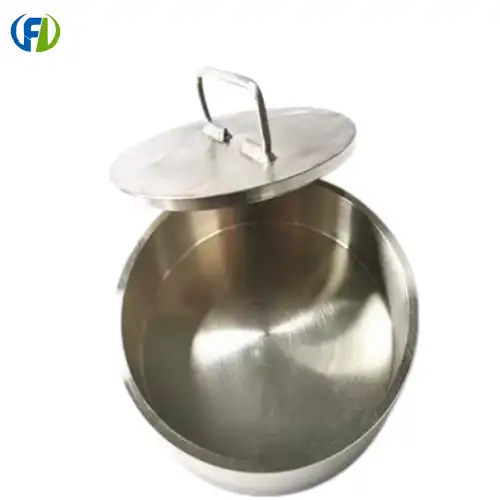
For work with things that need to be fired up, zirconium crucibles are the best lab tools. Because they have a very high melting point and good heat conductivity, they don't rust or corrode easily. Therefore, they are very helpful for accurate studies in chemistry analysis and material science. Crucibles made of zirconium work well and last a long time. This makes getting samples ready safer and more reliable in harsh places like metalworking labs and chemical processing plants. That's right, zirconium crucibles are great for seven distinct reasons. Professionals need to have these containers because their metal alloys need to be accurate, last a long time, and not react.


Exceptional Resistance to Corrosion and Acid
In laboratories, one of the best things about zirconium crucibles is that they don't rust when they come into contact with strong chemicals that respond quickly. Unlike many metals that are used in furnaces or lab cases, zirconium metal is very stable in acidic environments, even when exposed to strong inorganic acids that would quickly break down other materials. Crucibles used in acid digestion, chemical analysis, and high-temperature processes with corrosive chemicals need to have this trait in order to work properly. Zirconium is mostly chemically neutral, so the crucible doesn't break down or let germs into the sample. In turn, this helps keep the cleanliness of the samples, which makes sure that the analytical results are always correct and can be repeated. It is very important to keep analytical chemistry clean, because even small amounts of impurities can change the results. Corrosion resistance also stops equipment from breaking down, which lowers the need for replacement and upkeep costs while making the lab safer and more efficient overall.
Durability and Melting Temperature of Materials
It is common for laboratories and industrial research sites to need containers that can withstand very high temperatures without melting, deforming, or losing their structural integrity. Zirconium crucibles are perfect for these needs because they have a melting point that is usually higher than 2200 °C. In mining, materials science, and other high-temperature fields, where they are exposed to heat for long periods of time, this makes them reliable. Zirconium crucibles don't warp or crack when heated, unlike crucibles made of lower-quality materials. They keep their form and volume even after being heated many times. This longevity makes the experiments more reliable because stable containers help keep the reaction conditions and heating even. Also, the lower chance of containers breaking makes operations much safer by lowering the chance of spills or equipment damage during high-temperature procedures. So, zirconium crucibles offer both reliable performance and peace of mind in harsh thermal conditions.
Are experiments more accurate when they have better thermal conductivity?
Because zirconium metals are so good at conducting heat, they are very important for keeping the temperature even inside the crucible. Effective heat transfer helps spread heat widely throughout the container, preventing the formation of hotspots that might change how things melt, how reactions work, or how samples are prepared. In precise lab studies, where temperature changes can lead to inconsistent or wrong results, uniform heating is very important. Because they keep the temperature steady, zirconium crucibles make it possible to repeat experiments and improve the accuracy of chemical and physical analyses as a whole. It gives researchers and technicians more faith that every sample gets the same thermal treatment, no matter where it is in the crucible. This consistency is especially helpful in sensitive tasks like alloy development, phase transition studies, and controlled heat processes, where accurate temperature control has a direct effect on the accuracy of the data.
Materials that don't react make sure that things are safe and clean.
Zirconium crucibles are very valuable because they don't mix easily with most of the things that are processed in laboratories. For studies that need to be very careful about purity or that make sensitive compounds that could be damaged by metal contamination, this chemical inertness is very important. Zirconium helps keep test materials pure and accurate by stopping unwanted reactions between the crucible and the sample. This also makes sure that analytical results show the true qualities of the sample. The crucible has less chemical wear and surface degradation over time, which means it lasts longer when it is non-reactive. This lowers the risk of equipment breaking down without warning and cuts down on how often it needs to be replaced. Cleaner processing conditions also make the lab safer and stop tests from getting contaminated with each other. All of these reasons make zirconium crucibles a safe and clean choice for high-precision study in the lab and in industry.
Longer Lasting Due to Slow Rusting
What's in dry, hot air needs to be very good at rusting. Crystalline quartz crucibles last longer because they don't rust. After being used a lot in stoves, they will still work. Due to their durability, Zr crucibles will not need to be replaced as often. This gets cheaper over time.
How good are scientific studies?
Every detail matters when you work in a lab. Whatever the temperature is, Zr crucibles don't change size or shape. You can do this more than once to take the test. Knowing how metal alloys or thermal processes always form is helpful, even when things get tough. Advanced metals and material science can be studied better with this. It is on the cutting edge of science.
Versatility in Diverse Industrial and Laboratory Applications
Zirconium crucibles are useful in many fields around the world, including aircraft, offshore engineering, making medical devices, and chemical processing. Original equipment manufacturers and engineering companies around the world trust these parts because they can work in a variety of chemical environments and temperatures. Their consistency and performance support a wide range of lab processes, from pilot testing to mass production.
Freelong’s Zirconium Crucible vs. Others in the Market
Baoji Freelong New Material Technology Development Co., Ltd offers zirconium crucibles distinguished by exacting manufacturing standards rooted in China’s renowned Titanium Valley. Unlike many competitors, Freelong’s products exhibit rigorous quality control, ensuring each crucible meets precise specifications for purity, durability, and thermal resistance. Our close partnerships with clients internationally—from Germany to the United States—underscore our reputation for unmatched product reliability. Freelong’s commitment to zero tolerance for quality failure affirms our products’ superiority for demanding industrial and laboratory environments.
Optimizing Use for Maximum Benefit
To leverage the full advantages of zirconium crucibles, proper handling and usage protocols are key. It is advisable to avoid sudden thermal shocks by controlled heating and cooling cycles. Users should select crucibles sized appropriately for their sample volume to ensure uniform heating. Additionally, keeping crucibles clean and free from residue extends usability and maintains chemical inertness. Purchasing from reputable manufacturers like Freelong guarantees adherence to these quality aspects.
Important Notes for Users
- Always inspect zirconium crucibles for surface damage or deformation before use.
- Store crucibles in low-humidity environments to prevent surface oxidation.
- Handle with care during furnace insertion and removal to preserve crucible integrity.
- Confirm the compatibility of your materials with zirconium to avoid unexpected reactions.
- Follow manufacturer guidelines for lifespan and replacement intervals to avoid experimental inconsistencies.
Conclusion
Zirconium crucibles are indispensable tools for laboratories demanding exceptional performance in high-temperature and chemically aggressive environments. Their combination of corrosion resistance, thermal stability, and non-reactivity supports precise analytical processes and robust industrial applications. With Freelong’s commitment to superior quality and international trust, these crucibles remain a reliable foundation for scientific research and industrial innovation.
Frequently Asked Questions
1. What makes zirconium crucibles ideal for high-temperature laboratory applications?
Zirconium crucibles feature an exceptionally high melting point and excellent thermal conductivity, which allow them to withstand and evenly distribute extreme heat, essential for precision in high-temperature laboratory work.
2. How does the corrosion resistance of a zirconium crucible benefit chemical analysis?
Their high resistance to acids and oxidation prevents contamination and chemical degradation of the crucible, preserving sample purity and ensuring accurate chemical analysis.
3. Are zirconium crucibles reusable in industrial processes?
Yes. Due to their durability and resistance to thermal and chemical stress, zirconium crucibles can often be reused multiple times, providing economic and operational benefits.
4. How do Freelong’s zirconium crucibles ensure quality versus other suppliers?
Freelong strictly controls production quality, using advanced alloy compositions and precision machining, matched to customer specifications, and backed by strong international client trust.
5. Can I use zirconium crucibles for acid digestion procedures?
Absolutely. The crucibles’ outstanding acid resistance makes them highly suitable for acid digestion and related laboratory processes.
6. What precautions should I take while using zirconium crucibles in furnace applications?
Avoid thermal shock by gradually changing temperatures, handle crucibles with care, and follow cleaning protocols to maintain longevity and performance.
How to Get a Zirconium Crucible?
Freelong is a reliable partner for getting zirconium crucibles that meet strict laboratory standards. We are located in Baoji City, China's Titanium Valley, and our zirconium crucibles are carefully made to last and work accurately. People who are interested can email us directly at jenny@bjfreelong.com to ask about product details, prices, or custom orders. Our dedicated team makes sure that the needs of our customers are met with quality and service that can't be beat. Visit our website at frlmetal.com to learn more about why Freelong is the choice of world leaders in the metals industry.
References
1. J. R. Davis, Handbook of Materials for Medical Devices, ASM International, 2003.
2. G. Effenberg, “Corrosion Behavior of Zirconium and Zirconium Alloys,” Materials Science and Engineering, vol. 27, no. 3, 2011.
3. A. Shukla et al., “Thermal Properties and High-Temperature Applications of Zirconium,” Journal of Alloy and Compound Studies, vol. 578, 2014.
4. B. Singh, “Advances in Crucible Materials: Zirconium and Its Alloys,” International Journal of Metallurgy, 2019.
5. M. Yamada, “Non-Reactive Metals in Chemical Processing Equipment,” Chemical Engineering Progress, 2018.
6. S. T. Wilson, Material Science for Industrial Applications, Wiley, 2017.

_1744601338161.webp)
_1744340451118.webp)
_1745893546054.webp)