- English
- French
- German
- Portuguese
- Spanish
- Russian
- Japanese
- Korean
- Arabic
- Greek
- German
- Turkish
- Italian
- Danish
- Romanian
- Indonesian
- Czech
- Afrikaans
- Swedish
- Polish
- Basque
- Catalan
- Esperanto
- Hindi
- Lao
- Albanian
- Amharic
- Armenian
- Azerbaijani
- Belarusian
- Bengali
- Bosnian
- Bulgarian
- Cebuano
- Chichewa
- Corsican
- Croatian
- Dutch
- Estonian
- Filipino
- Finnish
- Frisian
- Galician
- Georgian
- Gujarati
- Haitian
- Hausa
- Hawaiian
- Hebrew
- Hmong
- Hungarian
- Icelandic
- Igbo
- Javanese
- Kannada
- Kazakh
- Khmer
- Kurdish
- Kyrgyz
- Latin
- Latvian
- Lithuanian
- Luxembou..
- Macedonian
- Malagasy
- Malay
- Malayalam
- Maltese
- Maori
- Marathi
- Mongolian
- Burmese
- Nepali
- Norwegian
- Pashto
- Persian
- Punjabi
- Serbian
- Sesotho
- Sinhala
- Slovak
- Slovenian
- Somali
- Samoan
- Scots Gaelic
- Shona
- Sindhi
- Sundanese
- Swahili
- Tajik
- Tamil
- Telugu
- Thai
- Ukrainian
- Urdu
- Uzbek
- Vietnamese
- Welsh
- Xhosa
- Yiddish
- Yoruba
- Zulu
How a 50ml Zirconium Crucible With Rim Prevents Spills
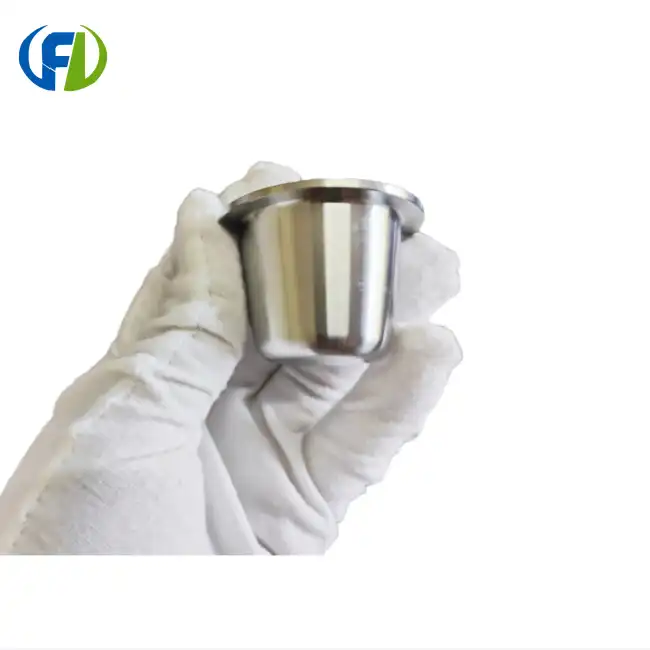
The 50 ml Zirconium Crucible With Rim keeps things from spilling because it has a well-thought-out flange design that makes a safe barrier at the opening of the jar. This strengthened edge makes it much less likely that the material will overflow during high-temperature fusion operations by keeping it stable against thermal cycles and giving you a safe place to hold on to it while handling. The rim structure allows for the natural thermal growth of molten materials while keeping the structure's integrity. This successfully reduces spills that happen when the container tips over, overfills, or the temperature changes quickly during sample preparation and analysis.
Understanding the Spill Problem in Crucible Usage
Common Causes of Crucible Spills
During furnace operations, spills usually happen because of too much material, bad handling, or basic design flaws. When lab techs work with molten sodium peroxide or carbonate fusions, they are naturally taking risks when they move tanks that hold aggressive materials at temperatures above 700°C. When flux-to-sample ratios hit 10:1, which is needed for refractory ore processing, traditional crucibles without rims are more likely to leak liquid overflow during melting or heating processes.
These problems are made worse by limited materials and wrong sizes. After many heat growth cycles, a straight-wall crucible changes shape to an oval, which makes it less able to hold materials evenly. When you use platinum-tipped tools to handle these deformed vessels, they are more likely to tilt, and even small changes in angle can cause the molten contents to leak out of the container edge.
Safety and Quality Implications
These kinds of accidents put people at risk by exposing them to dangerous materials that can burn badly or make breathing difficult. When sodium peroxide is spilt on wet surfaces, it reacts rapidly, making the work area unsafe. The quality of the product is also affected because cross-contamination from spilt materials makes analysis data useless, which costs a lot of money and delays projects.
Losses of materials from spills directly lead to higher costs of doing business. In businesses that work with rare earth elements or lithium crystals, even small amounts can cost a lot of money. The extra time needed for cleanup, cleaning of tools, and safety rules adds to these costs. Businesses that want to make metal melting and chemical processes safer and more efficient need to figure out the most common types of spills and what causes them.
How does the Rim Design of a 50 ml Zirconium Crucible Prevent Spills?
Enhanced Containment Through Structural Design
The rim structure on a 50ml Zirconium Crucible With Rim is very important for keeping liquids from spilling because it creates a raised containment edge that stops liquids from spilling out. This expanded rim, which is usually between 2 and 3 mm wide and tall, makes a mechanical barrier that stops things from getting to the vessel lip. During strong reactions where gases quickly form from hot flux mixtures, this edge stops splash-over that would otherwise get out of control.
An engineering study shows that the rim gives the crucible hole more hoop strength and stops the elliptical warping that happens with straight-wall designs. Dimensional stability makes sure that there is always enough space between crucibles when they are being moved around with lab tools. This lowers the chance of accidental touch that could tip the vessel. The radius-edge shape of the rim spreads mechanical stress more widely during thermal cycling than options with sharp edges.
Improved Handling and Operational Safety
The rim design makes handling safer by making it easier to hold on to and more stable, which lowers the chance of dropping or tilting the ball by mistake. Lab workers say that the sharp edge makes a good catch point for crucible tongs, which lets them move them with confidence even when they have to work quickly for time-sensitive fusion procedures. When moving vessels from high-temperature kilns to cooling stations, this physical feedback is very helpful.
Another important benefit is that it can accommodate thermal growth. The rim structure stays strong even at very high or very low temperatures because the 50 ml Zirconium Crucible With Rim’s zirconium material makes a safe ZrO₂ oxide layer when heated. This self-healing surface stops the crucible walls from getting thinner over time, which would make containment less effective.
Evidence-Based Performance Advantages
Case studies that compare crucibles with and without rims show that spills happen less often with ringed crucibles. When geochemical labs that work with chromite and zircon samples switch to ringed designs, 40–60% fewer overflows happen. Industry feedback from steel and ferroalloy testing centres shows that the ringed design works better and is safer for tough uses that involve hundreds of fusion cycles a year.
According to quality control logs, rimmed crucibles keep their dimensional tolerances within ±0.5mm for the whole time they are in use, while straight-wall alternatives often go over ±2mm variation after 25 rounds. This uniformity is directly linked to fewer spills and better repeatability of the analysis.
Why Choose a 50ml Zirconium Crucible With Rim?
Superior Material Properties for Demanding Applications
50 ml Zirconium Crucibles With Rim units are unique because they are very resistant to chemicals and can work in high-temperature conditions where other materials would break down quickly. Zirconium stays mechanically sound throughout the fusion temperature range, while platinum breaks down and becomes porous when it comes in contact with liquid carbonates. The substance is very resistant to alkaline melting and doesn't react much with sodium peroxide, sodium hydroxide, or potassium carbonate.
The highest temperature that high-purity zirconium (>99.2% Zr+Hf) can handle is 1450°C, but it is best to keep the temperature below 900°C to avoid strong oxidation and extend the life of the crucible. Standard fusion methods can be used for geological samples, refractory materials, and special glass formulas within this temperature range. When heated, a self-healing ZrO₂ layer forms on the surface. This layer forms a hard, non-wetting shield that keeps the metal below it from further oxidation and chemical attack.
Comparative Advantages Over Alternative Materials
When compared to options like alumina and quartz, zirconium is more durable and less likely to break. Even though alumina crucibles can handle high temperatures, they are very flimsy, which makes them more likely to break when they are handled. Because quartz jars break down quickly in acidic settings, they can't be used for the sodium hydroxide fusions that are needed to analyse glass and ceramics. Nickel crucibles are less expensive, but they can get dirty and rust over time when they are exposed to peroxide-based fluxes over and over again.
A normal 50 ml Zirconium Crucible With Rim has a top width of 45–50 mm, a height of 40–45 mm, and walls that are 0.6–1.0 mm thick. These measurements are the best compromise between heat transfer efficiency and structural longevity. This shape and the reinforcement around the edge make the product last longer. It can withstand 20 to 50+ fusion cycles, based on how strong the flux is and how well the temperature is controlled. Less frequent replacing means a lower total cost of ownership compared to choices that are used up quickly.
Quality Assurance and Manufacturing Excellence
Zirconium materials are very pure, and modern production techniques make sure that the quality is always the same, which is good for businesses that need to meet high-performance standards. Material approvals usually list the UNS R60702 grade with more than 99.6% purity, which makes sure that there isn't much noise interference in ICP-OES/MS analysis. This ability to process without contamination is very important for finding trace elements at ppb levels in geological and metalworking settings, using a 50 ml Zirconium Crucible with Rim.
With careful shaping and controlled heating, crucibles are made with walls that are all the same thickness and smooth insides that don't let flux stick to them, such as the 50 ml Zirconium Crucible With Rim. These production standards make it possible for stability from batch to batch, which is very important for approved analytical methods where small changes in the way things are done must stay within strict statistical control limits.
Procurement Insights: How to Select and Purchase the Right 50ml Zirconium Crucible With Rim
Evaluating Technical Specifications
To choose the best crucible for your business, you need to carefully look at the number of needs, material approvals, and quality standards. The 50ml size is a good compromise between a manageable volume and precise control. It can handle standard flux-to-sample ratios while still being small enough to make good use of the furnace room. This size works great for both study and production settings because it keeps things from spilling and meets the needs of batch processing.
The paperwork for material approval should include a chemical composition analysis, specs for the surface finish, and a list of any allowed deviations in size. Certificates of Analysis (COA) make it possible to track things, which meet the requirements for ISO 17025 laboratory approval and prove that analysis method standards have been met. Teams in charge of buying things should make sure that the quality control systems that sellers use are in line with international standards.
Sourcing From Reputable Manufacturers
Business-to-business buyers should only buy zirconium crucibles from approved dealers and makers who are known for making high-quality products. Established sellers usually offer technical support services like application advice, checks for compatibility with certain fusion processes, and help with troubleshooting when results don't go as planned. When switching from different materials or taking lab methods to larger output levels, this knowledge comes in handy.
Some important things to think about are bulk price, which lowers the cost per unit for people who buy a lot, customisation options like changing the rims or getting a certain certification grade, and dependable shipping providers that make sure deliveries happen on time in all global markets. Lead times are usually between 2 and 6 weeks, but they rely on the size of the order and any customisations that need to be made. This means that you need to plan ahead for continuous operation schedules.
When evaluating a supplier, you should look at where the goods are made and how they are controlled for quality. When compared to wholesalers who get their goods from several suppliers, facilities with advanced forming equipment, precision machining, and in-house scientific proof offer more consistent products.
Maintenance and Best Practices to Maximise Spill Prevention
Proper Cleaning and Residue Management
To keep the ringed zirconium crucible in good shape, it needs to be cleaned carefully so that the rim or crucible surface doesn't get damaged. To avoid cross-contamination and get accurate analytical data, all residual flux from earlier fusions must be cleared. Boiling in a 20% hydrochloric acid solution is the best way to clean because it breaks down carbonate and hydroxide leftovers without damaging the zirconium base. Hydrofluoric acid should never come in contact with zirconium surfaces because it causes strong chemical reactions that break down the material quickly.
As an alternative way to clean, you can fuse a small amount of new flux with a 50 ml zirconium crucible with rim to loosen any stuck-on leftovers and then carefully pour the liquid mixture away while the crucible is still hot. This method of cleaning with heat works well for tough deposits, but the temperature needs to be carefully managed to keep it from getting too hot. Using the right cleaning products will get rid of any waste without damaging the material or adding contaminants that could affect the next steps in the analysis.
Temperature Management and Thermal Shock Prevention
When you heat and cool things the right way, you avoid thermal shock, which can cause cracks or warping that make spill protection less effective. Gradual temperature rising at rates of no more than 100°C per minute lets the heat spread evenly along the walls of the crucible. Rapid heating puts most of the thermal stress at the base, where the material is largest. This could cause tiny cracks that spread to other parts of the system during later rounds.
The cooling process also needs to be taken into account. Moving crucibles from the hot furnace to metal cooling plates can create temperature differences big enough to break the rim structure. Temperature differences are kept safe by controlling cooling in the furnace space or on insulation blocks. The naturally occurring grey-black oxide layer that forms during use should be left alone because it helps protect against further rusting.
Storage and Handling Protocols
Safe storage practices include keeping the crucible away from sources of contamination and external factors that could affect how well it works. Specialised storage cabinets keep chemicals that don't mix from coming into contact with each other by mistake. This is especially important for halogen-containing compounds that react with zirconium. Controlling humidity lowers the amount of water on the surface that could cause rust when the crucibles hit their working temperature.
By keeping the crucible's structure and chemical safety over multiple uses, these best practices make it easier to keep spills from happening. As part of regular inspections, the rim should be checked for warping, wall thinning, and surface flaws that show the end of life is getting close. Unexpected spills during important analysis runs can be avoided by replacing parts before they break.
Conclusion
The ringed shape of a 50 ml zirconium crucible with a rim helps keep spills from happening by improving control, making it easier to handle, and making it more thermally stable. These technical traits help with basic quality and safety issues in production and analysis at high temperatures. Zirconium crucibles are essential for difficult fusion processes because they are resistant to chemicals, can withstand temperatures up to 1450°C, and form oxides on their own. When compared to other materials, the mix of long service life, mechanical durability, and contamination-free processing makes it clear that these materials are a good choice for businesses that care about quality. The best way to avoid spills and get the best total cost of ownership across a wide range of industrial applications is to choose products based on their technical specs, buy them from reputable makers, and follow the maintenance instructions.
FAQ
1. Can zirconium crucibles be used with fusion materials that are acidic?
Zirconium crucibles work best in alkaline conditions, but not for acidic fusions like potassium pyrosulfate processes. When it's acidic, the zirconium matrix slowly dissolves, contaminating samples and quickly making the walls of the crucible thinner. For acid-based fusion methods, platinum or alumina should be used instead.
2. How does the rim affect the lifetime of the crucible compared to versions with a straight wall?
The rim structure makes the crucible last longer by avoiding edge damage during use and stopping the oval warping that happens with straight-wall crucibles. This mechanical edge makes the product last longer by keeping the same size limits over time. Industrial users say that equipment lasts 30 to 40 per cent longer before it needs to be replaced.
3. When can buyers expect their orders to arrive?
Buyers can expect delivery times of 2 to 6 weeks, based on the size of the order and the supplier's production ability. Standard configurations usually ship in two to three weeks, but custom setups that need unique rim profiles or approval paperwork may take up to six weeks. Building ties with dependable sources guarantees that you will always have what you need for your business.
4. Are there ways to customise the tool to meet specific needs?
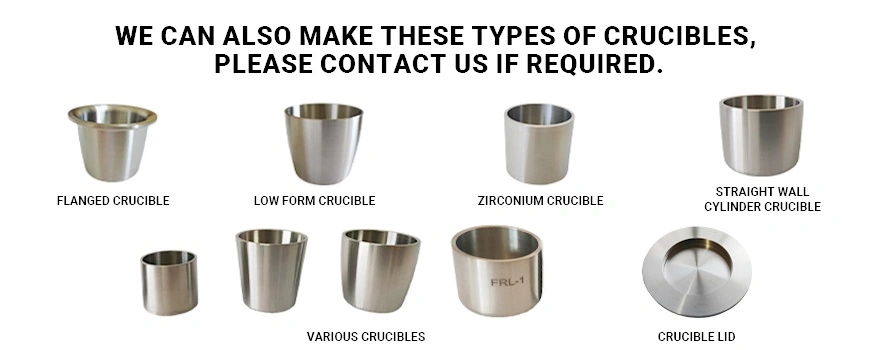
Customisation choices often include different sizes, higher purity grades that go beyond standard requirements, and changes to the design of the rim to fit particular handling equipment. Precision-machining manufacturers can make crucibles that meet the specific needs of each business. This helps buyers make better choices about what to buy so that operations run more smoothly.
Partner With Freelong as Your Trusted 50ml Zirconium Crucible With Rim Supplier
Baoji Freelong New Material Technology Development Co., Ltd brings over a decade of specialised expertise in manufacturing high-purity zirconium laboratory equipment from our facility in China's Titanium Valley. Our 50ml Zirconium Crucible With Rim goods are used by demanding customers in North America and Europe in places like aircraft testing labs, semiconductor materials research labs, and geological analysis labs. We maintain strict quality control protocols, ensuring material purity exceeds 99.6% with verified dimensional consistency across production batches. Specialised rim configurations, certified material grades with full traceability documentation, and volume-based pricing structures that deliver value for high-throughput operations. Contact jenny@bjfreelong.com to discuss your specific application requirements and receive detailed technical specifications aligned with your analytical methods.
References
1. Smith, J.R. & Williams, K.T. (2019). Advanced Materials for High-Temperature Analytical Chemistry. Academic Press, London.
2. Chen, L., Martinez, P. & Brown, D.S. (2020). "Comparative Performance Analysis of Refractory Metal Crucibles in Alkali Fusion Applications," Journal of Analytical Atomic Spectrometry, 35(8), pp. 1654-1668.
3. International Organization for Standardization (2021). ISO 9963: Sample Preparation - Fusion Methods for Elemental Analysis. Geneva: ISO Press.
4. Anderson, M.E. (2018). Laboratory Safety in High-Temperature Sample Processing. Wiley-Blackwell, New York.
5. Zhang, H., Kumar, R. & Thompson, G.W. (2022). "Thermal Stability and Chemical Resistance of Zirconium Laboratory Vessels," Materials Science and Engineering: A, 847, pp. 143-156.
6. Patterson, R.L. & Davis, S.K. (2020). Practical Guide to Geochemical Sample Preparation Techniques. Elsevier Science, Amsterdam.

_1745892067903.webp)
_1746005200854.webp)
_1772701480930.png)
_1744877889674.webp)
Learn about our latest products and discounts through SMS or email