- English
- French
- German
- Portuguese
- Spanish
- Russian
- Japanese
- Korean
- Arabic
- Greek
- German
- Turkish
- Italian
- Danish
- Romanian
- Indonesian
- Czech
- Afrikaans
- Swedish
- Polish
- Basque
- Catalan
- Esperanto
- Hindi
- Lao
- Albanian
- Amharic
- Armenian
- Azerbaijani
- Belarusian
- Bengali
- Bosnian
- Bulgarian
- Cebuano
- Chichewa
- Corsican
- Croatian
- Dutch
- Estonian
- Filipino
- Finnish
- Frisian
- Galician
- Georgian
- Gujarati
- Haitian
- Hausa
- Hawaiian
- Hebrew
- Hmong
- Hungarian
- Icelandic
- Igbo
- Javanese
- Kannada
- Kazakh
- Khmer
- Kurdish
- Kyrgyz
- Latin
- Latvian
- Lithuanian
- Luxembou..
- Macedonian
- Malagasy
- Malay
- Malayalam
- Maltese
- Maori
- Marathi
- Mongolian
- Burmese
- Nepali
- Norwegian
- Pashto
- Persian
- Punjabi
- Serbian
- Sesotho
- Sinhala
- Slovak
- Slovenian
- Somali
- Samoan
- Scots Gaelic
- Shona
- Sindhi
- Sundanese
- Swahili
- Tajik
- Tamil
- Telugu
- Thai
- Ukrainian
- Urdu
- Uzbek
- Vietnamese
- Welsh
- Xhosa
- Yiddish
- Yoruba
- Zulu
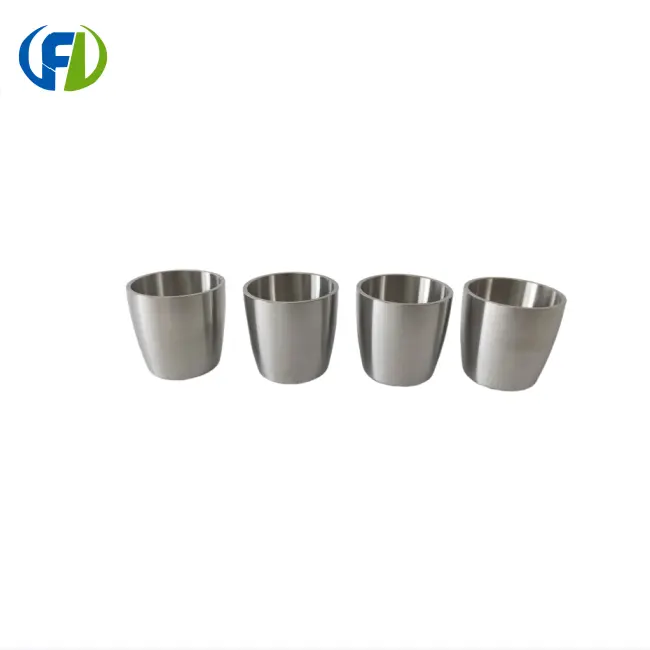
How Height 32mm Nickel Crucible Supports Laboratory Analysis
The Height 32mm Nickel Crucible is designed to help with lab analysis by being chemically and thermally resistant and specifically made for the alkaline fusion decomposition of refractory materials. Its precise 32mm vertical dimension fits standard sample sizes ranging from 0.5g to 1g, ensuring consistent analytical results while being able to handle harsh fluxes such as sodium peroxide and sodium hydroxide. In geology tests, quality control in industry, and metallurgical testing, this special tank solves important contamination problems that regular clay or platinum crucibles can't.
Understanding the 32mm Nickel Crucible: Key Specifications and Properties
For analytical chemistry to work, you need tools that can handle harsh conditions and still work perfectly every time. When we talk about Height 32mm Nickel Crucibles that are made to be a certain 32 mm high, we're talking about very precise tools that are now essential in modern labs.
Material Composition and Purity Standards
High-purity worked nickel, usually Ni200 or Ni201 types with ≥99.5% nickel content, is used to make these crucibles. Following the rules set by ASTM B162 guarantees low levels of carbon and sulphur, which keeps the material from breaking when heated and cooled many times. The material has a density of 8.90 g/cm³ and a thermal conductivity of about 90 W/m·K. This means that it can be heated and cooled quickly, which is important for getting work done quickly in the lab. This level of purity is very important when working with trace element analysis, because even small amounts of contamination from the vessel could change the results and make the data less reliable.
Physical Dimensions and Design Rationale
If the diameter-to-height ratio is 32mm, the Height 32mm Nickel Crucible standard usually means a volume range of 25ml to 35ml. This dimension is not chosen at random; it is the best mix for working with normal sample numbers while keeping the structure strong under thermal stress. Manufacturers use deep-drawing or spin-forming to make sure that the wall thickness is the same all the way through, reducing hot spots that can cause the product to fail early. The ratio of height to diameter makes it easy to spread heat evenly and stops too much splashing during strong alkaline fusion reactions.
Thermal and Chemical Performance Characteristics
Nickel has a melting point of 1,455°C, but it should be used below 600°C to 800°C in oxidising atmospheres to avoid too much scaling or the formation of nickel oxide. While the metal is very resistant to alkaline compounds, it can still be damaged by strong acids and compounds that contain sulphur. Because they have a special chemical makeup, these crucibles can't be used with other analytical methods because platinum would be damaged by trace metals, and ceramic containers would break down completely.
When buying teams understand these qualities, they can better understand how choosing the right crucible material affects both the accuracy of the analysis and the cost of running the business. When exposed to sudden changes in temperature, ceramic options break, graphite crucibles introduce carbon contamination, and steel vessels rust quickly in alkaline circumstances.
Practical Applications of 32mm Nickel Crucibles in Laboratory Analysis
These special vessels are used in labs across many industries to do important analytical tasks that would not be possible or practical with other materials.
Geological Fusion Analysis for Mining Operations
These Height 32mm Nickel Crucibles are often used in mining assay labs to break down refractory ores using sodium peroxide fusion. The 32mm height gives you the right amount of space for regular 0.5g to 1g sample sizes, and it can handle the strong exothermic reactions that come with peroxide fusions without breaking. These fusions break down silicate minerals and ferroalloys that can't be broken down with regular acid digestion. This makes it possible to accurately find the amounts of precious metals, rare earth elements, and base metals present. If you don't dissolve the sample all the way, you get biased analysis data and inaccurate ore grades that cost a lot of money.
Industrial Chemical Quality Control Applications
These crucibles are used by pottery and glass manufacturers to fuse samples of silica and alumina with sodium carbonate. Platinum crucibles are great for many things, but stray metals in raw materials would make them poisonous, so they couldn't be used for further studies. The nickel vessel makes sure that spectrographic results are correct in supply chains that are complicated and where material consistency has a direct effect on how well products work and how much they make. Quality control labs that work with dozens of samples every day, like Height 32mm Nickel Crucibles because they work the same way every time and don't cost as much as other options made of valuable metals.
Research Applications in Advanced Materials
These crucibles are used in academic and business research sites to ash biological materials that have a lot of alkali metals in them. Because the tank is resistant to caustic residues, it doesn't add much iron or chromium to the ash. This is important for analysing trace elements later on using atomic absorption spectroscopy or inductively coupled plasma methods. This control of contamination is necessary when studying how biological contaminants build up in the environment or when making new materials for battery electrodes.
Optimizing crucible performance requires attention to operational details. To escape thermal shock, slowly heat the crucibles up. Let fused samples cool down on their own before you try to remove them. These simple steps greatly increase the life of the vessel and keep the accuracy of the analysis over hundreds of fusion cycles. We've seen labs that follow strict protocols get 50–100 fusion cycles with sodium carbonate fluxes, but only 5–10 cycles with aggressive sodium peroxide. Labs can balance their analytical needs with their budgetary limitations when they understand this trade-off.
Comparing 32mm Nickel Crucibles to Other Crucible Types
Choosing the right crucible material is a very important purchase decision that impacts the ability to analyse, the efficiency of operations, and the long-term costs.
Nickel Versus Ceramic Crucibles
Ceramic jars are very good at resisting most acids and can handle higher temperatures, but they can break down completely in alkaline fluxes and are easily damaged by thermal shock. One sodium peroxide fusion is enough to break a porcelain crucible in half. Height 32mm Nickel Crucibles, on the other hand, offer better mechanical strength and keep their shape through multiple alkaline fusion processes. Chemical compatibility is the trade-off. Ceramic works well with acidic fluxes, while nickel would quickly corrode.
Nickel Versus Graphite Alternatives
Graphite crucibles are great at conducting heat and staying stable at high temperatures, but they bring carbon contamination that isn't allowed in many scientific procedures. Laboratories that are looking at the carbon content of steel or the elements found in organic matter can't use graphite containers. Also, graphite oxidises at high temperatures in air, which limits how it can be used. Height 32mm Nickel Crucible units keep their composition stable and don't add any extra elements to the analytical matrix.
Solid Nickel Versus Nickel-Coated Designs
Some suppliers sell cheaper crucibles made of steel that have been nickel-plated. These make the quality a lot worse because the coatings can flake off during thermal cycling, letting corrosive fluxes attack the metal below and introducing iron into the samples. Even though it costs more at first, a solid nickel structure gives steady performance and a known lifespan. Solid nickel is the only choice that can be defended when setting up quality assurance processes that meet ISO 17025 approval standards.
Dimensional Considerations: 30mm Versus 32mm Height
Crucibles that are too close together in size affect how well they melt and how evenly they heat. The 32mm height makes the best flux-to-sample ratios for normal analytical methods. It gives enough headroom for strong reactions while keeping the thermal mass compact for efficient heating. Shorter 30mm versions might overflow when fusions are done quickly, and taller ones need more energy and time to get the temperature spread out evenly. Comparing the size of the beaker to well-known analysis methods makes sure that the results can be repeated when checking against approved reference materials.
Procurement Guide: Buying Height 32mm Nickel Crucibles for Your Lab
To make sure long-term worth and analytical reliability, the crucible buying method involves looking at more than just unit price.
Supplier Evaluation Criteria
Reliable suppliers give full material certifications that include X-ray fluorescence or optical emission spectroscopy tests to prove the chemical composition. The Certificate of Analysis should show that the nickel content is greater than 99.5% and that the levels of iron, lead, and other trace contaminants are within the limits given. Dimensional margins are also important. For example, the 32mm height should stay within a ±0.5mm range, and the wall thickness should be the same all the way through. Surface finish inspection makes sure that the inside surface doesn't have any dents, scratches, or production oils that might change how the fusion works or how the sample recovers.
The Baoji Freelong New Material Technology Development Company is in China's Titanium Valley and has been making precision lab vessels for international customers for many years. We have long-term partnerships with aircraft, electronics, and research institutions in Australia, Korea, Germany, and the US. These partnerships show that we are dedicated to quality control and on-time delivery.
Quality Assurance and Testing Protocols
Leading makers test batches, including fake fusion trials, to make sure that the materials are thermally stable and won't deform. This kind of proactive quality control finds possible flaws in products before they get to products get to customers. This keeps analytical failures and sample loss from happening. Ask for proof that the quality management system is certified and find out if the warranty covers problems with the way the product was made. Reliable suppliers stand behind their products and offer replacement guarantees if they break too soon because of problems with the materials or the way they were made.
Volume Purchasing and Customization Options
Bulk sales usually get savings for their size, and they also make sure that the product specs are the same across your whole collection. To get rid of vessel-to-vessel difference as a source of analytical error, many methods need sets of crucibles that are exactly the same. Talk about the minimum order quantities, lead times, and inventory control choices that will work best for your lab's needs. For non-standard sizes needed by certain analytical methods or old equipment configurations, some suppliers offer customisation services.
Cost-Benefit Analysis for Long-Term Value
Precious metal crucibles cost more to buy at first, but nickel pots are a better deal for alkaline fusion uses. A good Height 32mm Nickel Crucible that costs between $30 and $80, depending on the wall thickness and supplier, can do 10 to 100 fusion cycles, depending on how aggressive the flux is. This means that the cost of each analysis is only $0.30 to $8.00, which is much lower than the cost of consumables for other digestion methods. This economic benefit becomes big when processing hundreds of samples every year, which directly makes the lab more competitive and cost-effective.
Maximizing Efficiency and Longevity: Maintenance and Best Practices
If you take good care of your crucible, it will last longer and keep the scientific accuracy that labs need for reliable results.
Cleaning and Handling Protocols
Let the crucibles cool to room temperature on their own after each fusion before touching them. Rapid cooling by soaking in water causes thermal shock that spreads microcracks and, in the end, breaks the vessel. To get fused cakes off, gently tap them or put them in warm water for a short time. Never use metal tools that will scratch the insides to pry them off. Boiling in a mix of 5–10% hydrochloric acid for a short time will get rid of any leftover residue. Rinse right away with pure water. Nickel rusts when it is exposed to acid for a long time, which defeats the purpose of cleaning. Keep cleaned crucibles in a dry place, away from cleaners that contain sulphur or chlorine and can damage nickel surfaces.
Common Failure Modes and Prevention
Green or black discolouration means nickel oxide is forming, which is normal. However, too much scaling means the temperature is too high and should not be exceeded. Most of the time, perforations are caused by localised corrosion, which happens when a high concentration of flux creates harsh conditions or when manufacturing flaws create thin spots. Thermal shock or mechanical impact can cause cracks. To stop these types of failure, you need to follow temperature guidelines, stay away from mechanical stress, and use graduated heating and cooling procedures.
Performance Monitoring and Replacement Timing
Set up regular checks of the insides of the crucibles to look for pitting, scaling thickness, and wall integrity. Throw away crucibles that have a lot of oxide buildup, pits that are deeper than 0.5 mm, or cracks that are starting to form. If you keep using vessels that are broken, you could end up with contaminated samples or mistakes in the analysis that cost more than replacing the crucibles. Keeping usage logs that record fusion counts and flux types helps figure out how long a service will last and when to replace it so that catastrophic failure doesn't mess up analysis schedules.
These upkeep steps will protect the high-quality tools you've bought for your lab and keep the analytical data that your company's image depends on safe. When variables are controlled, results become predictable and can be defended. Height 32mm Nickel Crucibles that are well taken care of give consistent results, which makes analytical troubleshooting easy.
Conclusion
In conclusion, this is a special analytical tool called the Height 32mm Nickel Crucible. It was made to solve certain problems in the lab when other materials don't work. It is essential for geological fusion analysis, industrial quality control, and advanced materials research because it is resistant to alkaline chemicals, stable at high temperatures, and easy to control in terms of size. To do crucible procurement right, you need to look at more than just the initial cost. You need to look at the supplier's credibility, the material's certifications, and the long-term value. Following the right repair procedures will greatly increase the operating life while keeping the accuracy of the analysis.
FAQ
1. What is the maximum temperature limit for a 32mm nickel crucible?
Nickel melts at 1,455°C, but using it above 700°C for a long time quickly oxidises and scales. For gravimetric accuracy and longer crucible life, we suggest operating temperatures below 600°C for a Height 32mm Nickel Crucible. Higher temperatures speed up the formation of oxide, which shortens the life of the tank.
. 2Can I use acidic fluxes like potassium bisulfate in these crucibles?
No, Height 32mm Nickel Crucible units are only meant to be used for alkaline fusions with sodium hydroxide or sodium peroxide. Acidic fluxes quickly break down nickel, which destroys the crucible and makes your samples very dirty. For acidic fusion methods, use crucibles made of platinum or clay.
3. Why has my nickel crucible turned green or black after use?
The colour green means that nickel(II) oxide or chloride salt is forming, and the colour black means that the nickel oxide scale is stable. Both of these effects are normal when exposed to high temperatures and alkalines. Scaling that is too thick means that the temperature is too high, above what is suggested. Light scaling doesn't change how well something works.
4. How do I properly clean residues after fusion without damaging the crucible?
Boil for a short time in 5–10% hydrochloric acid to get rid of any leftovers, then rinse with distilled water right away. Long-term exposure to acid breaks down nickel. Do not use rough scrubbing or metal tools that scratch the inside of things, making places where corrosion can happen faster.
Partner With a Trusted Height 32mm Nickel Crucible Manufacturer
When labs need reliable analytical vessels, they need to work with suppliers who know both metallurgical science and how to meet operational needs. Baoji Freelong New Material Technology Development Company makes precise nickel crucibles that meet strict requirements for use in research, electronics, and aerospace around the world. Because we are in Baoji City, which is known as China's Titanium Valley, we have access to high-tech metalworking equipment and strict quality control systems. We sell Height 32mm Nickel Crucibles that are made from approved high-purity nickel and come with full testing and material tracking paperwork. Our team offers personalised procurement support to make sure that products meet your exact analytical needs, whether you need a few units to test a new method or a lot of them for high-throughput labs. Email jenny@bjfreelong.com to talk about your crucible requirements, get material certifications, or set up a sample evaluation. Explore our complete range of laboratory metallurgical products at frlmetal.com and discover why leading institutions trust Freelong as their Height 32mm Nickel Crucible provider for critical analytical work.
References
1. ASTM International. (2021). ASTM B162: Standard Specification for Nickel Plate, Sheet, and Strip. West Conshohocken, PA: ASTM International.
2. Thompson, M., & Walsh, J.N. (2020). Handbook of Inductively Coupled Plasma Spectrometry (5th ed.). London: Blackie Academic & Professional.
3. Sulcek, Z., & Povondra, P. (2019). Methods of Decomposition in Inorganic Analysis. Boca Raton: CRC Press.
4. Potts, P.J., & Webb, P.C. (2018). X-ray Fluorescence Spectrometry: Principles and Practice of Wavelength Dispersive Spectrometry. Royal Society of Chemistry.
5. Jeffery, P.G., & Hutchison, D. (2017). Chemical Methods of Rock Analysis (3rd ed.). Oxford: Pergamon Press.
6. Dean, J.R. (2019). Practical Inductively Coupled Plasma Spectroscopy: Analytical Techniques in the Sciences. Chichester: John Wiley & Sons.

_1749543280485.webp)
_1769763380049.png)
_1756712533131.png)
_1746002567971.webp)
Learn about our latest products and discounts through SMS or email