- English
- French
- German
- Portuguese
- Spanish
- Russian
- Japanese
- Korean
- Arabic
- Greek
- German
- Turkish
- Italian
- Danish
- Romanian
- Indonesian
- Czech
- Afrikaans
- Swedish
- Polish
- Basque
- Catalan
- Esperanto
- Hindi
- Lao
- Albanian
- Amharic
- Armenian
- Azerbaijani
- Belarusian
- Bengali
- Bosnian
- Bulgarian
- Cebuano
- Chichewa
- Corsican
- Croatian
- Dutch
- Estonian
- Filipino
- Finnish
- Frisian
- Galician
- Georgian
- Gujarati
- Haitian
- Hausa
- Hawaiian
- Hebrew
- Hmong
- Hungarian
- Icelandic
- Igbo
- Javanese
- Kannada
- Kazakh
- Khmer
- Kurdish
- Kyrgyz
- Latin
- Latvian
- Lithuanian
- Luxembou..
- Macedonian
- Malagasy
- Malay
- Malayalam
- Maltese
- Maori
- Marathi
- Mongolian
- Burmese
- Nepali
- Norwegian
- Pashto
- Persian
- Punjabi
- Serbian
- Sesotho
- Sinhala
- Slovak
- Slovenian
- Somali
- Samoan
- Scots Gaelic
- Shona
- Sindhi
- Sundanese
- Swahili
- Tajik
- Tamil
- Telugu
- Thai
- Ukrainian
- Urdu
- Uzbek
- Vietnamese
- Welsh
- Xhosa
- Yiddish
- Yoruba
- Zulu
TA1 Titanium Plate Corrosion Tests: Ensuring Quality and Safety
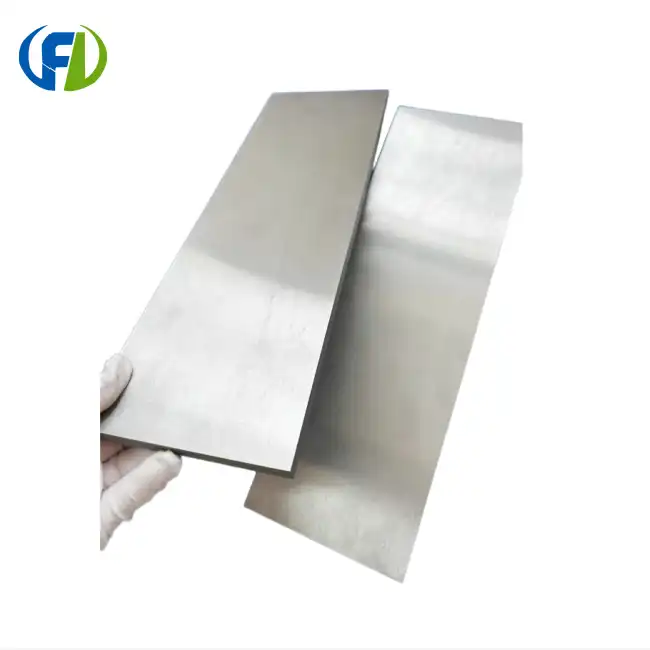
Because it is so reliable and long-lasting, the TA1 Titanium Plate is one of the best high-performance materials for tough industry uses. Corrosion testing is the most important step between choosing the right materials and their successful use, especially in places where failure is not a choice. When procurement workers make choices that affect the whole lifecycle of a project, they need to know how these tests make sure of quality and safety. The strict testing methods used on widely pure titanium plates have a direct effect on how well they work in places like medical devices, airplane structures, and tools for chemical processing. In these places, corrosion resistance is important for both safety and economic reasons.
Understanding TA1 Titanium Plate: Properties and Applications
Material Composition and Characteristics
With a minimum of 99.5% titanium content, TA1 Titanium Plate is the best type of titanium that can be bought in stores. These ingredients give the material great resistance to rust while also making it easy to shape and join, which makes it very popular in many industries. The material is very strong for how light it is. Its tensile strengths are usually between 240 and 550 MPa, but its density is only 4.5 g/cm³.
Because of its unique crystalline structure, TA1 grade titanium is naturally resistant to many types of chemical attack, such as the rust caused by chlorine that happens to many metals. This protection comes from the fact that a protective oxide layer forms quickly and can fix itself if it gets broken. This makes the environment less likely to get worse.
Industrial Applications and Performance Requirements
A lot of TA1 Titanium Plates are used in aircraft, where reducing weight and resistance to rust are important performance factors. Manufacturers of airplanes use these materials to make structural parts, engine accessories, and skin panels that have to be able to handle high temperature changes and be exposed to the air for long periods of time.
TA1 plates are used in the chemical processing industry for heat exchanges, reaction tanks, and pipe systems that deal with aggressive media. Because it can stand up to acids, bases, and organic solvents, the material is very useful in places that make medicines, process petrochemicals, and clean water. Titanium is exceptionally resistant to rusting by seawater, which is why it is used in desalination plants, underwater platforms, and submarine parts.
The biocompatibility of the TA1 Titanium Plate is used by medical device makers to make implantable devices, surgical instruments, and monitoring tools. The material is safe for patients because it is non-toxic and doesn't corrode when exposed to body fluids. It also stays mechanically strong for long periods of time after insertion.
Corrosion Challenges and Causes in TA1 Titanium Plates
Types of Corrosion Affecting Titanium Materials
TA1 titanium is better at resisting corrosion than many other materials, but some weather situations can still make things difficult. Pitting corrosion is one of the most dangerous types of attack because it happens when the protected oxide film breaks down in one place, letting harmful ions get through to the surface. The occurrence of this effect usually happens in places with a lot of chloride, high temperatures, or limited air supply.
Crevice corrosion happens in small areas where solution stagnation stops the oxide layer from growing again. This kind of attack works best when there are gasket surfaces, bolt connections, and plate pieces that meet. When acidic conditions form in cracks, they speed up the rusting process and can cause a lot of material to be lost over time.
When the TA1 Titanium Plate touches different metals in the presence of an electrolyte, galvanic rusting happens. Titanium is usually the better material in these kinds of pairs, but if you don't choose the right material or don't isolate them well enough, the nearby parts could corrode faster, and the titanium surface could become contaminated.
Environmental Factors Influencing Corrosion Behavior
Temperature differences have a big effect on how titanium plates corrode. Temperatures above 300°C can change the qualities of the protected oxide layer, which could make some media less resistant to corrosion. On the other hand, very low temperatures may change the material's mechanical features and its ability to prevent cracking.
Conditions of chemical contact are very important in figuring out how likely something is to rust. More damage is done by reducing acids, especially hydrochloric and sulfuric acids, than by oxidizing conditions. When fluoride ions are present, they can weaken the protective oxide layer, which makes the attack go faster even at low amounts.
Through stress corrosion cracking processes, stress conditions, whether they are applied or left over, can change how corrosion acts. Stress peaks can be caused by hot forming, welding, and mechanical force during service. These can be places where corrosion-assisted cracking starts.
Corrosion Testing Methods for TA1 Titanium Plates
Standard Testing Protocols and Procedures
Corrosion testing on TA1 Titanium Plates is done according to worldwide standards that make sure results can be repeated and comparisons between materials and sources are useful. Using ferric chloride liquids at controlled temperatures, ASTM G48 gives standard ways to test for pitting and crevice corrosion. This test mimics harsh chloride conditions and lets you figure out how resistant something is to rust by measuring weight loss and looking at it visually.
Potentiodynamic polarization and electrochemical impedance spectroscopy are two electrochemical testing methods that can quickly and accurately show how rust works in controlled environments. These methods help us learn a lot about how rust works, how passivation works, and how well protective metal layers work. ASTM G61 describes how to do cyclic potentiodynamic polarization tests that find out how susceptible something is to localized rust types.
According to ASTM B117, salt spray testing exposes titanium plates to sodium chloride mist for a long time at a constant temperature and humidity. This test doesn't directly apply to certain working environments, but it does give us a starting point for comparing how well coatings and corrosion protection work.
Advanced Characterization Techniques
These days, checking for rust uses complex analytical methods that help us fully understand how things break down. Using scanning electron microscopy and energy-dispersive X-ray spectroscopy together shows how rust changes the shape of surfaces and the elements that make them up. These methods find corrosion products, describe attack shape, and check how well protection treatments work.
X-ray photoelectron spectroscopy looks at the chemical make-up and thickness of the oxide layers that form during tests by exposure. This surface-sensitive method tells us very important things about how passivation works and how stable protection films are in different kinds of environments.
Electrochemical noise tracking is a new way to check for rust in real time while testing is going on. This method finds changes in current and potential that are linked to localized rust starting and spreading. This lets corrosion events be found early.
Comparative Corrosion Resistance: TA1 vs Other Materials
Performance Comparison with Alternative Titanium Grades
When compared to other widely pure types of titanium, like TA2 and Grade 4, TA1 titanium has different corrosion properties. Although TA2 has a few more impurities than TA1, mostly iron and oxygen, these extras can make it stronger mechanically but may make it less resistant to rusting in some settings. Since Grade 4 titanium is stronger than Grade 1, it has similar weathering properties to TA1. However, because it is stronger, it may be more or less likely to crack under stress.
The amount of oxygen in these types has a big effect on how they react to rust. The smaller amount of oxygen in TA1 makes it easier to shape and weld, and it also resists rust very well. TA1 is great for difficult shaping tasks and welded parts where post-weld heat treatment might not be possible because of this property.
Adding aluminum and vanadium to titanium alloys like Ti-6Al-4V changes how they react to rust compared to grades that are sold as pure titanium. Even though these metals are stronger, they may be more or less resistant to different types of rust, so different testing methods are needed to get a good idea of how well they work.
Material Selection Considerations
A cost-benefit study is a very important part of choosing materials. While the TA1 Titanium Plate is more expensive than stainless steel and aluminum alloys, its better corrosion protection often makes up for the extra cost by extending the life of the product and lowering the amount of upkeep that needs to be done. Titanium often has a lower total cost of ownership than other materials that need to be replaced often or protected in large ways in harsh settings.
Comparing different types of stainless steel shows that they have very different levels of chloride protection. Titanium performs better in marine and chemical processing settings. Stainless steels may be better in some temperature ranges or when magnetic qualities are needed, though.
Even though aluminum metals are cheaper and have better strength-to-weight ratios, titanium is better at resisting corrosion in harsh settings. Often, the choice between these materials is based on how toxic the climate is and how long the product needs to last.
Ensuring Quality and Safety: Procurement and Supplier Insights
Supplier Evaluation and Certification Requirements
To find good TA1 Titanium Plate suppliers, you need to look at their production skills, quality processes, and certification compliance. ISO 9001 quality management system certification is a basic way to make sure that production methods and quality control techniques are always the same. Most aerospace providers keep their AS9100 certification up to date, which has extra standards for aviation and space uses.
Material tracking is an important part of qualifying a seller. Documentation that connects raw materials, processing steps, and final goods makes it easy to find possible quality problems quickly and take corrective action when needed. The paperwork that comes with the certificate of analysis should include data from checking the chemical composition, trying the mechanical properties, and inspecting the size.
Third-party testing proof through independent laboratories gives you more faith in the performance and qualities of a material. Suppliers who regularly send their goods to a third party for inspection show that they care about quality and being open about how they run their businesses.
Manufacturing Excellence and Technical Support
Leading providers set themselves apart by offering advanced production skills and a wide range of expert support services. Modern factories with vacuum melting equipment, computer-controlled forming processes, and automatic checking systems make sure that the properties of the materials are always the same and that the sizes are correct.
Technical support services should help with choosing the right materials, making suggestions based on the application, and fixing problems. Suppliers who know a lot about metals can give you useful information about how to handle materials, how long they need to be heated, and how they will work with other materials so that they work as well as possible.
Precision cutting, surface finishing, and joining processes are some of the custom processing options that add a lot of value by lowering the need for further processing and making sure that the dimensions are correct. Most of the time, these services save money because they cut out extra steps in the process and reduce the amount of waste.
Freelong is based in Baoji City, China's Titanium Valley, and has decades of experience handling titanium and making sure its quality. Our dedication to excellence goes beyond just making products. It also includes full customer support and scientific knowledge that helps you make good choices about which materials to use and how to use them.
Conclusion
TA1 Titanium Plate rust testing is the basis for choosing materials with confidence in serious situations where failure would have big effects. The thorough testing procedures talked about in this analysis give procurement workers the tools they need to judge the performance of materials and make smart choices. Knowing how testing methods, external factors, and long-term performance are connected helps choose the best materials while keeping safety and dependability in mind. Tough tests have shown that TA1 titanium is better at resisting rust than other types of titanium. This is why it is used so much in industries like aircraft, chemical processing, and medical devices, where safety and performance are very important.
FAQ
Q1: What is the expected service life of TA1 titanium plates in marine environments?
TA1 Titanium Plates last a very long time in marine environments. Parts that are properly made and placed can last more than 20 to 30 years. The substance is strong against ocean corrosion, such as chloride-induced pitting and crevice corrosion, which makes it perfect for use in offshore platforms, desalination equipment, and marine vehicle parts. Service life can be extended even more by following regular check and repair procedures.
Q2: How does heat treatment affect the corrosion resistance of TA1 titanium plates?
Heating TA1 titanium can change its corrosion resistance by changing its texture and the way the oxides on the surface behave. Stress relief annealing at temperatures between 480°C and 650°C usually keeps or improves rust resistance by lowering leftover loads without changing the protective oxide layer too much. To keep things from getting contaminated, solutions at higher temperatures may need careful atmosphere control.
Q3: Can TA1 titanium plates be recycled after service use?
It is very easy to recover TA1 Titanium Plates, and the recycled material still works well in a lot of different situations. Usually, recycling includes remelting and refining to get rid of impurities and get the chemical makeup back to the right levels. This eco-friendliness feature helps make titanium materials more cost-effective over their whole lifetime.
Partner with Freelong for Superior TA1 Titanium Plate Solutions
For TA1 Titanium Plate supplier relationships to work, the makers need to know about both the science of the material and the needs of the application. Freelong makes titanium plates that are better than the industry standard by combining advanced production skills with thorough quality assurance programs. Our factory in Baoji's Titanium Valley gives us access to high-quality raw materials and processing know-how that we've gained over many years of making titanium products. Get in touch with jenny@bjfreelong.com to talk about your unique needs and find out how our expert team can help you choose the best materials for better performance and dependability.
References
1. Davis, J.R. It was published by ASM International in 2003 and is called "Handbook of Materials for Medical Device Design."
2. Schutz, R.W. ASM International published the ASM Handbook Volume 13B: Corrosion Materials in 2005. It is called "Corrosion of Titanium and Titanium Alloys."
3. Donachie, Matthew J. It was published by ASM International in 2000 and is called "Titanium: A Technical Guide, Second Edition."
4. Boyer, R., Welsch, G., & Collings, E.W. It was published by ASM International in 1994 and is called "Materials Properties Handbook: Titanium Alloys."
5. Peters, M., Kumpfert, J., Ward, C.H., and Leyens, C. Advances in Engineering Materials, Vol. 5, No. 6, 2003, "Titanium Alloys for Aerospace Applications."
6. The International ASTM. ASTM B265-20, West Conshohocken, PA, 2020. "Standard Specification for Titanium and Titanium Alloy Strip, Sheet, and Plate."

_1745830239756.webp)
_1757493475150.png)
Learn about our latest products and discounts through SMS or email