- English
- French
- German
- Portuguese
- Spanish
- Russian
- Japanese
- Korean
- Arabic
- Greek
- German
- Turkish
- Italian
- Danish
- Romanian
- Indonesian
- Czech
- Afrikaans
- Swedish
- Polish
- Basque
- Catalan
- Esperanto
- Hindi
- Lao
- Albanian
- Amharic
- Armenian
- Azerbaijani
- Belarusian
- Bengali
- Bosnian
- Bulgarian
- Cebuano
- Chichewa
- Corsican
- Croatian
- Dutch
- Estonian
- Filipino
- Finnish
- Frisian
- Galician
- Georgian
- Gujarati
- Haitian
- Hausa
- Hawaiian
- Hebrew
- Hmong
- Hungarian
- Icelandic
- Igbo
- Javanese
- Kannada
- Kazakh
- Khmer
- Kurdish
- Kyrgyz
- Latin
- Latvian
- Lithuanian
- Luxembou..
- Macedonian
- Malagasy
- Malay
- Malayalam
- Maltese
- Maori
- Marathi
- Mongolian
- Burmese
- Nepali
- Norwegian
- Pashto
- Persian
- Punjabi
- Serbian
- Sesotho
- Sinhala
- Slovak
- Slovenian
- Somali
- Samoan
- Scots Gaelic
- Shona
- Sindhi
- Sundanese
- Swahili
- Tajik
- Tamil
- Telugu
- Thai
- Ukrainian
- Urdu
- Uzbek
- Vietnamese
- Welsh
- Xhosa
- Yiddish
- Yoruba
- Zulu
TA9 Titanium Plate for Seawater and Desalination Systems
When corrosion threatens operational continuity in seawater environments, TA9 Titanium Plate emerges as the metallurgical solution engineered specifically for resistance. This premium alpha-phase titanium alloy, designated as Ti-0.2Pd and equivalent to ASTM Grade 7, incorporates strategic palladium additions that eliminate crevice corrosion in reducing acid conditions and high-chloride marine applications. TA9 delivers the ductility of commercially pure titanium while providing localised corrosion protection approaching pure palladium performance, making it indispensable for desalination heat exchangers and seawater-exposed chemical processing equipment where containment integrity cannot be compromised.
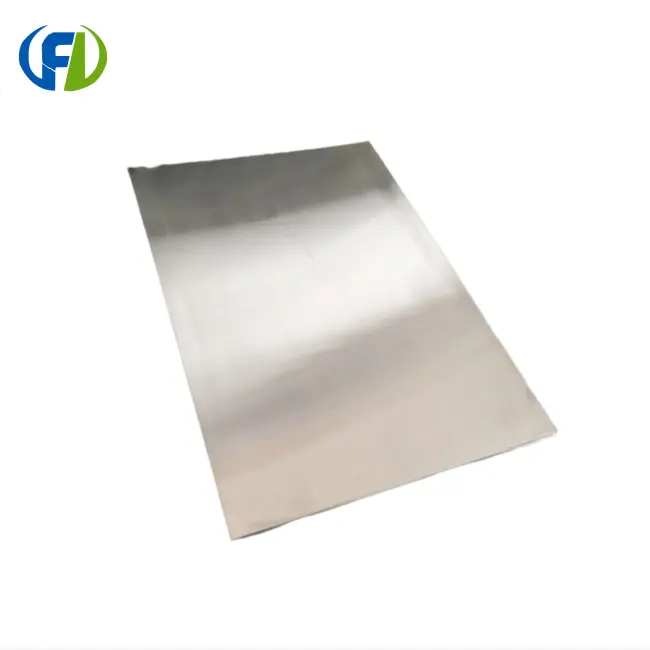
Understanding TA9 Titanium Plate: Properties and Applications
The electrical behaviour of this palladium-enhanced titanium alloy in harsh saline circumstances is what makes it unique in the field of metals. As a supplier to companies that make aerospace parts and chemicals, we've seen that knowing these basic qualities has a direct effect on buying choices and the long-term performance of assets.
Chemical Composition and Metallurgical Structure
Palladium levels between 0.12% and 0.25% are what make the TA9 Titanium Plate unique. This metal works as a cathodic depolariser inside the titanium matrix. This smart addition moves the corrosion potential into a stable passive area, which completely changes how the material reacts to places with a lot of salt. The alpha-phase structure keeps its excellent ductility, with tensile strengths between 345 and 483 MPa and elongation values above 20%. This gives it enough mechanical stability for use in pressure vessels while still letting it be shaped easily during production.
Superior Corrosion Resistance in Marine Environments
When commercially pure titanium gets attacked in cracks and under layers, the palladium treatment is very important for protecting it. Testing done at desalination plants in the Middle East that have been running for more than 15 years shows that titanium-palladium plates that are properly sized can keep their surface structure in hot seawater with more than 150,000 ppm chloride. This resistance works in a wide range of acidic conditions that are typical in chemical dosing systems. For example, pure titanium would break down quickly in diluted sulfuric acid at high temperatures.
Key Applications Across Marine Industries
The main area of use is in desalination plants, especially in multi-stage flash distillation and reverse osmosis systems, where the performance of the heat exchanger decides how efficiently the system uses energy. The material works great for building brine heaters, evaporator tube sheets, and condenser parts that are exposed to fast-moving saltwater. Offshore oil platforms use these plates for systems that clean created water, and marine chemical ships ask for them for the linings of their cargo tanks that handle chlorinated compounds, which are very toxic. More and more power plants along the coast are using this material for their cooling water pipes and wastewater cleaning units, which are always at risk of chloride getting in.
In addition to these main industries, we have also provided custom-cut plates to research centres working on cutting-edge membrane technologies and naval equipment makers making high-performance pumps and valve parts. The material's ability to keep the passive film stable under the mechanical stress and temperature changes that come with naval service is what makes these different uses work so well together.
TA9 Titanium Plate vs Other Materials: Making the Right Choice for Your Project
When choosing materials for marine systems, you have to weigh the starting cost against the total cost of running the system over its entire life. Our purchasing partners always ask for comparative research to back up choices about specifications, and the data shows clear differences in performance.
Performance Comparison with Other Titanium Grades
TA2 or Grade 2 commercially pure titanium is the most common parallel. Both materials have about the same mechanical strength, but one is better at resisting rust in certain areas than the other. TA2 works well in clean, aerated seawater, but it fails when the water doesn't move, when it's under marine growth layers, or when it's exposed to reducing acids. The 0.2% palladium content gets rid of these failure modes completely, which lowers the risk of sudden shutdowns that can cost desalination companies up to $50,000 a day in lost production for projects requiring TA9 Titanium Plate.
Titanium-Palladium Plates vs Stainless Steel and Nickel Alloys
For example, 316L stainless steel and other common naval materials cost about $8 to $15 per kilogram, while titanium-palladium plates cost about $45–75 per kilogram. But because of pitting and cavity rust, stainless steel needs to be replaced often when it comes into contact with salt water—often every 5 to 8 years. Some nickel-based metals, like Alloy 625 or C-276, are very resistant to rust. However, they are very expensive to make and add a lot of weight, which makes installation and structural support more difficult.
Suitability Matrix for Seawater Applications
Choosing the best grade of material relies on certain working conditions. TA2 works well enough in saltwater below 60 °C for a long time with few chemical inputs, and it costs less. The palladium-modified grade is needed when working temperatures are higher than 60 °C or when the design of the system includes crack-filled shapes, like bolted flange connections and tube-to-tubesheet joints. Chemical processing tasks that use acidic cleaning processes or chlorine injection need the extra protection that can only be provided by adding palladium.
Procurement Guide: How to Buy TA9 Titanium Plate for Seawater and Desalination Systems
A successful buying process includes more than just negotiating prices. It also includes checking the capabilities of suppliers and following quality control rules. Over the past 20 years, we've learned what makes a relationship solid and what makes a deal problematic by working with aerospace makers and chemical processors.
Supplier Selection Criteria and Certifications
As a minimum, trustworthy makers must have ISO 9001:2015 quality management systems. Top providers also hold other aircraft certifications, like AS9100D or NADCAP accreditation, for special processes. Certifications for materials should include a full chemical makeup analysis using optical emission spectroscopy, mechanical property proof through standard tensile testing according to ASTM E8, and paperwork from an ultrasonic check confirming that the material is sound inside. Material test results, certificates of origin, and compliance statements that reference relevant ASTM standards must be included in export paperwork for TA9 Titanium Plate.
Stock Availability and Custom Cutting Services
Standards for hot-rolled plates range from 1 mm to 60 mm thick, with widths up to 2500 mm and lengths up to 6000 mm. 3 mm, 5 mm, 10 mm, and 15 mm thicknesses in 1000 mm x 2000 mm and 1219 mm x 2438 mm squares are common sizes that are kept in stock. Custom cutting services that use water jet or plasma cutting systems can handle complicated shapes without adding heat-affected areas that could weaken the resistance to rust. Most of the time, tolerances can reach ±0.5 mm for rolled plates' thickness and ±2 mm for cut pieces' linear measurements.
Pricing Considerations and Negotiation Strategies
On the market right now, mill-direct purchases cost between $55 and $70 per kilogram for normal industrial sizes greater than 500 kilograms. Smaller orders cost 15 to 25 per cent more. The prices of goods are based on the costs of the raw materials, like sponge titanium and palladium, which make up 60 to 70% of the total cost of production. There are also costs for melting, rolling, and checking the quality. When companies make long-term supply deals that let them plan their production schedules better, they can often get better prices when they commit to buying a lot of goods at once and delivering them in multiple orders.
For foreign deals, payment terms usually include a 30% deposit up front and the rest against the bill of lading. However, established relationships may be able to work out net-30 or net-60 terms with the right credit references. The warranty should clearly cover material flaws like changes in chemical makeup, lack of mechanical properties, and internal breaks. The replacement requirements should last for 18 months from delivery or 12 months from installation, whichever comes first.
Ensuring Optimal Performance of TA9 Titanium Plates in Seawater and Desalination Systems
The success of a material depends on both how it is installed and how it is maintained over time. Our scientific consultations with desalination workers have shown us that the way something is made has a big effect on how well the TA9 Titanium Plate resists corrosion over time.
Installation Best Practices and Fabrication Considerations
The most common assembly mistake that hurts corrosion performance is carbon steel bits getting on the surface. We only use stainless steel tools for cutting, grinding, and handling so that iron ions don't get into the work and cause limited galvanic cells. Protective films must stay in place until the final installation is finished. They must be removed right before the system is turned on so that no glue waste builds up.
In order to weld titanium-palladium plates, inert gas shielding must be present on both the weld face and the root sides. The following shields must reach at least 150 mm beyond the arc to keep the metal from getting contaminated by air. The quality of the argon must be higher than 99.995%, and the backing bars should not be made of carbon steel but of clay or copper. Some special transition joint methods are needed to keep the bond surface from becoming brittle when joining carbon steel substrates in bimetallic applications, like titanium-clad steel pressure tanks.
Preventive Maintenance and Inspection Protocols
Every 12 to 18 months, routine inspections can find any early signs of localised rust, though properly specified material rarely breaks down. A visual inspection focuses on cracks under seals and at fixed connections, which are places where concentration cells could form. Ultrasonic thickness gauging records initial measures and keeps track of any metal loss over time. In palladium-modified grades, erosion from high-velocity flow is a more likely way for the material to break down than rust.
Case Study: Middle Eastern Desalination Plant Performance Data
In 2004, titanium-palladium heat exchanger plates were put in a 50 million gallons per day multi-stage flash distillation plant in Saudi Arabia. This plant works nonstop, even when the top brine temperature reaches 110 °C, and the chloride concentration goes over 70,000 ppm. Annual inspections from now until 2022 showed that there was no measurable rust entry, and the surface was still considered "like new" after 18 years of use. During the same time period, similar units made of 316L stainless steel had to have their whole heat exchangers replaced in 2011 and again in 2019 because they were failing due to pitting and stress corrosion cracking.
The operational cost comparison showed that titanium had higher starting material costs than stainless steel by $1.2 million, but over the evaluation time, replacement costs were avoided, which added up to $2.8 million. Keeping the heat transfer surfaces in good shape saved an extra $180,000 a year compared to using old stainless steel units that didn't work as well as they should have in terms of energy economy.
Conclusion
TA9 Titanium Plate palladium-modified options solve the important problem of long-term rust resistance in seawater and desalination uses, where failure of the material has bad effects on operations and the economy. The purposeful addition of palladium removes the risk of crevice corrosion while keeping the good strength-to-weight ratio and the ability to be fabricated of commercially pure titanium. Lifecycle cost study regularly shows that it is more cost-effective than stainless steel and nickel alloys, even though it costs more at first. It has been shown to last more than 18 years in harsh coastal settings. To make implementation work, you need to carefully choose your suppliers, pay attention to best practices for manufacturing, and follow upkeep procedures that keep the material's natural resistance to corrosion.
Frequently Asked Questions
1. How does TA9's mechanical strength compare to other titanium grades?
TA9 and practically pure titanium TA2 have almost the same mechanical qualities. Their tensile strength is between 345 and 483 MPa, and their yield strength is about 275 MPa. This makes it a lot weaker than Grade 5 aerospace metal (900+ MPa tensile), but it's strong enough for pressure vessels and heat exchangers, where resistance to corrosion is more important than strength for TA9 Titanium Plate.
2. What are typical delivery timelines for custom orders?
For normal sizes, stock thickness plates ship in 7–14 days. It takes 8–12 weeks for custom rolling from an existing ingot, and 16–20 weeks for full custom orders that include dedicated melting processes, based on the production queue and the amount ordered.
3. Can these plates be welded to carbon steel substrates?
Direct fusion welding makes titanium-iron intermetallic products that are very fragile. Explosive bonding or roll bonding is used to make titanium-clad steel shapes. To stop intermetallic development, field joining needs either mechanical fastening or special transition joint methods that use tantalum or niobium as middle layers.
4. What customisation options exist for seawater system applications?
We offer unique cutting services using water jet or plasma systems to create complex shapes. Thicknesses range from 1 mm to 60 mm, and sizes go up to 2500 mm x 6000 mm. We also prepare the edges for welding by beveling them. Depending on the needs of the placement, the surface can be pickled, polished, or covered with a protective film.
Partner with Freelong for Your TA9 Titanium Plate Requirements
Baoji Freelong New Material Technology Development Co., Ltd has been a reliable TA9 Titanium Plate manufacturer for over twenty years, serving the aircraft, chemical processing, and desalination businesses around the world. We are located in China's Titanium Valley and can do all stages of production, from melting ingots to inspecting the finished product. This way, you can be sure that quality control and tracking are maintained throughout your supply chain. Our large stock of standard specs lets us get things to you quickly, and our custom rolling and cutting services can meet the specific needs of your project with accurate tolerances and approved paperwork.
We know that choosing the right materials is only the first step in completing a job successfully. To help you make engineering choices, our technical team gives you thorough fabrication advice, suggestions for welding procedures, and performance data that is relevant to your application. We have built relationships with customers in the US, Europe, the Middle East, and the Asia-Pacific region that show our dedication to on-time delivery and helpful customer service that lasts long after the sale.
Contact jenny@bjfreelong.com today to talk about your seawater system needs. We'll give you customised quotes based on your needs, including your specs, delivery timeline, and number requirements. Our quotes are backed by full material certifications and our unwavering dedication to quality. These products are made for the most difficult tasks in the world.
References
1. Boyer, R., Welsch, G., and Collings, E.W. (1994). Materials Properties Handbook: Titanium Alloys. ASM International, Materials Park, Ohio.
2. Schutz, R.W. and Thomas, D.E. (1987). Corrosion of Titanium and Titanium Alloys in Seawater and Marine Atmospheres. Journal of Metals, Volume 39, Issue 2, pages 24-28.
3. ASTM International (2021). ASTM B265-20a: Standard Specification for Titanium and Titanium Alloy Strip, Sheet, and Plate. West Conshohocken, Pennsylvania.
4. Covington, L.C. (1979). The Influence of Surface Condition and Environment on the Hydriding of Titanium. Corrosion Journal, Volume 35, Issue 7, pages 289-295.
5. Peters, M., Kumpfert, J., Ward, C.H., and Leyens, C. (2003). Titanium Alloys for Aerospace Applications. Advanced Engineering Materials, Volume 5, Issue 6, pages 419-427.
6. National Association of Corrosion Engineers (2015). Corrosion Control in the Desalination Industry. NACE International Technical Committee Report, Houston, Texas.

_1745890135003.webp)
_1770272742152.png)
_1745895046031.webp)
_1768290029760.png)
Learn about our latest products and discounts through SMS or email