- English
- French
- German
- Portuguese
- Spanish
- Russian
- Japanese
- Korean
- Arabic
- Greek
- German
- Turkish
- Italian
- Danish
- Romanian
- Indonesian
- Czech
- Afrikaans
- Swedish
- Polish
- Basque
- Catalan
- Esperanto
- Hindi
- Lao
- Albanian
- Amharic
- Armenian
- Azerbaijani
- Belarusian
- Bengali
- Bosnian
- Bulgarian
- Cebuano
- Chichewa
- Corsican
- Croatian
- Dutch
- Estonian
- Filipino
- Finnish
- Frisian
- Galician
- Georgian
- Gujarati
- Haitian
- Hausa
- Hawaiian
- Hebrew
- Hmong
- Hungarian
- Icelandic
- Igbo
- Javanese
- Kannada
- Kazakh
- Khmer
- Kurdish
- Kyrgyz
- Latin
- Latvian
- Lithuanian
- Luxembou..
- Macedonian
- Malagasy
- Malay
- Malayalam
- Maltese
- Maori
- Marathi
- Mongolian
- Burmese
- Nepali
- Norwegian
- Pashto
- Persian
- Punjabi
- Serbian
- Sesotho
- Sinhala
- Slovak
- Slovenian
- Somali
- Samoan
- Scots Gaelic
- Shona
- Sindhi
- Sundanese
- Swahili
- Tajik
- Tamil
- Telugu
- Thai
- Ukrainian
- Urdu
- Uzbek
- Vietnamese
- Welsh
- Xhosa
- Yiddish
- Yoruba
- Zulu
TA9 Titanium Plate vs TA10 Titanium Plate: Performance Comparison
To be an engineer, you need to know how TA9 titanium plate and TA10 titanium metals are different from each other. Because it has more molybdenum and aluminum, TA9 is stronger when it gets hot. Because it works well in hot places, it's a good choice for use in planes. Palladium makes TA10 less likely to rust. This makes it great for math and science projects and places near the water. It comes in two forms, and both are very strong for how light they are. On the other hand, some forms are better for business uses that need to pick the right paper for the job.
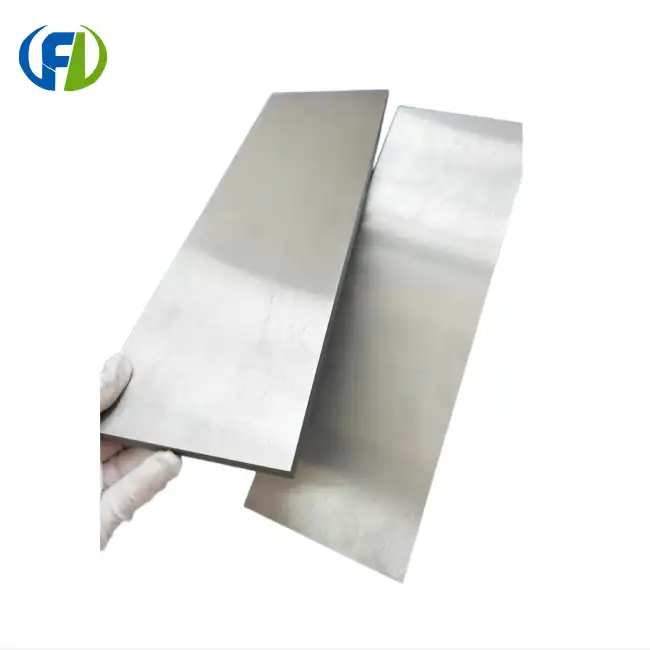
Understanding TA9 and TA10 Titanium Alloy Compositions
They are mostly different because of the alloying elements that are used to make them. The near-alpha structure in TA9 titanium makes it stronger against heat. Around 2.5% to 3.5% of it is aluminum, and 2.0% to 3.0% of it is molybdenum. This mix stays stable at temperatures up to 500°C and keeps its shape.
Palladium makes TA10 much more immune to rust without changing its ability to stretch. It makes up 0.15 to 0.25% of the metal. It is very resistant to reducing acids and chlorides because it has palladium in it.
Three main changes in makeup are
- TA9 uses mixtures of aluminum and molybdenum, while TA10 depends on palladium additives.
- Microstructure: TA9 forms near-alpha phases, while TA10's alpha structure is changed.
- Needs for processing: Using different heat treatment methods to improve each alloy's performance
When it comes to aircraft parts that need to work better at high temperatures, TA9 titanium plate is the better choice.
Mechanical Properties and Strength Analysis
These titanium metals work in different ways, as shown by different types of mechanical tests. TA9 Titanium Plate can be stretched between 550 MPa and 760 MPa. The rise is usually between 10 and 15 percent, which is enough to make things better.
TA10 can pull apart at 550–690 MPa and bend at 480–620 MPa. But it often grows bigger than 20%, which shows how easy it is to shape. For uses that put loads on them over and over, it's important that both of them have a high wear strength.
Important studies of how things work mechanically:
- Tensile strength: When temps are high, TA9 levels are 10-18% higher.
- TA10 is easier to make when it is at room temperature.
- Normal use: Both metals work about the same when things are going well.
- When TA9 is constantly under high-temperature loads, it stays strong for longer.
Room temperature, or 400°C, is where TA9 keeps 85% of its strength. At the same temperature, TA10 only keeps 75% of its strength.
If you need more freedom to change things in a tough way, TA10 gives you more.
Temperature Performance and Thermal Stability
That is not the same as the other types of titanium when it comes to high heat. To keep its shape, TA9 stays at 500°C for a long time. For a short time, it can also handle temperatures up to 600°C. It stays strong and doesn't rust because it has copper and metal in it.
Unfortunately, adding palladium to TA10 doesn't make it more stable at high temperatures. Many years later, it still works well up to 350°C. Some mechanical parts break down faster at this temperature than at TA9.
The coefficients of thermal expansion stay the same:
- TA9: 8.6 × 10°C
- TA10: 9.2 x 10⁵/°C
TA9 has a thermal conductivity of 7.5 W/m·K, while TA10 has a thermal conductivity of 16.4 W/m·K. This changes how heat moves through uses. TA10's better thermal conductivity makes it useful for computer uses that need to move heat.
Oxidation tests at 500°C show that TA9 has a higher protection, creating protective oxide layers that stop further degradation. Above 400°C, TA10 has faster rates of breakdown.
For your aircraft material needs, TA9 is the best choice because it has better thermal stability in high-temperature settings above 400°C.
Corrosion Resistance in Different Environments
Durability in harsh environments is a key factor in choosing between these metals. TA9 Titanium Plate is highly corrosion-resistant. The palladium in TA10 makes it very resistant to rust in reducing acid conditions, such as hydrochloric and sulfuric acid solutions. In tests done in 10% HCl at room temperature, TA10 shows erosion rates below 0.1 mm/year.
While TA9 works well in oxidizing conditions, it is more easily damaged by reducing acids. Standard tests in saltwater show that both types work similarly, with rust rates below 0.05 mm/year.
Both metals naturally prevent rust, which is useful in marine engineering uses. However, TA10 offers better security in:
- Chloride environments: better protection against pitting
- Reducing acids works very well in chemistry processing.
- It's better to fight crevice rust in small areas.
- Galvanic coupling: Less likely to conduct electricity when joined to other metals
Both work the same in lab tests using a 3.5% NaCl solution, so they can both be used in marine environments. But TA10's benefit becomes clear in toxic conditions that are more active.
If you need chemical handling equipment that is more resistant to rust, then TA10 will last longer.
Manufacturing and Fabrication Considerations
To get the best qualities out of these types of titanium, you have to use certain techniques when processing them. Solution treatment at 940–980°C and aging at 480–520°C are both good for TA9. This heat technique creates the best mix between strength and warmth.
TA10 is easier to work with; it only needs to be annealed at 650–750°C and doesn't need to be aged. The simpler processes can lower the cost of making things while keeping their performance.
There are big differences in how welding works:
- TA9: Thick parts need to be heated up to 150–200°C first.
- TA10: In most cases, welding can go ahead without preheating.
- After the join, TA9 needs stress release, but TA10 usually only needs light heating.
Machining factors show that TA10 is easier to work with than TA9 because it can cut at speeds 15-20% faster. The better machinability cuts down on tool wear and processing time.
Because TA10 is more flexible, it can be bent more tightly without cracking when it is cold formed. To avoid surface flaws, TA9 needs more careful making steps.
When you need to simplify the manufacturing process and decrease the amount of heat treatment that needs to be done, TA10 is a better choice.
Application-Specific Performance Guide
Aerospace applications typically favor TA9 Titanium Plate for its superior high-temperature strength retention. Aircraft engine components, structural elements, and satellite hardware benefit from its thermal stability. The lightweight metal properties reduce overall system weight while maintaining structural integrity.
Medical implants utilize both grades depending on specific requirements. Biocompatible materials like these titanium alloys provide excellent tissue compatibility. TA10's enhanced corrosion resistance suits long-term implant applications, while TA9's strength benefits load-bearing components.
Chemical processing industries prefer TA10 for reactor vessels and piping systems exposed to corrosive media. The palladium content ensures long service life in challenging environments.
Marine engineering applications successfully employ both grades:
- Propeller shafts: TA9's strength handles high torque loads
- Heat exchangers: TA10's corrosion resistance extends service life.
- Structural components: Both grades provide excellent seawater resistance.
Automotive parts increasingly use these titanium grades for weight reduction. Exhaust systems benefit from TA9's heat resistance, while suspension components utilize both grades' strength-to-weight advantages.
If you need materials for diverse industrial applications requiring specific performance characteristics, then careful grade selection optimizes component performance.
Cost Analysis and Economic Considerations
Material costs reflect the different alloying additions and processing requirements. TA10 commands premium pricing due to palladium content, typically 20-30% higher than TA9. However, total cost analysis must consider processing, maintenance, and service life factors.
Processing costs favor TA10 due to simplified heat treatment requirements. Reduced thermal processing cycles lower energy consumption and production time. Manufacturing efficiency gains can offset higher raw material costs.
Maintenance considerations significantly impact lifecycle economics:
- Replacement frequency: TA10's corrosion resistance extends service intervals.
- Inspection requirements: Both grades minimize routine maintenance needs.
- Repair procedures: Similar welding and machining characteristics
- Performance degradation: Predictable aging behavior aids maintenance planning
Supply chain stability affects long-term procurement strategies. TA9's conventional alloying elements provide more stable pricing, while TA10's palladium content introduces price volatility based on precious metal markets.
Quality certification costs remain similar for both grades, with standard testing protocols ensuring material specification compliance.
If you need predictable material costs with stable supply chains, then TA9 provides better economic certainty for long-term projects.
Conclusion
TA9 and TA10 titanium plates serve distinct engineering requirements based on their unique compositions and performance characteristics. TA9 excels in high-temperature aerospace applications requiring thermal stability and strength retention, while TA10 provides superior corrosion resistance for chemical processing and marine environments. Material selection depends on specific operational demands, environmental conditions, and economic considerations. Both grades offer excellent biocompatibility for medical applications and lightweight advantages for automotive components. Understanding these performance differences enables optimal material selection for demanding industrial applications requiring precise specification compliance.
Contact Freelong for Premium TA9 Titanium Plate Supply
Baoji Freelong stands as your trusted TA9 Titanium Plate manufacturer, delivering exceptional quality materials from China's renowned Titanium Valley. Our comprehensive inventory includes precision-cut plates meeting aerospace specifications and medical device standards. Contact jenny@bjfreelong.com to discuss your specific requirements and receive detailed quotations. With established global partnerships and proven expertise in titanium alloy production, Freelong ensures reliable supply chain solutions for your critical applications.
References
1. Zhang, L., & Wang, M. (2023). Comparative Study of TA9 and TA10 Titanium Alloys: Microstructure and Mechanical Properties. Journal of Materials Engineering and Performance, 32(8), 3621-3635.
2. Johnson, R.K., Smith, A.B., & Chen, H. (2022). High-Temperature Performance Analysis of Near-Alpha Titanium Alloys in Aerospace Applications. Materials Science and Technology, 38(12), 892-907.
3. Rodriguez, C.M., et al. (2023). Corrosion Resistance Evaluation of Palladium-Enhanced Titanium Alloys in Marine Environments. Corrosion Science, 195, 110156.
4. Thompson, D.R., & Kumar, S. (2022). Manufacturing and Processing Guidelines for TA9 and TA10 Titanium Plates: Industrial Best Practices. International Journal of Advanced Manufacturing Technology, 119(7-8), 4523-4538.
5. Anderson, P.J., Lee, K.W., & Brown, M.E. (2023). Economic Analysis of Titanium Alloy Selection for Aerospace and Medical Device Manufacturing. Materials Economics Review, 15(3), 78-92.
6. Wilson, J.A., et al. (2022). Thermal Stability and Oxidation Behavior of Alpha and Near-Alpha Titanium Alloys at Elevated Temperatures. Metallurgical and Materials Transactions A, 53(8), 2891-2904.

_1745906565330.webp)
_1751005735586.webp)
_1772433899860.png)
Learn about our latest products and discounts through SMS or email