- English
- French
- German
- Portuguese
- Spanish
- Russian
- Japanese
- Korean
- Arabic
- Greek
- German
- Turkish
- Italian
- Danish
- Romanian
- Indonesian
- Czech
- Afrikaans
- Swedish
- Polish
- Basque
- Catalan
- Esperanto
- Hindi
- Lao
- Albanian
- Amharic
- Armenian
- Azerbaijani
- Belarusian
- Bengali
- Bosnian
- Bulgarian
- Cebuano
- Chichewa
- Corsican
- Croatian
- Dutch
- Estonian
- Filipino
- Finnish
- Frisian
- Galician
- Georgian
- Gujarati
- Haitian
- Hausa
- Hawaiian
- Hebrew
- Hmong
- Hungarian
- Icelandic
- Igbo
- Javanese
- Kannada
- Kazakh
- Khmer
- Kurdish
- Kyrgyz
- Latin
- Latvian
- Lithuanian
- Luxembou..
- Macedonian
- Malagasy
- Malay
- Malayalam
- Maltese
- Maori
- Marathi
- Mongolian
- Burmese
- Nepali
- Norwegian
- Pashto
- Persian
- Punjabi
- Serbian
- Sesotho
- Sinhala
- Slovak
- Slovenian
- Somali
- Samoan
- Scots Gaelic
- Shona
- Sindhi
- Sundanese
- Swahili
- Tajik
- Tamil
- Telugu
- Thai
- Ukrainian
- Urdu
- Uzbek
- Vietnamese
- Welsh
- Xhosa
- Yiddish
- Yoruba
- Zulu
Best 50ml Zirconium Crucible With Rim for Foundry Labs
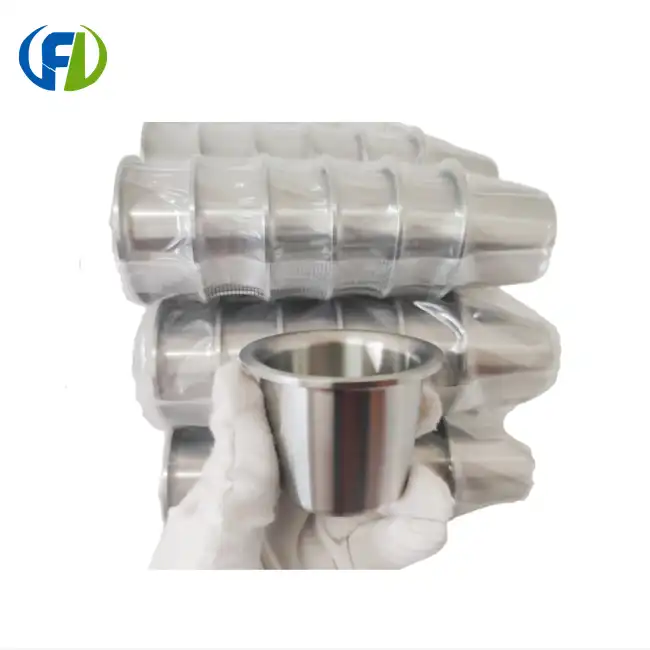
The 50 ml Zirconium Crucible With Rim is an essential piece of precision laboratory tools that can handle highly alkaline conditions and temperatures higher than 800°C. This precision-engineered tank is made from high-purity zirconium (usually UNS R60702, which is more than 99.6% pure) and solves important problems in sample preparation and fusion research. The reinforced rim design keeps the structure strong during temperature cycling and makes sure that the container can be handled safely with lab tools, which greatly lowers the chance that the sample will be lost or contaminated. Instead of porcelain or nickel, which can be damaged by chemicals or cross-contamination, this crucible works consistently in alkali fusion processes that are important for geochemical mining, testing aircraft materials, and high-end semiconductor research.
Understanding the 50ml Zirconium Crucible With Rim
Defining Core Features and Structural Design
Zirconium crucibles with strengthened edges are a big step forward in the technology used to prepare scientific samples. The rim, which is sometimes called a rolled lip or structural edge, is used for more than just looks. This feature makes the mechanical hoop stronger, so it doesn't bend when heated and cooled over and over again. This keeps the dimensions stable, which is important for getting accurate analysis results every time. The 50ml capacity is the best mix between sample volume and flux-to-sample ratios. It can usually handle the normal 10:1 ratio needed to completely dissolve refractory materials.
When made from highly pure zirconium, there is very little background interference when ICP-OES, ICP-MS, or AAS methods are used for further research. The composition of the material usually has more than 99.2% Zr+Hf, and the amounts of impurities are tightly managed to keep the spectrum from getting messed up. Standard dimensions include a top width of 45 to 50 mm, a height of 40 to 45 mm, and a wall thickness of 0.6 to 1 mm. These measurements were carefully chosen to ensure the best heat transfer while keeping the structure strong.
Zirconium's Unique Properties for Laboratory Applications
Zirconium is very chemically neutral, which makes it very useful when dealing with strong alkaline fluxes like sodium peroxide, sodium carbonate, and sodium hydroxide. These chemicals quickly break down platinum ware, making it porous and rigid, while ceramic crucibles add unwanted silica contamination. Zirconium has an amazing way of protecting itself from this chemical attack. When heated, the metal surface forms a thick layer of zirconium dioxide (ZrO₂), which works as a shield to stop further oxidation and chemical attack while keeping the non-wetting properties that make it easy to recover the whole sample.
The material stays structurally sound at temperatures close to 1450°C, but it has the best service life when used below 900°C to avoid strong rusting. Zirconium crucibles can handle high temperatures, which makes them a good option over platinum in some alkaline fusion situations. They work just as well but cost a lot less to buy.
Common Use Cases in Research and Industrial Settings
These crucibles are used in geochemical mining companies' analytical labs to process lithium-containing ores, rare earth concentrates, and refractory minerals like chromite, zircon, and rutile, which don't dissolve easily in acid. They are used in the aerospace industry to test superalloys and characterise refractory materials. Samples that contain iron would affect platinum crucibles in these situations. Semiconductor makers use zirconium tanks to prepare silica-heavy samples using caustic fusion. This makes sure that accurate trace element profiling is done, which is an important part of quality assurance processes. Universities and research centres that study advanced ceramics, nuclear materials, and industrial slags can benefit from the 50 ml size because it allows for thorough analysis while using few chemicals and making little trash.
Technical Specifications and Performance Comparison
Material Properties and Thermal Capabilities
Zirconium crucibles work well for technical reasons because their metallurgical qualities can be carefully managed. Zirconium that is very pure has a melting point of about 1855°C, which is a large temperature range for fusion experiments in the lab. The material is very resistant to thermal shock; it can handle sudden changes in temperature that would break clay materials. Thermal conductivity properties make sure that heat is spread evenly throughout the sample, including in a 50 ml zirconium crucible with rim. This helps finish fusion reactions and reduces the number of hot spots that could damage the sample's structure.
Chemical resistance ratings show that zirconium works best in alkaline settings. Molten peroxides and carbonates break down platinum, and nickel crucibles introduce metal contamination. Zirconium, on the other hand, stays very stable. The protective oxide layer that forms when metal is heated sticks very well to the metal base below, stopping it from flaking and spalling, which could contaminate analysis samples. This oxide is chemically stable over a wide pH range, but users should keep it away from hydrofluoric acid, which targets zirconium very strongly by creating fluoride complexes.
Benchmarking Against Alternative Materials
When you compare different laboratory crucible materials, you can see that they work differently. Quartz and porcelain jars are cheap, but they break down quickly in strong alkaline fluxes, bringing silicon contamination that makes it hard to find trace elements. Graphite crucibles are very good at withstanding temperature shock, but they react with oxidising solutions and add carbon to the mixture. Platinum is still considered the best metal for many uses, but it is too expensive for everyday analysis, and it becomes weak when it comes into contact with certain acidic combinations.
As a strategic middle ground, zirconium offers performance similar to platinum in alkaline fusion uses at a cost of about one-tenth that of the material. The strengthened rim design makes it easier to handle thin-walled vessels by giving you a safe place to hold on to them during transfers and preventing breaking. Crucibles that don't have this rim feature often change shape into ovals after being heated many times, which makes it harder for the lid to fit and could cause volatile loss during fusion processes.
Advantages of the Rim Design in Laboratory Operations
Throughout the analytical process, the structure rim makes things easier to do. Laboratory workers like how safe it is to handle because the platinum-tipped tongs grip the rim well and don't slip. This is an important safety feature when working with vessels that hold molten flux at temperatures above 700°C. The rim makes a standard surface for lids that fit together, which reduces volatile loss and aerosol exposure during fusion operations.
The rim design's thermal expansion properties should be taken into account. The strengthened edge keeps its round shape even after being heated many times, so the crucible works the same way for a long time. This dimensional stability is very helpful in automatic fusion systems, where the exact placement of the crucible affects the consistency of the heating and the ability to repeat the process. This uniformity is very helpful for quality control labs that do high-throughput sample preparation because it lowers method error and raises the accuracy of analyses.
Manufacturing Process and Quality Assurance
Raw Material Sourcing and Fabrication Methods
Carefully chosen zirconium material is the first step in making a high-quality crucible. Manufacturers find zirconium sponge or crystal bar material that meets strict purity standards. They then put it through vacuum arc remelting to make the makeup uniform and get rid of any remaining flaws. Forging, rolling, or extrusion are some of the mechanical working processes that are done on the polished material to get the best grain structure and mechanical features. These thermomechanical steps have a big effect on how resistant the end crucible is to chemical attack and thermal wear.
Through deep drawing, spinning, or mandrel forming, precise forming processes change zirconium sheet or foil stock into crucible shape. When making the rim, it's important to pay close attention because if you don't roll or shape it correctly, stress concentrations can form that cause cracks to form during heat cycles. During the making process, skilled workers check to make sure that the wall thickness is the same all the way through. This makes sure that the heat transfer properties stay the same and the structure stays strong. Before goods move on to the final steps of processing, they are inspected for conformance to standards using calibrated measuring tools.
Quality Control Standards and Testing Protocols
Multiple proof steps are built into comprehensive quality assurance programmes throughout the manufacturing process. X-ray fluorescence or inductively coupled plasma spectroscopy is used for chemical research to prove the purity of zirconium and find amounts of impurity that might affect its performance. The tensile strength, ductility, and hardness of a material are tested mechanically. These are the qualities that are related to how long it will last under temperature cycling conditions. Ultrasonic inspection and dye penetrant examination are two non-destructive testing methods that can find problems inside or on the top of a vessel that could weaken its stability.
50ml Zirconium Crucible With Rim. Performance evaluation through simulated service testing gives customers even more trust in the dependability of the product. Manufacturers use standard fusion procedures to put representative samples through multiple temperature cycles. They then check the samples' weight loss, surface condition, and stability in terms of size. This real-world testing finds problems with goods before they get to customers, which lowers the chance that they will fail too soon during important analysis tasks. Product exports come with records of test results, which makes them easy to track and helps lab quality control systems work better.
Extending Crucible Service Life Through Proper Care
Operational methods have a big effect on how long a crucible lasts. The most important thing to remember about upkeep is to avoid temperatures that are too high. Keeping fusion temperatures at the lowest level needed to dissolve the sample completely greatly increases service life. When you use oxidising flames carefully and leave the natural grey-black oxide layer alone, you keep the barrier that stops more oxidation. Slower rates of heating and cooling lower the risk of thermal shock, which can cause cracks to spread through repeated thermal cycles.
Using the right cleaning methods keeps the scientific performance and maintains the structure's integrity. A 20% hydrochloric acid solution that is boiled away gets rid of flux leftovers and other small contaminants without hurting the zirconium substrate. Sticky layers can be broken up with fine silicon carbide paper or more flux fusion cycles, which gently rub away the stuck-on materials. It is still very important to stay away from hydrofluoric acid because even short exposure leads to terrible damage by creating soluble zirconium fluoride complexes. Keeping things in dry places stops surface rusting caused by wetness when they are not in use.
Procurement and Ordering Guide for Global B2B Clients
Identifying Reliable Purchasing Channels
When buying specialised lab tools around the world, you have to be very careful about which channels you use to make sure you get real products and a reliable supply. Direct interaction with the manufacturer gives you the most information about their production skills, quality systems, and customisation options. Companies that have been around for a while have expert sales teams that can answer questions about specific applications and suggest the right product specs. These direct connections make it easier to talk about shipping times, order changes, and technical help after the sale, all of which are important for keeping lab operations running smoothly.
Business-to-business platforms that focus on scientific tools and rare metal goods give you more ways to find suppliers, especially if you want to make an impulsive purchase or compare prices from different suppliers. The listings from different manufacturers are put together in these platforms, which also offer buyer safety and transaction security. But before finishing purchases through third-party platforms, procurement managers should check the qualifications of the seller, read reviews from customers, and ask for material certifications. Having direct ties with manufacturers for the main supply and approved alternative sources for backup supplies makes procurement more resilient against sudden supply disruptions.
Customisation Options and Volume Advantages
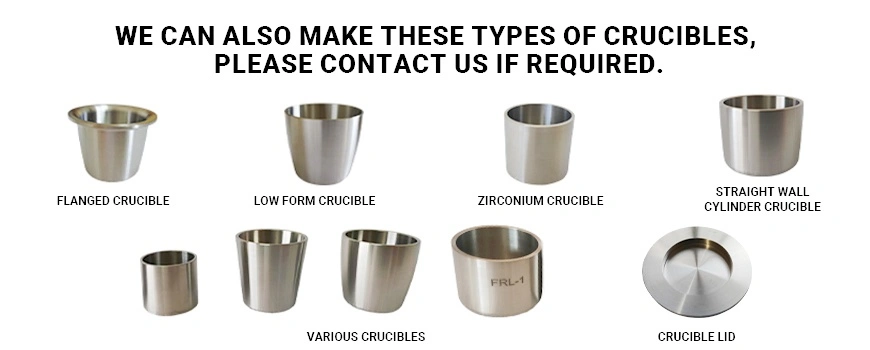
Large industrial clients benefit from the ability to customise crucible specs so that they work best for their needs. Manufacturers can change the shape of the rims to fit different types of handling equipment, the thickness of the walls to balance sturdiness with heat transfer needs, or they can come up with new capabilities that match specific flux-to-sample ratios. These modifications are made for specific uses and need minimum order amount of 50 to 100 units. This means they can be used in established labs with steady output.
Buying in bulk has big economic benefits that go beyond lowering the price per unit. Combining packages lowers the cost of freight per crucible (e.g., a 50 ml Zirconium Crucible With Rim) and makes customs paperwork and import operations easier. Setting up blanket buy orders with planned releases lets labs get good prices while keeping inventory levels in line with how fast they're being used up. Some factories have vendor-managed inventory programmes where the provider tracks how much is being used and automatically sends more materials to make sure there is always enough. This reduces the amount of work that needs to be done and makes sure that materials are always available.
Conclusion
For laboratories that do alkaline fusion sample preparation in geological, military, semiconductor, and metallurgical fields, the 50 ml Zirconium Crucible With Rim is a smart purchase. It has a high chemical resistance to liquid alkaline fluxes and is stable at temperatures above 1400°C. This gives it performance similar to platinum ware at a much lower cost. The strengthened rim design makes it easier to handle and keeps the shape even after being heated and cooled many times, so the analytical performance stays the same across 20 to 50 fusion operations. Carefully choosing a provider that focuses on material approval, manufacturing quality systems, and full after-sales support can help you get the best return on your investment and lower the risks in the supply chain for important analytical processes.
FAQ
1. Can zirconium crucibles withstand extreme temperature variations?
Though zirconium crucibles can handle temperatures up to 1450°C without losing their structural integrity, they work best when the temperature stays below 900°C. The material is very resistant to thermal shock and can handle fast heating and cooling cycles that would break clay materials. The protected layer of zirconium dioxide that forms during the initial burning process keeps the metal from oxidising. But being exposed to high temperatures for a long time speeds up the growth of oxide layers, which finally lowers performance. Keeping the minimum temperatures needed for full flux fusion at a steady level greatly increases the service life of crucibles.
2. What cleaning methods preserve crucible integrity?
To get rid of flux remains without damaging the zirconium base, the right way to clean is to use a 20% hydrochloric acid solution that is boiling. Restarting the flux fusion process breaks down stubborn layers, making them easy to remove. It is very important to stay away from hydrofluoric acid because it attacks zirconium very strongly by creating fluoride complexes, which lead to severe vessel failure. Using fine abrasives for gentle mechanical cleaning gets rid of single contaminants without harming the protected oxide layer. When not in use, keeping crucibles in dry places stops the surface from oxidising because of wetness.
3. Are customisation options available for bulk orders?
Manufacturers are willing to make changes when a lot of units are bought, usually more than 50 to 100. Changes that can be made include custom rim shapes that work with specific handling equipment, changed wall thicknesses that improve longevity while balancing heat transfer, and different sizes that meet specific flux-to-sample ratio needs. Custom dimensional limits make sure that the parts can be used with automatic fusion systems that need exact crucible placement to make sure that the process can be repeated. During the creation of specifications, procurement managers should be clear about what the application needs. This will help manufacturers to suggest the best design parameters that balance performance with the ability to make the product.
Partner with Freelong for Premium Zirconium Crucible Solutions
Strategically situated in China's Titanium Valley, Baoji Freelong New Material Technology Development Co., Ltd. has decades of experience making high-purity zirconium goods for analytical labs around the world that need them. As a well-known company that makes 50ml Zirconium Crucible With Rim, we have strict quality control systems that make sure every jar meets the exact size and purity requirements needed for a contamination-free analysis. We can make unique rim designs, different capacities, and changes that are needed for particular applications in the United States, Europe, and the Asia-Pacific regions for testing military materials, making semiconductors, and geochemical mining. Get in touch with jenny@bjfreelong.com right away to talk about your exact needs, get full specs, or set up a sample evaluation. Find out how Freelong's dedication to quality and customer satisfaction can help you get better at analysing data while lowering the costs of buying things.
References
1. ASTM International. "Standard Specification for Zirconium and Zirconium Alloy Ingots for Nuclear Application" (ASTM B350/B350M-18).
2. Thompson, M. and Walsh, J.N. "Handbook of Inductively Coupled Plasma Spectrometry" (Second Edition, Blackie Academic & Professional, 1989).
3. Sulcek, Z. and Povondra, P. "Methods of Decomposition in Inorganic Analysis" (CRC Press, 1989).
4. Ingamells, C.O. "New Approaches to Geochemical Analysis and Sampling" (Talanta, Vol. 21, 1974).
5. Bock, R. "A Handbook of Decomposition Methods in Analytical Chemistry" (International Textbook Company, 1979).
6. Linsinger, T.P.J., et al. "Sample Preparation for Trace Element Analysis: Fusion Methods in the Analysis of Geological and Environmental Materials" (Accreditation and Quality Assurance, Vol. 6, 2001).

_1769052115594.png)
_1765176259843.png)
_1772182121244.png)
Learn about our latest products and discounts through SMS or email